Introduction
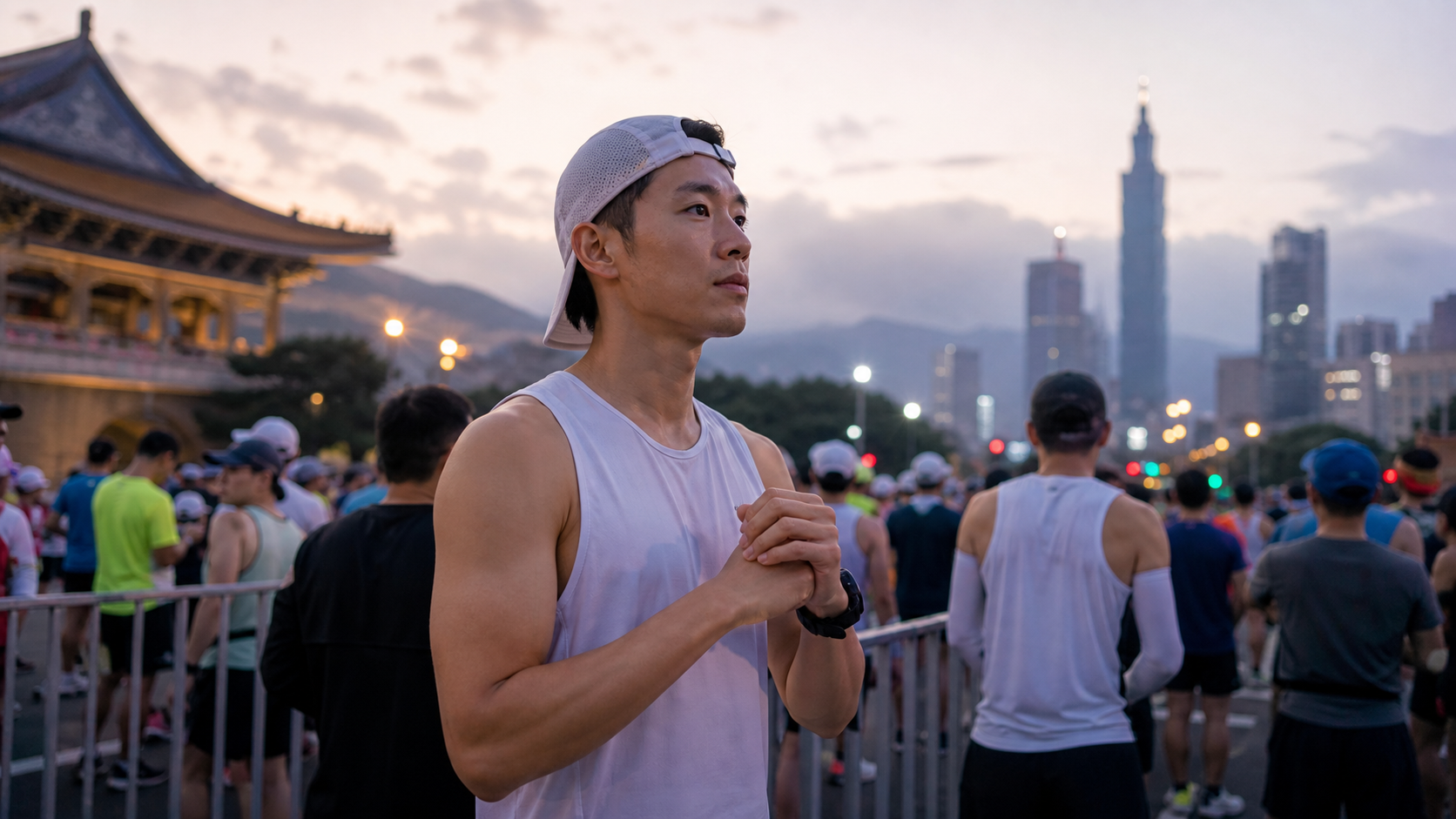
At 5:30 in the morning, tens of thousands of runners have already gathered in front of Taipei City Hall. The starting gun for the Taipei Marathon is still 30 minutes away, but your heart is already racing—your heart rate is over 100 beats per minute, and you haven’t even started running yet. This feeling is called “pre-race anxiety,” and it can be both a friend and an enemy, depending on how you handle it.
Sports psychology research shows that moderate anxiety can indeed enhance athletic performance, but excessive anxiety can disrupt motor coordination and drain precious cognitive resources. The question has never been “how not to be nervous,” but rather “how to get the level of nervousness just right.”
The Physiology of Anxiety: Why Your Body Reacts This Way
Pre-race anxiety is essentially “sympathetic nervous system activation”—a survival mechanism evolution has given us:
- Adrenaline secretion increases, heart rate accelerates, and blood is redistributed to the muscles
- Breathing quickens, increasing oxygen supply to the muscles
- Glycogen begins to mobilize, preparing for the upcoming energy demands
- Attention narrows, focusing on the task at hand
These reactions are all essentially “your body helping you prepare to run faster.” The problem is that the brain’s language centers are simultaneously generating catastrophic thoughts: “What if I run slower than expected?” “What if I trip in front of everyone?” This cognitive anxiety is the real obstacle.
| Type of Anxiety | Characteristics | Impact on Performance |
|---|---|---|
| Somatic Anxiety | Rapid heartbeat, sweating, gastrointestinal discomfort | Low to moderate levels benefit performance |
| Cognitive Anxiety | Negative thoughts, self-doubt, distracted attention | Almost always harmful to performance |
| Self-confidence | Positive expectations of success | Significantly enhances performance |
Five Techniques for Transforming Anxiety
1. Reappraisal
Research from Harvard University found that telling yourself “I’m excited” improves performance more than telling yourself “I need to calm down.” This is because excitement and anxiety are physiologically nearly identical—only the meaning differs.
Change “I’m so nervous, am I ready?” to “I’m so excited, today I’m going to run my best!”
2. Box Breathing
The “square breathing” technique used by the U.S. Navy SEALs can effectively lower cortisol levels within 2–3 minutes:
- Inhale for 4 seconds → Hold for 4 seconds → Exhale for 4 seconds → Hold for 4 seconds
- Repeat 4–6 times
- Best used while waiting in the starting corral
3. Process Focus
Shift your attention from the “outcome (what time I need to finish)” to the “process (how to pace each kilometer)”:
- Don’t ask “Can I break 4 hours?”
- Instead ask “For the first 10 km, I’m going to run at a 5:30 per km pace—how do I execute that?”
4. Pre-race Routine
Establish a fixed pre-race ritual: a specific breakfast, specific warm-up exercises, a specific music playlist. A routine sends your brain the signal that “everything is under control.” Many Taiwanese runners take a few steps along the beach before the Wan Jin Shi Marathon to settle their emotions in nature.
5. Gratitude Shift
At the peak of anxiety, list three things you’re grateful for:
- “I have a healthy body that allows me to compete”
- “I have enough time and resources to complete six months of training”
- “I have friends who run alongside me for support”
Gratitude effectively activates the parasympathetic nervous system, counteracting the overactivation of the sympathetic nervous system.
Anxiety Profiles by Runner Type
Understanding your anxiety type helps you choose the most suitable coping strategy:
- The Perfectionist: Worries about not hitting goals, fixates on numbers. Recommendation: Set “A goal/B goal/C goal” to allow flexible definitions of success
- The Social Comparer: Worries about running slower than others or being seen walking by acquaintances. Recommendation: The race is a challenge against yourself, not a competition
- The Body Sensation Focuser: Magnifies any subtle physical discomfort (“My knee feels a bit tight before the start—am I about to get injured?”). Recommendation: Warm up and trust your body; normal pre-race muscle tension is not a sign of injury
Practical Advice
Mental Preparation the Week Before the Race
- Minimize new attempts—don’t switch running shoes or change your diet in the week before the race
- Spend 5 minutes daily on visualization practice, imagining yourself completing the race smoothly
- Avoid obsessively checking weather forecasts and course information; this only increases anxiety from uncertainty
- Ensure adequate sleep in the final three days; sleep deprivation significantly amplifies anxiety responses
Emergency Techniques on Race Day
If you feel anxiety spiking before the start, use the “5-4-3-2-1 Grounding Technique”: name 5 things you can see, 4 sounds you can hear, 3 textures you can feel, 2 smells you can detect, and 1 taste you can sense. This technique quickly pulls your attention away from worries in your mind and back to the present sensory experience.
Conclusion
The nervousness at the starting line is a testament to all the preparation you’ve put in. It shows you care, you’ve invested, and you have the courage to stand on that line. Don’t try to eliminate it—instead, shake hands with it: “Thank you, let’s go run together.” The force that propels you forward was never calmness; it’s that transformed, energy-charged excitement.
Related Reading
- Pre-Race Anxiety Management: Psychological Stabilization Techniques for the 10 Minutes Before the Start
- Race Anxiety Management: Breathing and Relaxation Techniques Before the Start
- The Science of Pre-Race Anxiety: How to Manage Marathon Nerves
- Pre-Race Anxiety Management: How to Turn Nervousness into Race Momentum
西進武嶺 免費訓練分析服務 Intervals | 練不夠還是練過頭?你哪一種類型選手?AI模型告訴你! | 備戰神器 | 公路車 訓練 | CT Yeh
4 年前
西進武嶺 自製新版AI配速表產生器 x 賽前攻略 抱佛腳! 沒有功率計也可以產生配速表嗎?有什麼其他眉角賽前要注意的呢? | 西進武嶺 / 東進武嶺 KOM 攻略 | 公路車 | CT Yeh
4 年前
[教學] Premiere 影片 手震 修正 教學 防抖 單眼 影像 GoPro 穩定 Video Stabilization
8 年前
Live) 備戰2019彰化經典百K 賽前攻略 (已完賽請看新影片
7 年前
福隆鐵人團練隨拍
8 年前
戰略) Zwift Race 如何咬在第一集團 如何評估自己要開多少推力 (請開1.5倍速看)
7 年前
一日北高/長距離團騎 常見問題補充篇 / 組團或跟團的眉角 / 壯車友容易被瘦車友慢性拉爆 / 原來屁股痛可能是這個原因...? / 風場配速法 / 公路車 / CT Yeh
2 年前
2018 田中馬拉松 全程健跑 VR 360 環景錄影 體驗現場狂野加油氣氛! Insta 360
7 年前