Taipei Marathon Race Strategy: Execution Details of a Conservative First Half and Accelerating Second Half
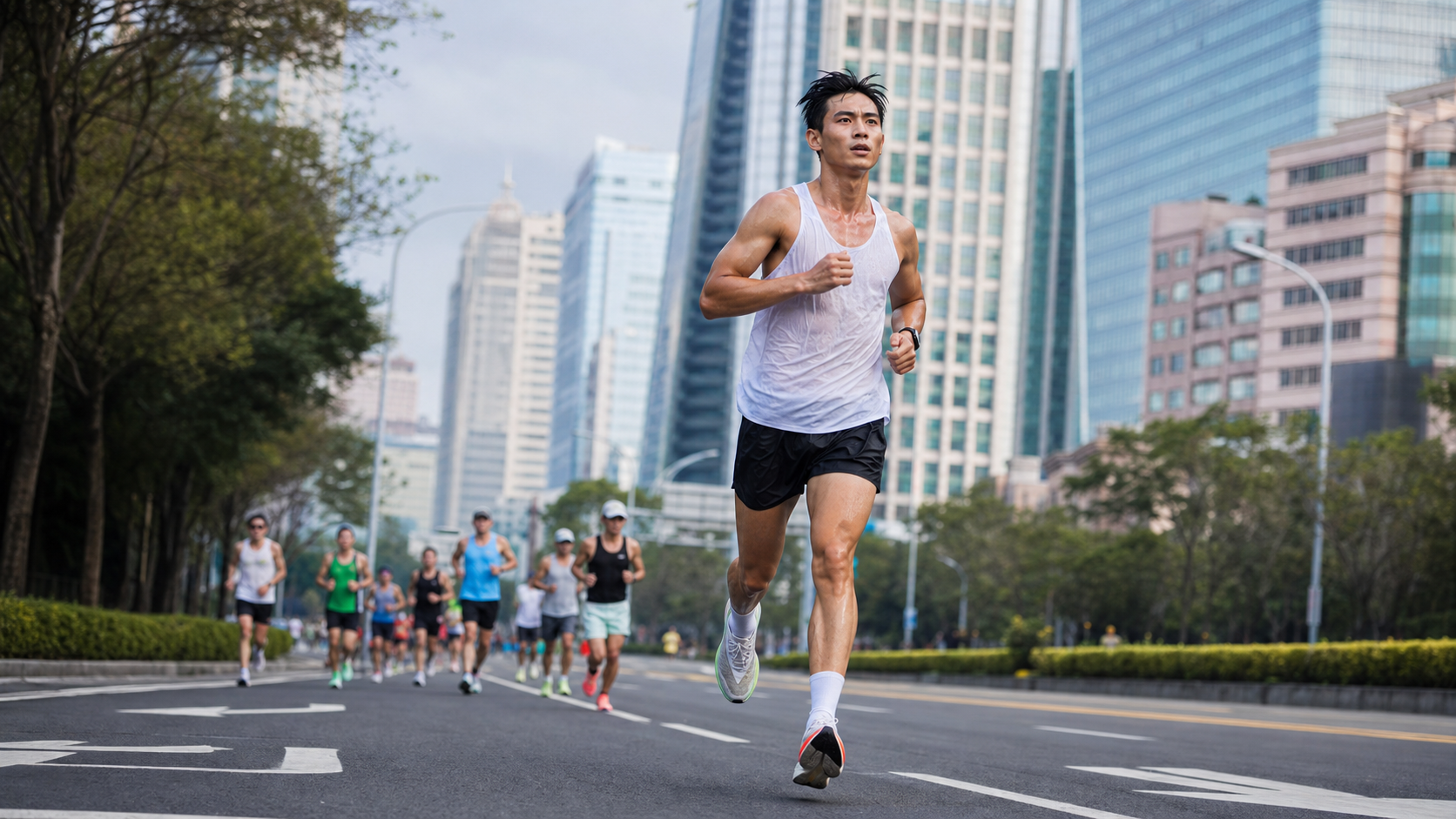
Introduction
Every December, when the starting gun sounds for the Taipei Marathon, tens of thousands of runners set off from Taipei City Hall Plaza, weave through the city, and eventually return to the finish line on Xinyi Road. It is one of the most coveted marathon events for Taiwanese runners and a grand stage that tests strategic execution.
The biggest mistake most first-time marathoners make is running the first half too fast—caught up in the excitement of the start, drawn in by the pace of nearby runners, they unknowingly run 15–30 seconds faster, then pay a heavy price at the 30–35 kilometer mark. Analysis of Taipei Marathon results shows that over 60% of runners finish the second half more than 10 minutes slower than the first half—a collective manifestation of a failed “positive split” strategy.
A “Negative Split”—making the second half faster than the first—is the true elite strategy.
Taipei Marathon Course Analysis
The characteristics of the Taipei Marathon course directly influence strategy:
| Course Section | Kilometers | Terrain Features | Strategic Impact |
|---|---|---|---|
| Start Section (Xinyi District → Ren’ai Road) | 0–6K | Flat, wide | Dense crowds make pace control difficult; you must actively “hit the brakes” |
| Middle Section (Chiang Kai-shek Memorial Hall → Dazhi) | 6–25K | Slight undulations, crossing multiple bridges | The most stable pacing section; the key conservative segment |
| Huazhong Bridge | 22–24K | River-crossing bridge, slight incline | A psychological test point; many runners slow down here |
| Later Section (Return Leg) | 25–36K | Reverse of the outbound route, possible headwind | The stage requiring the most pacing discipline |
| Final Section (36K → Finish) | 36–42K | Gradually returns to Xinyi District | The acceleration and sprint segment, designed for runners to showcase their reserves |
Designing the Numbers for a Negative Split Strategy
Using a target finish time of 4 hours (SUB-4) as an example, here’s how to design a negative split strategy:
Target pace: 5 minutes 41 seconds per kilometer on average
| Segment | Range | Target Pace | Notes |
|---|---|---|---|
| First Half (21K) | 0–21K | 5:50/km | Conservative by 9 seconds, accumulating a 3-minute buffer |
| Transition Segment (21–30K) | 21–30K | 5:41/km | Maintain target pace |
| Acceleration Segment (30–36K) | 30–36K | 5:35/km | Begin accelerating, test the body’s response |
| Final Sprint Segment (36–42K) | 36–42K | 5:25/km | Go all out, burn every reserve |
The logic behind this design: the 9-second-per-kilometer “deficit” in the first half buys the body enough energy to accelerate in the second half.
Execution Details: The 6 Most Difficult Key Points
Key Point 1: The “Crowd Gravity” After the Start
The crowd surges at the Taipei Marathon start, and runners unconsciously get pulled faster by the pace around them. The countermeasure: start from a corral one pace group slower than your target pace, letting the crowd naturally “brake” for you.
Key Point 2: Watch Discipline
Check your pace once every kilometer, not every 200 meters (the latter makes you anxious; the former gives you enough information to make decisions). Set a pace alert to vibrate when you exceed your target pace.
Key Point 3: Speed Management at Aid Stations
Every aid station is a point of pace fluctuation. Grab water → walk while drinking → resume running; this process typically takes 30–60 seconds. Factor aid stations into your pace calculation—don’t sprint in the next kilometer to make up for time lost at a station.
Key Point 4: Mental Approach to Bridge Climbs
The Taipei Marathon crosses several bridges, and the slight inclines make many runners struggle to hold their pace. Strategy: when climbing a bridge, let the pace “slow by 5–8 seconds,” but don’t increase your effort—let the body decelerate naturally and pick up speed on the descent. Don’t “force the pace,” as that burns extra energy.
Key Point 5: The 30-Kilometer Decision Point
At 30 kilometers, you must make a decision based on your current physical condition:
- If energy is abundant: Enter the acceleration segment early
- If energy is as expected: Continue as planned
- If energy is worse than expected: Hold the current pace, abandon the acceleration plan, and prioritize finishing
This decision is not a failure; it’s a mature strategic adjustment.
Key Point 6: The Mental Switch After 36 Kilometers
At 36 kilometers, you need a mental trigger to enter “battle mode.” Pre-design a trigger phrase, such as “From now on, Xinyi Road is waiting for me,” and practice activating it during long runs while fatigued.
Practical Advice
Simulation Preparation the Week Before the Race
During your final easy run before race day (usually 3–4 days prior), run the last 3 kilometers at race pace and feel what it’s like to “hold yourself back from running too fast.” Store that feeling in your muscle memory.
Pace Card on Race Day
Prepare a small pace card, attach it to your wrist with waterproof tape, and write down your target split times for every 5 kilometers. This way, when you’re fatigued, you don’t need to calculate—just glance and compare.
Conclusion
At the Xinyi Road finish line of the Taipei Marathon, every year some runners cross the line with everything they have, while others are already walking by the 30-kilometer mark. The difference between the two isn’t about who trained harder—it often comes down to who, in the first 6 kilometers after the start, had the discipline to hold back that impulsive speed. A conservative first half is the victory of the second half.
Related Reading
- Marathon Negative Split Pacing Strategy: The Science and Execution of Running the Second Half Faster Than the First
- The Complete Taipei Marathon Guide: Course Analysis and Pacing Strategy
- Negative Split Running: The Golden Marathon Strategy
- Taipei Marathon Course Analysis: A Breakdown of Turn Counts and Elevation Profiles on the Urban Route
Live) 備戰2019彰化經典百K 賽前攻略 (已完賽請看新影片
7 年前
西進武嶺 免費訓練分析服務 Intervals | 練不夠還是練過頭?你哪一種類型選手?AI模型告訴你! | 備戰神器 | 公路車 訓練 | CT Yeh
4 年前
台北闊瀨陡坡 騎旅 / 日本單車雜誌編輯車友臨時加入!/ 髮香才是最強的 / feat. 北迴歸線小隊 / 公路車 CT Yeh
6 個月前
2019 柯P 超越北高 第一集團實錄 (11小時實錄請參考另一部影片) 一日雙城 一日北高 NeverStop Taiwan Long Distance Cycling Challenge
7 年前
台北大雁西飛 約騎挑戰 feat. Doris | 公路車 | CT Yeh
3 年前
爬坡ITT實境)台中 魔王 松鼠坡 首航 6:12 大肚山 大三元 科福路
8 年前
2019 夏季KOM 5小 完賽心得 準備攻略 東進武嶺 夏季登山王之路 Taiwan KOM Challenge
7 年前
live) 超越北高 之一日北高12小時 策略
7 年前