Swim Vacation Training: A Minimal Workout Plan to Maintain Your Feel for the Water During a 2-Week Trip
文章導覽
- Introduction
- Physiological Effects of a 2-Week Break
- Analysis of Real-World Conditions for Swimming While Traveling
- Minimal Maintenance Plan for a 2-Week Trip
- 30-Minute Session Plan (Assuming a 15m Short Pool)
- Open-Water Maintenance Plan (Suitable for Beaches with Buoys or Lifeguards)
- Land-Based Supplementary Training (When Swimming Isn't Possible)
- Rapid Recovery Plan After Returning
Introduction
Training for 3 months, then a business trip or vacation for 2 weeks—this is a real dilemma for many Taiwanese office workers who are swimming enthusiasts. Will the feel for the water and aerobic base you worked so hard to build be completely undone by a 2-week break?
The answer is: If you don’t swim at all, you will regress; but if you can maintain a minimal training volume, most of your abilities can be preserved. What matters is knowing which abilities decline fastest within 2 weeks, and how to maintain them with the least amount of time.
Physiological Effects of a 2-Week Break
Different physical capacities have different resistance to training cessation:
| Capacity Type | Onset of Decline | Decline After 2 Weeks |
|---|---|---|
| Feel for the Water & Technical Memory | After 3–5 days | Moderate (5–15%) |
| Aerobic Endurance (VO2max) | After 7–10 days | Low (3–8%) |
| Muscular Endurance | After 5–7 days | Moderate (10–20%) |
| Muscular Strength | After 10–14 days | Low (5–10%) |
| Speed & Neuromuscular Coordination | After 3–7 days | Moderate (10–15%) |
Conclusion: The most critical things to maintain are feel for the water and technical memory (which decline fastest), while aerobic endurance is relatively more preservable.
Analysis of Real-World Conditions for Swimming While Traveling
Travel typically comes with the following constraints:
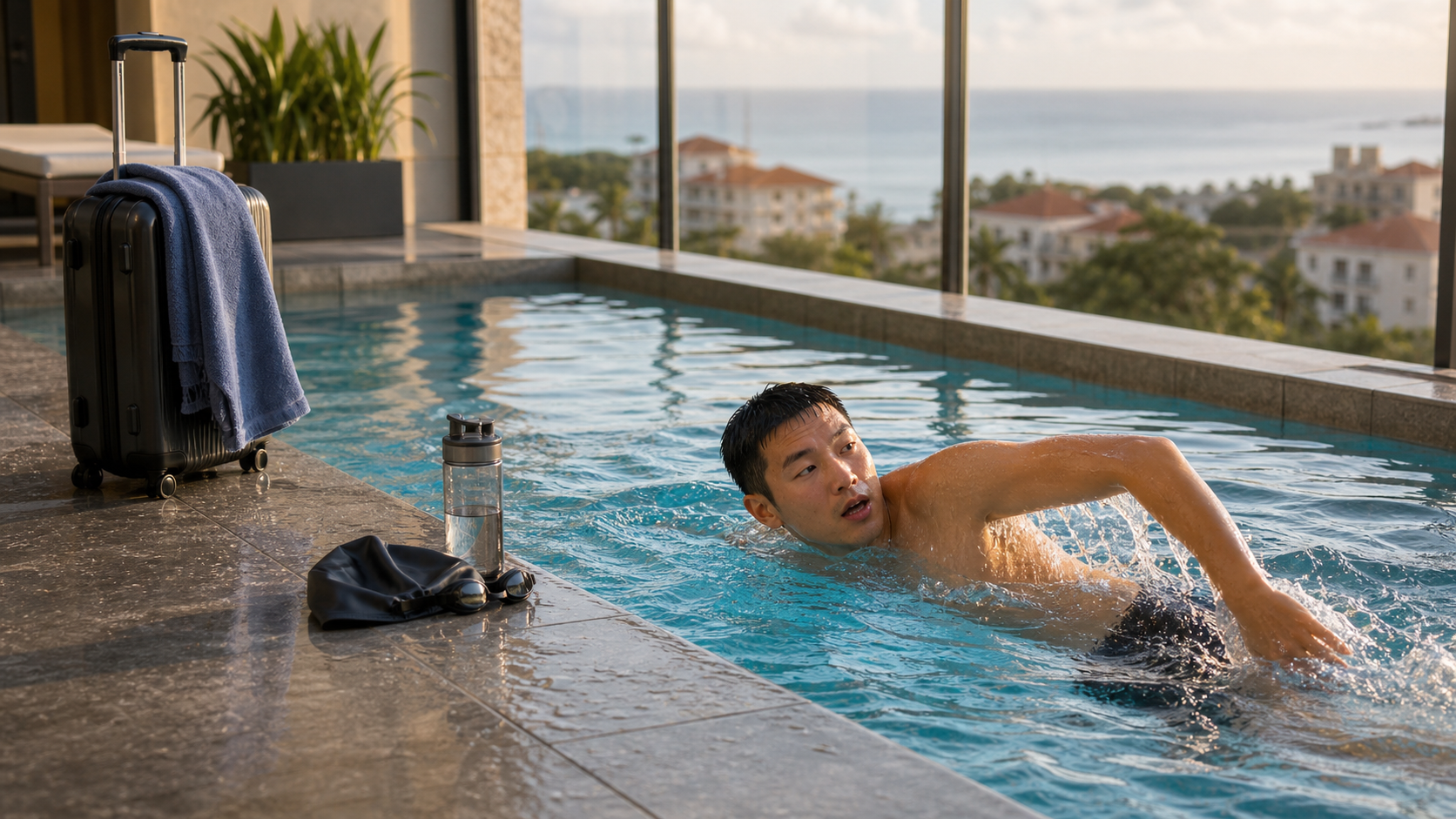
- Hotel pools are usually only 10–15 meters long (not standard 25m or 50m)
- Swim time is limited by the itinerary, usually only 30–45 minutes in the morning
- Swimming every day may not be possible (schedule too packed)
- Open-water swimming is limited by safety and water conditions
Therefore, the workout plan during travel must:
- Be doable in a 15m short pool
- Not exceed 30–40 minutes per session
- Prioritize maintaining feel for the water, not chasing aerobic training volume
Minimal Maintenance Plan for a 2-Week Trip
30-Minute Session Plan (Assuming a 15m Short Pool)
| Segment | Content | Distance | Time |
|---|---|---|---|
| Warm-up | Easy freestyle | 150m (10 lengths) | 5 minutes |
| Technique Set | Stroke-count swimming (record stroke count each length) | 120m (8 lengths) | 5 minutes |
| Feel-for-the-Water Set | 6×15m slow swim (focus on the pressure of your palms catching the water) | 90m | 6 minutes |
| Speed Maintenance | 8×15m sprints (with full rest) | 120m | 8 minutes |
| Cool-down | Easy breaststroke | 90m | 5 minutes |
| Total | 570m | 29 minutes |
Recommended frequency during travel: Swim once every 2 days (7 sessions total), 30 minutes each. If the schedule is too packed, swim at least once every 3 days.
Open-Water Maintenance Plan (Suitable for Beaches with Buoys or Lifeguards)
- Warm-up: Easy swim parallel to the shore for 5 minutes
- Main set: Use a fixed buoy as a target, swim back and forth 5–8 times (about 50–80m each)
- Speed: Swim the last 2 repetitions at full effort
- Cool-down: Relax with backstroke for 5 minutes
Safety notes: When swimming in the ocean, make sure a lifeguard is on duty, never swim alone in unfamiliar waters, and be mindful of currents.
Land-Based Supplementary Training (When Swimming Isn’t Possible)
On days when swimming truly isn’t possible, these land-based exercises can help maintain swim-related muscle groups:
Daily 15-Minute Land-Based Maintenance Set:
- Resistance band pull simulation (4×20 reps): Mimics the freestyle pull motion to maintain shoulder muscles
- Plank hold (3×45 seconds): Maintains core stability
- Prone swimming motion (2×20 reps): Lying on a yoga mat, mimic the freestyle arm-recovery motion
- Ankle circles (20 circles in each direction): Maintains ankle mobility and kicking efficiency
- Shoulder rotation stretches (10 rotations in each direction): Prevents shoulder stiffness after travel
Rapid Recovery Plan After Returning
In the first week after your trip, don’t immediately return to your pre-trip training volume. Instead, take a “progressive return” approach:
- Sessions 1–2: Return to 60% of pre-trip volume, emphasizing technique work (stroke counting, side swimming)
- Sessions 3–4: Return to 80% of pre-trip volume, adding a small amount of aerobic main sets
- Session 5 onward: Fully return to original training volume, and do a timed test to confirm your status
Most intermediate swimmers fully recover to their pre-trip level after 5–7 sessions back in training.
Pre-Trip Preparation Strategy
In the week before your trip, you can use an “overload training” strategy to bank some aerobic reserves:
- In the final week before travel, increase training volume by 15–20%
- On the last training session, do a timed long swim and record the data as a baseline for comparison when you return
- Bring a travel-sized resistance band (folds up compactly) for in-hotel training
Practical Tips
- Check the location of pools at your destination before you leave—many cities have public pools that are often very affordable
- Bring a swim cap and goggles—the minimal gear investment for traveling swimmers (lightweight and compact)
- A relaxed mindset during travel is important—treat each short swim as “enjoying relaxation in the water” rather than a “training task”
- Getting enough sleep during travel helps swimming recovery—adequate rest during the journey is itself a form of recovery
Conclusion
Travel is not the enemy of swim training—it’s just a brief period of rhythm adjustment. As long as you maintain short swim sessions every 2–3 days, supplemented with land-based training when necessary, a 2-week trip has very limited impact on your swimming ability. More importantly, approach travel with the right mindset: relax your body and mind, and you’ll often come back with even better training quality.
Related Reading
- The Minimum Training Volume to Maintain Swimming Fitness: How Many Sessions Per Week to Avoid Regression
- Off-Season Swimming Maintenance Plan: Minimal Training to Preserve Base Fitness in the Non-Season
- Maintaining Cycling During Travel or Business Trips: Minimal Training Strategies to Preserve Fitness
- Off-Season Swim Training Applications: Maintaining Water-Based Fitness Outside the Swim Season