The Complete Guide to Swimmer's Shoulder Pain: Causes and Prevention of Shoulder Impingement Syndrome
Introduction
At swimming pools across Taiwan, tens of thousands of swimmers train every day — whether they are early-morning regulars, competitive athletes, or people swimming for weight loss — and shoulder pain is by far the most common complaint. The term “swimmer’s shoulder” has long been familiar in sports medicine circles, and its core underlying mechanism is shoulder impingement syndrome.
Research shows that competitive swimmers face as high as a 47–67% lifetime probability of experiencing shoulder pain. The rate is lower among recreational swimmers, but persistently ignoring early symptoms can still lead to serious consequences such as rotator cuff tears.
What Is Shoulder Impingement Syndrome?
Shoulder impingement syndrome occurs when the space between the acromion (part of the shoulder blade) and the head of the humerus — known as the subacromial space — becomes compressed. This causes the rotator cuff tendons and bursa within that space to be repeatedly rubbed and pinched, triggering inflammation, swelling, and even tendon tears.
Swimming is one of the sports with the highest volume of repetitive overhead shoulder motion. In freestyle alone, roughly 1,000 stroke cycles are needed to cover one kilometer. Elite swimmers can train 70–80 kilometers per week, which translates into a staggering cumulative load on the shoulder joint.
Key Risk Factors
| Risk Factor | Description |
|---|---|
| Poor stroke technique | Hand entering too far across the midline (cross-over entry), dropped elbow |
| Overtraining | Sharp increases in weekly training volume, insufficient rest |
| Weak rotator cuff muscles | Insufficient strength in the supraspinatus, infraspinatus, teres minor, and subscapularis |
| Poor scapular stability | Weak serratus anterior and lower trapezius, leading to a winged scapula |
| Limited thoracic mobility | Rounded upper back compensates by narrowing the subacromial space |
| Inadequate warm-up | Jumping straight into high-intensity training with tendons that lack flexibility |
How to Recognize Early Symptoms
Shoulder impingement syndrome presents along a continuous spectrum. In its early stages, a vague ache is often felt during the catch-to-recovery phase, right as the stroke finishes and the arm exits the water. Here are three warning signs worth paying attention to:
- Night-time shoulder pain: pain intensifies when lying on the affected side, indicating a notable inflammatory response
- Painful arc at specific angles: pain occurs when raising the arm between 60–120 degrees, with other angles remaining normal (the “painful arc”)
- Weakness during arm elevation with internal rotation: the “empty can test” (as if pouring out a cup) produces noticeable pain or weakness
If two or more of these three signs are present, it is recommended to reduce training load immediately and consult a sports medicine physician or physical therapist.
Prevention Strategies: From Technique to Training Plan
Technical Corrections
- Hand entry point: Make sure the hand enters the water outside shoulder width, avoiding crossing the body’s midline (cross-over), which forces internal rotation and compression of the subacromial space
- High elbow catch: Keep the elbow higher than the wrist so the latissimus dorsi and rhomboids share the load, reducing the shear force placed solely on the rotator cuff
- Breathing posture: Avoid excessive head rotation that hikes the shoulder up; instead, let body roll drive the breath
Dryland Strengthening Exercises
The following exercises are recommended three times a week, 15–20 minutes per session, performed after pool training:
- Side-lying external rotation: targets the infraspinatus, using a 0.5–2 kg dumbbell, 15 reps × 3 sets
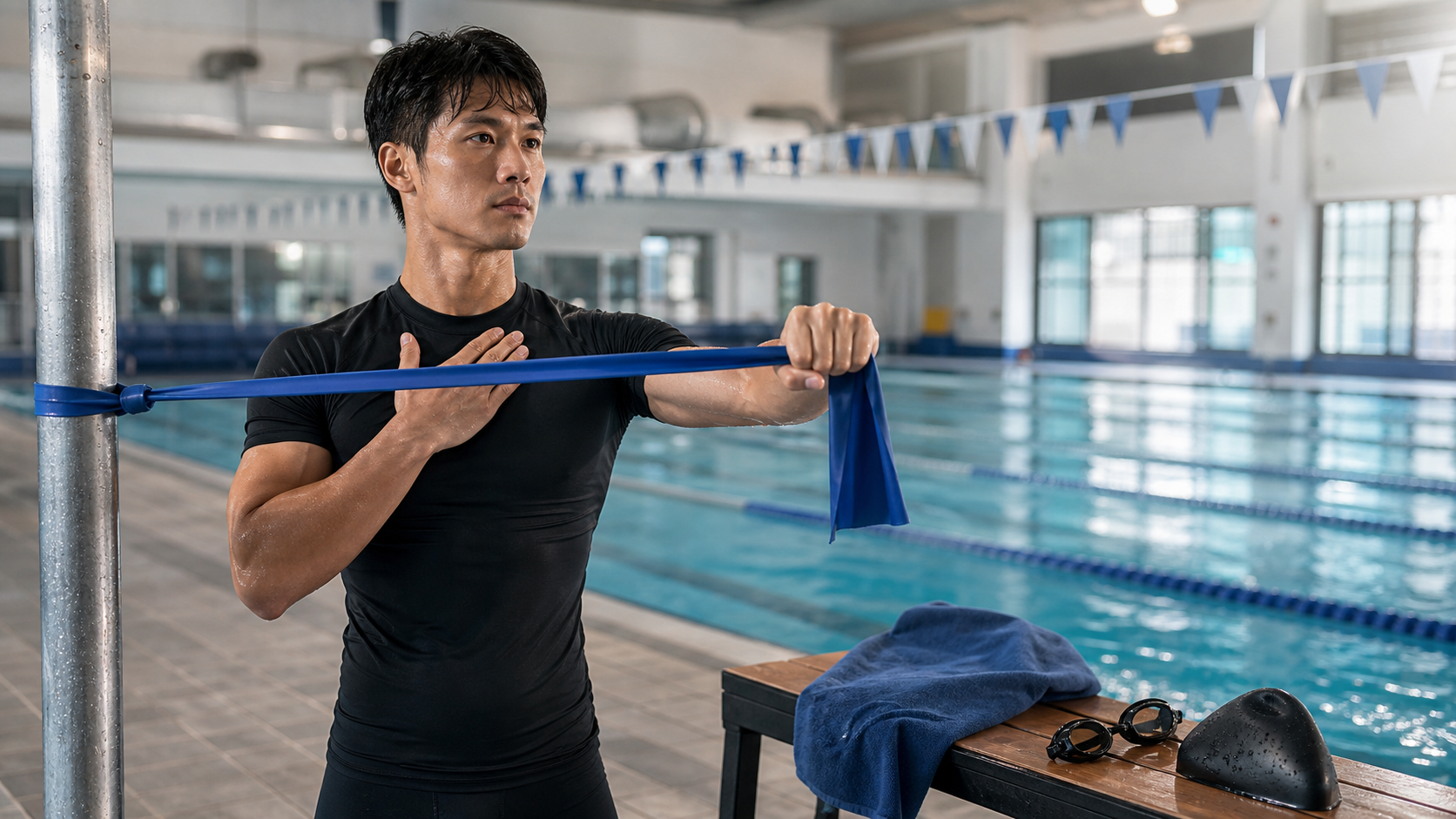
- Resistance band W/Y/T drills: activates the middle and lower trapezius and serratus anterior, improving dynamic scapular stability
- Prone row: strengthens the rhomboids to counteract rounded shoulders from prolonged forward reaching
- Thoracic extension on a foam roller: roll the T4–T8 thoracic spine daily to improve thoracic extension mobility
Managing Training Volume
Follow the “10% rule”: weekly training volume should not increase by more than 10% over the previous week. Schedule a deload week every three to four weeks to allow the rotator cuff tendons to fully recover.
Practical Recommendations
- Always perform a 5–10 minute dryland warm-up before pool training, including shoulder circles, resistance band stretches, and rotator cuff activation
- When shoulder pain occurs, prioritize backstroke over freestyle to reduce internal rotation pressure on the front of the shoulder
- Major hospitals across Taiwan (such as National Taiwan University Hospital, Chang Gung Memorial Hospital, and Taipei Veterans General Hospital) all have sports medicine clinics specializing in swimming injuries — don’t delay seeking treatment
- When using a kickboard, avoid holding both hands raised and pressing down on the board for extended periods, as this movement actually places even more pressure on the subacromial space
- Consider doing a technique video analysis with your swim coach once a season; underwater footage helps identify hidden postural issues
Conclusion
Shoulder impingement syndrome is frustrating, but it is a preventable and treatable sports injury. For swimmers in Taiwan, the most important thing to remember is this: pain is not proof of progress — it is your body’s warning signal. By building correct stroke technique, combining it with systematic dryland strengthening, and addressing pain promptly when it first appears, you can enjoy a lifetime of health and pleasure in the water.
Related Reading
- Preventing Swimmer’s Shoulder Injuries: Causes and Training Strategies for Shoulder Impingement Syndrome
- Swimmer’s Shoulder: Recognizing and Understanding Rotator Cuff Syndrome
- A Complete Breakdown of Swimmer’s Shoulder: Causes, Diagnosis, and Prevention
- The Complete Diagnosis and Treatment Guide for Swimmer’s Shoulder
一日北高/長距離團騎 常見問題補充篇 / 組團或跟團的眉角 / 壯車友容易被瘦車友慢性拉爆 / 原來屁股痛可能是這個原因...? / 風場配速法 / 公路車 / CT Yeh
2 年前
抖肩舞 台灣x日本交流版 (台灣 vs 前橋) 赤城山登山賽 coincidance
8 年前
一日北高常見問題大集合 | 攻略 | 路線 | 訓練 | 補給 | 自行車 單車 | 一日雙城 | 雙塔 | TWB北高360 | 屁股痛
6 年前
一起升級!海鷗盃LSD團練...JJSC Zone2招待 騎到手抖 / 公路車 / CT Yeh
1 天前
2025 海鷗團體繞圈賽 網路直播 超激烈裁判長視角 / EIPC 李廷威、Waypoint 等眾多高手競爭 / feat. 卡密兒主持 / 海鷗繞圈賽
9 個月前
[教學] Premiere 影片 手震 修正 教學 防抖 單眼 影像 GoPro 穩定 Video Stabilization
8 年前
2026 輪霸西濱200K 挑戰VLOG / 第一集團 / 首次參加..經驗不足、膀胱不足 /死守6H內 / AI戰鬥力顯示系統 / 公路車 / CT Yeh
4 個月前
2023桃園團體繞圈賽/環台賽等級拍攝/賽事精華/ 10人一隊缺一不可!50隊廝殺大場面 / 第三屆 海鷗繞圈賽 /公路車/CT Yeh
2 年前