/no_think
The Allure and Cost of Night Riding: A Safety Guide and Real Experiences on Dark Roads
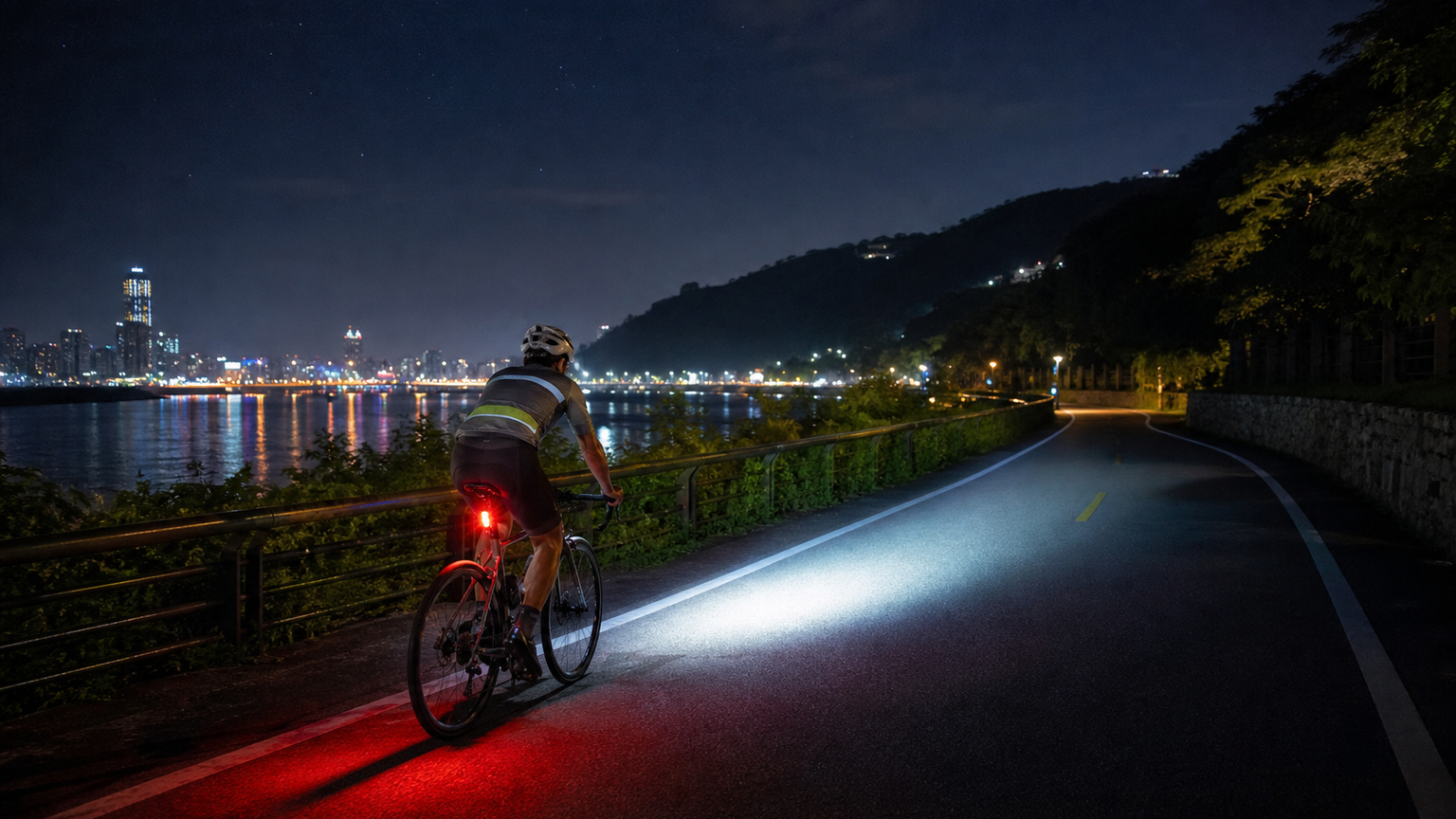
My first night ride was on a summer evening. What started as a short ride planned for just an hour turned into riding into the dark without realizing it, because the breeze was too comfortable and the road too smooth. The bike path on the Guandu Plain had no streetlights, leaving only the small circle of light cast by my headlight. The city lights in the distance reflected off the river, and above me was a starry sky I had never seen in downtown Taipei.
That night, I fell in love with night riding.
But the experiences that followed taught me that behind the romance of night riding lie quite a few real risks.
Why Ride at Night?
In Taiwan, night riding isn’t just a romantic choice—it’s often a practical necessity:
Beat the summer heat. During July and August, daytime temperatures routinely exceed 35°C, making cycling not just miserable but also risky for heatstroke. After 7 PM, temperatures drop to around 28°C, which feels much more comfortable.
The office worker’s time window. For those working 9-to-6, the only riding windows on weekdays are early morning and evening. Many people choose to ride for an hour or two after work as a way to decompress.
The need for long-distance challenges. Ultra-long-distance challenges like the One-Day Twin Towers or fast island laps are nearly impossible to complete in daylight alone, making night riding an unavoidable part of the journey.
Pure enjoyment. At night, traffic on the roads is lighter, the air is cooler, and the city’s clamor fades away, leaving only the sound of tires rolling and the wind. That solitude and tranquility is something you simply can’t experience riding during the day.
An Experience That Nearly Went Wrong
What made me take night riding safety seriously was a near-miss with a car.
That night, a little after 9 PM, I was riding on a road in Taipei heading toward the riverside. I was wearing a black jersey, my rear light was off because I hadn’t charged it (yes, I know how stupid that was), and my headlight was a small one barely bright enough to light the road. As I passed through an intersection, a car turning right cut past within what felt like less than 30 centimeters of my rear wheel.
The driver rolled down the window and yelled something to the effect of, “You’re riding so dark, who can even see you?”
At the moment, I was furious, thinking he wasn’t paying attention. But after I calmed down and put myself in the driver’s shoes, I thought about it: a rider in black clothes, no rear light, and only a dim headlight—at a poorly lit intersection, I was probably just a shadow in the driver’s field of vision. The fact that he didn’t hit me was already lucky.
When I got home that day, I immediately went online and ordered a full set of night riding gear.
The Complete Night Riding Gear Guide
Lighting Systems
Lights are the most important piece of night riding equipment, bar none.
Front light (headlight):
| Use Case | Recommended Brightness | Notes |
|---|---|---|
| City commuting | 300-500 lumens | Mainly so others can see you |
| Suburban roads | 800-1200 lumens | Need to illuminate the road surface |
| Unlit mountain roads | 1500+ lumens | Need to see curves and road conditions clearly |
I currently use a Bontrager Ion Pro RT, 1300 lumens, with switchable high/low beam. On unlit suburban roads, this brightness is just right for seeing the road surface 20 to 30 meters ahead.
Rear light:
The rear light is just as important as the headlight—you can’t see traffic coming from behind, but you need them to see you.
I recommend a rear light with at least 50 lumens and a “daytime flash” mode. Daytime flash is a special flashing pattern that remains visible from hundreds of meters away even in daylight. I use a Bontrager Flare RT, 100 lumens, which claims a visibility range of over two kilometers.
Extra tip: Mount a rear light on both the seatpost and the back of your helmet. Two light sources are easier to notice than one, and if one dies, you have a backup.
Reflective Accessories
Besides active light sources, passive reflective gear is also important:
- Reflective vest: Worn over your jersey, it reflects light over a large area when hit by headlights
- Reflective ankle bands: The up-and-down motion of your ankles while pedaling creates a dynamic reflective effect that draws more attention than static reflection
- Rim reflective strips: Applied to the wheel rims so side-approaching traffic can see you
- Jersey choice: Wear light-colored jerseys or ones with reflective elements for night riding—never all black
Road Surface Observation Tools
One of the biggest challenges at night is unclear road conditions. Potholes, gravel, and puddles that are obvious in daylight can be completely invisible at night.
Besides a high-output headlight, I recommend mounting an auxiliary light on the handlebar angled slightly downward, specifically to illuminate the road surface 2 to 3 meters ahead of the front wheel. This lets you spot road obstacles at a closer range.
Choosing Night Riding Routes
Features of Routes Suitable for Night Riding
- Street lighting: Riverside bike paths (some sections), city roads
- Good road surface: Avoid roads with many potholes and cracks
- Low but not zero traffic: Heavily trafficked roads are dangerous; overly remote roads mean no one will find you if something goes wrong
- Routes you know well: Night is not the time to explore new routes, because you can’t see the road conditions clearly
Recommended Night Riding Routes in Taiwan
Taipei:
- The Dadaocheng to Guandu riverside bike path (some sections have streetlights)
- The Dunhua North-South Road bike path (fully lit)
- The Shezi Island loop bike path (lights are dim but traffic is light)
Taichung:
- Taichung Science Museum to Tunghai University (lit, good road surface)
- Houli loop bike path
Kaohsiung:
- The Love River waterfront bike path
- Cijin Wind-riding Boulevard
Routes Absolutely Not Recommended for Night Riding
- Mountain roads: No streetlights, many curves, rockfall risk, animals crossing
- Provincial highways and expressways: Heavy truck traffic, high speeds, no bike lanes at all
- Sections under construction: Nighttime construction zones often have inadequate warning signage
Physical and Mental Adjustment for Night Riding
Visual Adaptation
When riding from a brightly lit city into unlit suburbs, your eyes need about five to ten minutes to fully adapt to the dark. During this period, your field of vision narrows and your reaction time slows. I recommend slowing down before entering dark areas to give your eyes time to adjust.
Another tip: don’t stare directly at oncoming headlights. Bright light instantly resets your dark adaptation, forcing you to spend several minutes re-adapting. When facing oncoming traffic, shift your gaze slightly to the white line on the right side of the road.
Distance Judgment
Your ability to judge distances degrades at night. In daylight, you can easily gauge the distance and size of a pothole ahead; at night, the same pothole might not be visible until you’re right on top of it. Therefore, your night riding speed should be at least 20 to 30 percent slower than the same route in daylight.
Loneliness
The loneliness of riding solo at night is real, especially on remote stretches. Some people enjoy that solitude; others find it anxiety-inducing. If you’re not sure you can handle it, I suggest starting with group night rides and gradually transitioning to solo riding.
Many cycling clubs and bike shops organize weekday night rides—these are a great way to start. Riding in a group isn’t just safer; if something unexpected happens, there’s someone to help.
After Years of Night Riding
Night riding has now become second nature to me. In summer, I’m out on the riverside bike path two or three evenings a week. My bike always has front and rear lights mounted, and in my jersey drawer there’s a reflective vest that’s always charged and ready.
The most memorable night ride recently was one evening after a typhoon. The sky had been washed completely clean, with exceptional visibility. When I reached Guandu, the entire Taipei Basin’s lights spread out before me, the distant Taipei 101 glittering in the night, with scattered lights reflecting off the river.
I stopped, leaned against the railing, and watched for a long while. In that moment, I felt that for this view, all those years of riding in the dark, nearly getting hit by a car, and coming home with legs covered in mosquito bites were completely worth it.
Safety reminder: When riding solo at night, always tell your family your route and expected arrival time. Keep your phone charged and location sharing enabled. Carry your NHI card and emergency contact information with you. If anything ever feels wrong, don’t hesitate—stop immediately and assess the situation.
Related Reading
- Night Riding Safety Guide: Gear Selection, Route Planning, and Essential Tips
- The Appeal and Safety Rules of Night Riding: A Guide to Urban and Suburban Night Cycling
- Night Riding Culture: A Complete Guide to Taiwan’s Night Riding Routes and Light Safety
- Late-Night Riding Experience: The Unique Charm of Night Cycling in Taiwan
單車 一日北高 ( 雙城 ) 肥宅雙人瘋狂行 紀錄片 REACTO
10 年前
一日北高常見問題大集合 | 攻略 | 路線 | 訓練 | 補給 | 自行車 單車 | 一日雙城 | 雙塔 | TWB北高360 | 屁股痛
6 年前
碟煞公路車 優缺點?換車一年半實際經驗分享 / 公路車 / CT Yeh
2 年前
高雄綠園道鐵路自行車道 / 外地人能輕鬆駕馭 還是整路崩潰? / 2025 全線開通 春節實地探索一次!(附GPS連結)/ 公路車 / CT Yeh
1 年前
太平山單車員工旅遊 | 這樣玩CP值最高!| 公路車
5 年前
虎豹潭!日本老師來台一日約騎 台灣車友熱情招待私房路線 / CT Yeh
18 天前
台中大雪山 膏王領騎 震到都沒畫面了 公路車
5 年前
2024 如來神掌 百人約騎挑戰!feat. 秘境單車社團 / 神人們太可怕 / 全程錄影 x 完整坡度解析 / 公路車 / CT Yeh
2 年前