The Pain and Sweetness of Winter Training: A Winter Cycling Training Camp Experience in Southern Taiwan
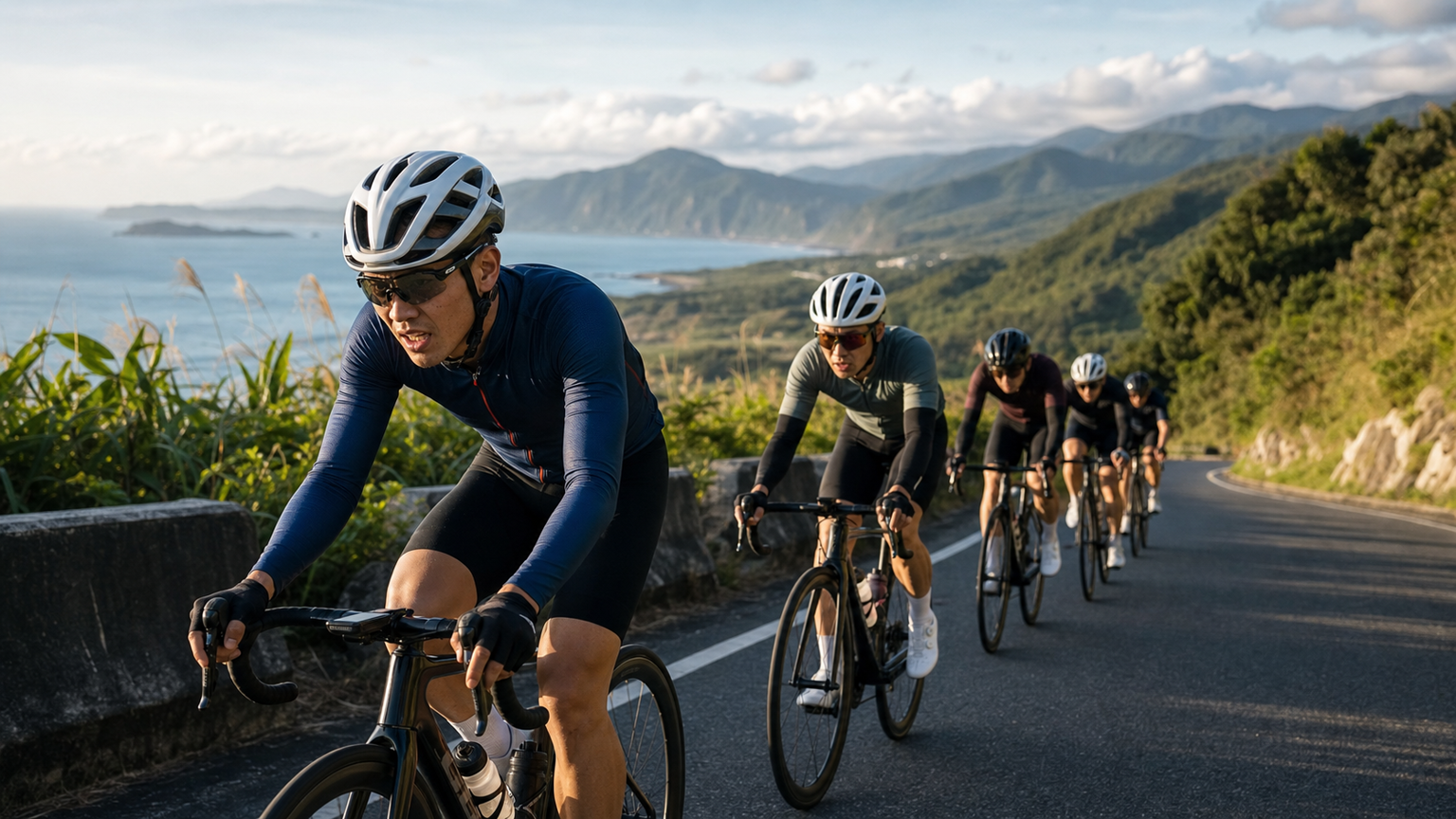
The Pain and Sweetness of Winter Training: A Cycling Winter Training Camp Experience in Southern Taiwan
In mid-December, Taipei’s damp cold made it hard to even leave the house, let alone ride a bike. The riverside bike path was deserted, with only the occasional jogger in a thick jacket passing by. My trainer sat in the corner of the living room gathering dust—I couldn’t even muster the motivation to ride at home.
Every winter is the same. Once the temperature drops below 15 degrees, my motivation to ride plummets along with the mercury. In November I can still force myself out; by December I start making excuses; in January I almost completely stop; in February I ride occasionally on sheer willpower; and in March, when it finally warms up, I start again—only to find my fitness has taken a huge hit, and it takes a month or two to get it back.
After repeating this vicious cycle for three years, I decided to do something different. When I saw a cycling training camp ad on Facebook—“Southern Taiwan Winter Training Camp, Five Days Four Nights, Pingtung・Hengchun”—I signed up without overthinking it.
Check-in Day: A Schedule That Shocked Me
The camp gathered at a hotel in downtown Pingtung. The coaching team consisted of three people—a former national team rider, a sports science master’s graduate, and a certified fitness coach. There were 24 trainees, ranging in age from 25 to 58, most of them amateur road cyclists like me.
After check-in, the coaches handed out the five-day schedule. I took one look and my heart sank:
| Day | Morning | Afternoon | Evening |
|---|---|---|---|
| Day 1 | Fitness test + bike fit adjustment | Base endurance ride 60K | Core training + foam rolling |
| Day 2 | Climbing training (Beidawu Mountain industrial road) | Tempo ride 50K | Sports nutrition lecture |
| Day 3 | Interval training (Hengchun Peninsula) | Recovery ride 40K | Sports psychology lecture |
| Day 4 | Long endurance ride 120K | Rest | Video analysis + strategy discussion |
| Day 5 | Individual time trial 20K + awards | — | — |
The total riding distance over five days was about 350 kilometers, plus core training and stretching every evening. That’s roughly the volume I’d normally do in a month and a half, compressed into five days.
Seeing the look on our faces, the coach smiled and said, “Don’t worry, we’ll adjust the intensity based on each person’s condition. But the whole point of winter training is to train when you least want to, to build your foundation. Next spring, you’ll thank yourself for what you do now.”
Day 1: Woken Up by the Numbers
The morning fitness test on Day 1 was an FTP test (Functional Threshold Power). Twenty minutes of all-out riding, taking 95% of the average power as your FTP.
This is a test that makes you want to die. Twenty minutes doesn’t sound long, but the pain index of going all-out for twenty minutes is about ten out of ten. The first five minutes felt okay, the middle five minutes made me question my life choices, and the last ten minutes were pure willpower. When it was over, I lay on my handlebars gasping for five minutes before I could speak.
My FTP came out to 198 watts. For my weight (72 kg), that’s a power-to-weight ratio of 2.75 W/kg. The coach said the number “has room for improvement”—which translates to “you’re weak.”
The afternoon base endurance ride was 60 kilometers along the flat roads of the Pingtung plain. The coach required us to stay at 55-65% of FTP the entire time, which is Zone 2 heart rate. For most trainees, this intensity was easy, but the coach emphasized: “The aerobic base is the foundation of all training. If the foundation is unstable, anything you build on top will collapse.”
Pingtung’s December weather was around 20 to 25 degrees, sunny but not harsh. Compared to Taipei’s damp cold, it was paradise. The roadside stretched with endless pineapple fields and betel nut trees, with the silhouette of Dawu Mountain visible in the distance. Riding in that environment made even base endurance enjoyable.
The evening core training was another wake-up call. I thought my core was decent, but I was shaking within fifteen seconds of a side plank. The coach said, “Look at how your upper body sways when you climb—that’s because your core isn’t stable enough.”
Day 2: Humbled on the Mountain Road
The climbing training on Day 2 was the hardest day of the entire camp. The target was a section of industrial road on Beidawu Mountain, about 12 kilometers long, with an average gradient of 7% and the steepest sections exceeding 12%.
The coach split the trainees into three groups—Group A was the six best performers, climbing at near-FTP intensity; Group B was the middle twelve (including me), climbing at 80-85% of FTP; Group C was the six who were less fit or older, climbing at their own pace.
Within two kilometers of starting, I knew today would be painful. A 7% gradient in cool weather is manageable, but maintaining 80-85% of FTP meant every pedal stroke came with a clear burning sensation in my muscles. The coach rode alongside, constantly reminding: “Don’t let your cadence drop below 70! Sit up straight! Push with your glutes!”
By kilometer seven, my thighs were sending clear signals of surrender. Lactic acid buildup made every pedal stroke feel like stirring a pot of boiling water. The coach noticed my struggle, rode up beside me, and said one thing: “Your pain right now is temporary, but you’re getting stronger—that change is permanent.”
I don’t know if those words actually helped, but I did make it to the top. For the last three kilometers, I shifted to the easiest gear, barely keeping my cadence at 65 rpm, with a speed of only about 8 km/h—but I never got off the bike.
The view at the summit was the best reward. At an elevation of about 1,200 meters, you could see the entire Pingtung plain stretching all the way to the coastline. December’s air was especially clear, with excellent visibility. The coach waited at the top until everyone arrived, then took a group photo. In the picture, everyone’s face was flushed red and drenched in sweat, but everyone was smiling.
The afternoon tempo ride and evening nutrition lecture were relatively easy. The nutritionist taught some practical fueling knowledge—when to eat carbs, when to eat protein, and how to arrange your diet during recovery. I learned that consuming carbs and protein (in roughly a 3:1 ratio) within 30 minutes after training maximizes glycogen replenishment.
Day 3: Intervals in the Wind
On Day 3, we moved to the Hengchun Peninsula for interval training. Hengchun has a famous winter specialty—the fall wind (luòshānfēng). In December, the fall wind can reach 10 to 15 meters per second, equivalent to the force of a small typhoon.
The coach chose this location for intervals for a reason. He said: “Doing intervals into a headwind allows you to produce high power output at lower speeds. Lower speed means lower risk, but the training effect is just as good.”
The interval workout was six three-minute all-out efforts, with three minutes of recovery between each. The target power was 110-120% of FTP.
Riding all-out for three minutes in the fall wind felt surreal. You pedal with everything you have, the power meter shows you’re operating above your FTP, but when you look at the speed on your computer, it’s only 15 km/h—which under normal flat conditions would be a leisurely pace. That feeling of “trying so hard but not moving” was both frustrating and amusing.
After six intervals, my legs were completely shot. The coach had us do a 40-kilometer recovery ride on a less windy section. The scenery of the Hengchun Peninsula was still beautiful even when I was exhausted—the coastline, grasslands, cattle, and the Eluanbi Lighthouse in the distance.
The evening sports psychology lecture was my favorite session. The speaker was a sports psychology PhD, and she talked about “self-talk” techniques in training. She said many athletes use negative self-talk when in pain (“I’m so tired,” “I can’t do this”), but research shows that switching to instructional self-talk (“Hold the pace,” “Push harder next lap,” “Focus on breathing”) can improve performance by 2 to 5 percent.
Day 4: The 120-Kilometer Long Ride
Day four was a long-endurance day, setting out from Pingtung and heading south along Provincial Highway 1 to Hengchun before turning back, for a total of 120 kilometers.
This was a comprehensive test of the training from the previous three days. The accumulated fatigue made my legs feel heavy the moment I got out of bed, but the coach said this was exactly the purpose of winter training—being able to maintain riding quality under fatigue is proof of fitness gains.
The 120-kilometer ride was divided into several segments, each with a different training goal:
- First 40K: Zone 2 aerobic warm-up
- 40-80K: Gradually build to Zone 3, practicing “Sweet Spot” intensity
- 80-100K: Return to Zone 2 for recovery
- Final 20K: Simulate a race finish, riding at the highest intensity you can sustain
The final 20 kilometers were the highlight of the entire ride. The coach shouted “Go!” and everyone flipped a switch, instantly shifting from relaxed aerobic mode to full-power output. Rotating pace lines, chasing, overtaking, being caught—that atmosphere of group competition let adrenaline completely overpower the fatigue.
After the ride, we returned to the hotel, and almost everyone collapsed directly onto the sofas in the lobby. Someone went out and bought two large cases of sports drinks and a pile of fried chicken. We ate, laughed, and ribbed each other about our performances that day. The vibe was great—like returning to that pure joy of being on a college sports team.
Day 5: Time Trial—Reaping the Results
The final day was an individual time trial on a 20-kilometer flat course. Each rider started alone, one minute apart, going all out.
The time trial is the most painful and most pure discipline in cycling—no drafting off a pace line, no tactics to play, no teammates to rely on. Just you and your legs, giving everything over 20 kilometers.
My strategy was to hold 95% of FTP for the first 10 kilometers, then add more depending on how I felt for the last 10. After starting, the wind was a cross-headwind, and my speed in the first five kilometers was slightly slower than expected, but power stayed steadily in the target range.
By kilometer 12, the wind shifted to a tailwind, and speed jumped by three to four kilometers per hour. I decided to push the intensity to 100% of FTP. My thighs were protesting, my lungs were burning, but my mind kept repeating what I’d learned in the sports psychology lecture: “Hold the rhythm, one more lap, focus on your breathing.”
For the final three kilometers, I poured out every ounce of strength I had left. Standing to sprint, sitting to spin a high cadence, then standing to sprint again. When I crossed the finish line, I couldn’t even read the numbers on my computer—my eyes were blurred from sweat and the wind.
The result came in: 20 kilometers, 34 minutes and 12 seconds, average speed 35.1 km/h, average power 206 watts.
Five days earlier, my FTP test was 198 watts. Now my average power in the time trial was 206 watts. My power-to-weight ratio improved from 2.75 to 2.86 W/kg.
The coach said: “This isn’t because your fitness truly improved that much in five days. It’s because over these five days, you learned how to output more efficiently, pace more intelligently, and face pain more resolutely.”
The Meaning of Winter Training
After returning to Taipei, my training habits changed completely.
I’m no longer afraid of riding in winter. Because now I know that winter in southern Taiwan is cycling paradise. And because I know that training when you least want to yields the greatest gains.
More importantly, the five-day camp introduced me to a group of people who share the same passion for riding. We now have a LINE group where we share training logs, motivate each other, and plan weekend group rides. The difference between training with company and training alone is enormous—when you know others are putting in the work alongside you, your excuses for slacking off are cut in half.
Next winter, I’ll go again. This time I want to see if I can push my FTP to 220 watts.
Winter training tip: Even in southern Taiwan, morning temperatures can drop to just over ten degrees Celsius. Bring plenty of cold-weather gear—arm warmers, leg warmers, wind vest, and full-finger gloves. The fall winds (落山風) in Hengchun are extremely strong; first-time riders should pay extra attention to bike handling in crosswinds. Also, recovery is just as important as training during winter camp—sleep, nutrition, and stretching are all non-negotiable.
Related Reading
- Winter Training: Off-Season Strength Plan for Taiwanese Cyclists
- Taiwan Winter Cycling Training: Complete Base Period Plan from November to February
- Adapting to Taiwan’s Climate: Training Strategy Adjustments for Summer Heat and Winter Northeast Monsoon
- Riding South in Taiwan’s Winter: Chasing Good Weather in the South from December to April
山道猴出沒!? JJSC屏東單車行 Day1 一直催 / 皮卡丘來了!/ 墾丁 旭海 恆春 社頂 / 公路車 / CT Yeh
2 年前
JJSC南台灣單車走春三日行 DAY 1 / 強度 x 美食 x 節慶體驗 / 公路車 CT Yeh
5 個月前
單車 一日北高 ( 雙城 ) 肥宅雙人瘋狂行 紀錄片 REACTO
10 年前
大武山後門26%歡樂陡坡!JJSC南台灣單車行Day2 / 被颱風追著跑 / 公路車 / CT Yeh
2 年前
一日北高前的西濱集訓 | 跟著11小時軍團 | 300W踩不動的大逆風 | 輪車破風差幾瓦?
6 年前
一日北高 11小時 賽後心得分享篇 | TWB北高360 | 一日雙城 | 單車 | 公路車
6 年前
西拉雅五庫單車挑戰 / 曾文水庫 & 南168 二寮 / 500元報名費居然這麼超值/ 公路車 / CT Yeh
10 個月前
大武山20%魔王陡坡【JJSC南台灣遊騎Day2】!屁股真的要裂開了...凡士林抹滿也沒用?神秘金教堂還有超便宜夜市
3 個月前