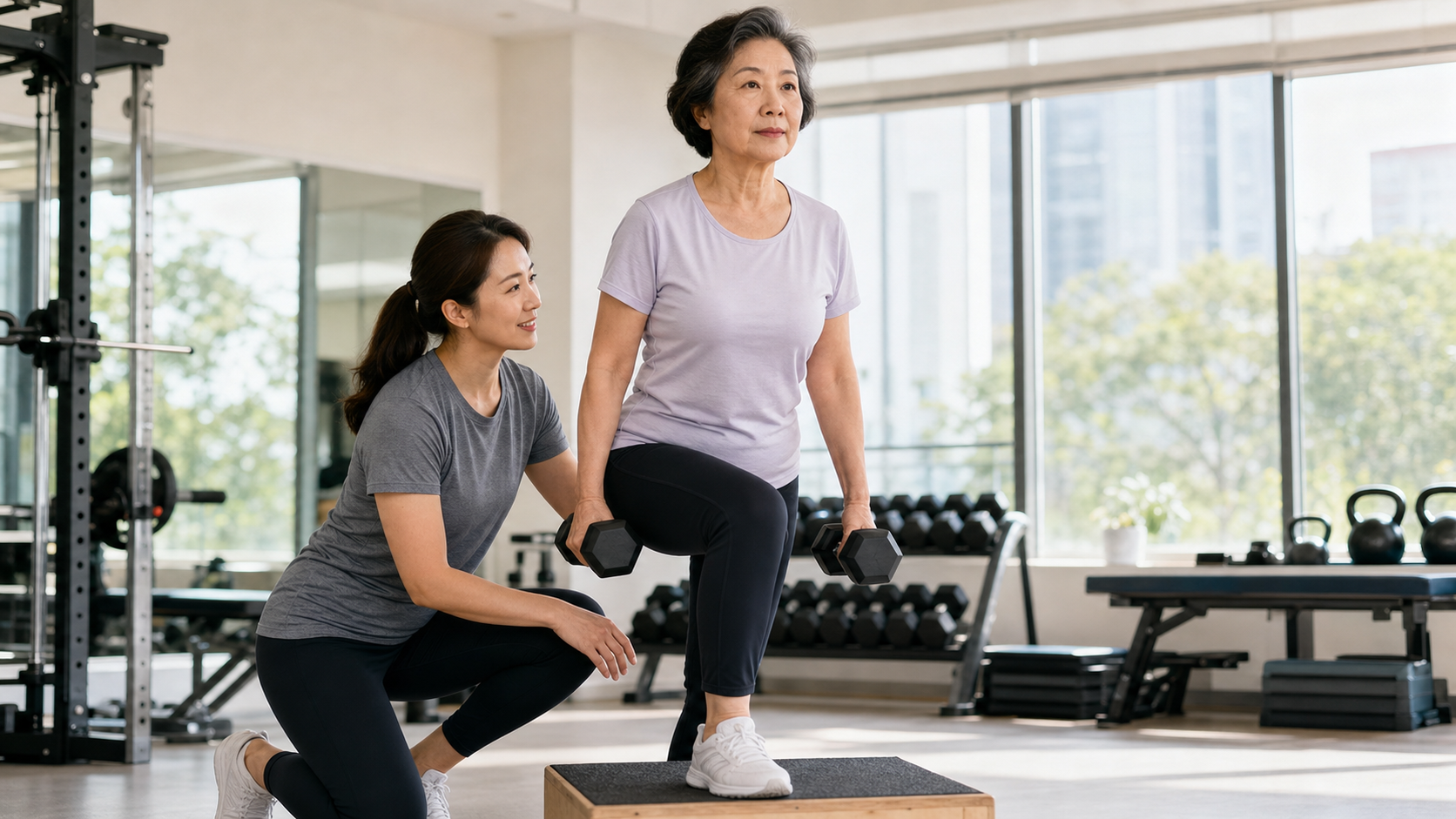
It Starts with an Auntie on the Stairs
A few years ago, a woman in her early sixties, Auntie Zhang, walked into my training studio, dragged in by her daughter. Her chief complaint was simple: “I used to climb four flights of stairs without getting winded. Now I have to stop and hold the railing by the second floor. And when I carry a case of bottled water home from the supermarket, my hands shake.” She wasn’t sick, her health check-up report was all within normal range, and she even weighed two kilograms less than she did in her younger years. She proudly told me she “hasn’t gained any weight.”
But after I had her do a few simple tests, I had a pretty good idea of what was going on. She had to push off her thighs to get up from a chair without armrests. When I asked her to stand on one leg, she wobbled within ten seconds. And when I measured her grip strength, her right hand only managed just over eighteen kilograms. Her weight hadn’t changed—it had even gone down—but what she had lost was muscle, and what had grown back was fat. This is exactly what makes sarcopenia so insidious: it doesn’t show you a warning sign on the scale.
In my fifteen years of training athletes and the general population, the more I’ve worked, the more I’ve come to believe that sarcopenia is the health issue I’ve encountered that is “the most underestimated, yet the most worth investing in.” It doesn’t have a clear red flag like high blood pressure or diabetes, yet it silently determines whether a person can go up and down stairs on their own after sixty, whether they can carry their grandkids, and whether they can get back up after a fall. In this article, I want to lay out for you, in full, the concepts and methods I’ve accumulated over the years from coaching clients on the ground and from continuously reading the literature.
Let me start with the conclusion: Sarcopenia is not an inevitable fate of aging; it is a condition that can be dramatically reversed with training and nutrition. And the earlier you start, the more capital you have.
What is Sarcopenia? Let’s First Clarify the Mechanisms
Definition and Current Status of Sarcopenia
Sarcopenia refers to a syndrome characterized by the age-related loss of both skeletal muscle mass and function. Please note these two words: it’s not just about the “quantity” decreasing; more critically, it’s about “function”—meaning strength and performance—declining.
According to the consensus of the European Working Group on Sarcopenia in Older People 2 (EWGSOP2), clinically, grip strength is used as the first screening indicator for “probable sarcopenia,” with the cut-off points being approximately 27 kg for men and approximately 16 kg for women (EWGSOP2-related research, Aging Male journal). Auntie Zhang’s grip strength of eighteen kilograms, while not yet below the female cut-off, is already a clearly low signal for someone with a decent activity level and warrants active intervention.
In terms of prevalence, the literature indicates that about 5% to 13% of people in their sixties are affected by sarcopenia, and this may rise to as high as 50% in those over eighty (MDPI Nutrients review). In other words, the older you get, the more common this becomes, and the more you need to plan ahead.
Why Does Muscle Loss Occur?
Many trainees think, “Muscle naturally decreases with age; there’s nothing you can do about it.” That statement is half right and half wrong. Muscle loss is indeed related to age, but behind it is a chain of mechanisms that can be intervened upon:
- Disuse: This is the biggest and most reversible cause. After retirement, activity levels drop sharply, along with sedentary behavior and illness-related bed rest. Muscle follows the “use it or lose it” principle faster than most people imagine. Studies often mention that healthy young people who are completely bedridden for one to two weeks can lose several hundred grams to over a kilogram of lean tissue.
- Anabolic resistance: This is one of the most core physiological changes of aging. When a young person eats a serving of protein, their muscles sensitively initiate synthesis; as we age, the muscle’s “response” to the same serving of protein becomes blunted, requiring larger amounts and stronger signals (such as sufficient leucine and resistance training) to drive the same level of synthetic response.
- Hormonal changes: Testosterone, growth hormone, estrogen, etc., decline with age, and the rate of loss accelerates in women after menopause.
- Chronic inflammation and chronic diseases: Long-term low-grade inflammation, insulin resistance, diabetes, chronic kidney disease, heart failure, etc., can all accelerate muscle breakdown (MDPI Nutrients review).
- Inadequate nutrition: Especially insufficient protein intake and vitamin D deficiency. The Taiwanese elder generation’s mindset of “fearing fat, fearing kidney damage, and eating less meat” often ends up being a driver of sarcopenia.
- Neural degeneration: The motor neurons that innervate muscles decrease with age, and the type II (fast-twitch) muscle fibers responsible for explosive power atrophy particularly noticeably—this explains why the problem of “not being able to react in time when falling” appears earlier in older adults than “having trouble walking.”
Laying these out, you’ll find: at least half of them are things we can actively change through lifestyle. Disuse can be reversed with training, anabolic resistance can be overcome with adequate protein plus resistance stimulation, and nutritional deficiencies can be addressed through dietary adjustments. This is why I remain optimistic about every trainee.
The Two Pillars of Combating Sarcopenia
If I had to condense the entire strategy into one sentence, it would be: Use resistance training to give your muscles the signal “to grow back,” and use adequate protein to give your muscles the raw materials “to grow back with.” Both are indispensable, and their relationship is multiplicative, not additive.
The literature supports this direction as well: combining aerobic training, resistance training, and increased protein intake is more effective at preventing sarcopenia than any single approach (MDPI Nutrients review). Below, I’ll break down the two pillars separately.
Pillar One: Resistance Training—The Irreplaceable Core
I’m going to say something here that might offend some people: When it comes to combating sarcopenia, walking and cycling are not enough.
I fully support aerobic exercise—it’s great for your heart, lungs, blood sugar, blood pressure, and mood, and Taiwan’s riverside bike paths are an excellent resource for public fitness. But aerobic exercise alone provides quite limited stimulation for “increasing muscle mass and maximal strength.” To grow back atrophied muscle fibers, you have to give them a resistance challenge that “your current strength can’t easily handle.” This is the core of progressive overload.
Resistance training doesn’t mean you have to go to a gym and lift heavy barbells. Here are several forms I flexibly use when training clients of different levels:
- Bodyweight training: Squats, sit-to-stand, wall push-ups, bridges, calf raises. For complete beginners or frail older adults, this is the safest starting point.
- Resistance bands: Cheap, lightweight, and joint-friendly. Great for home workouts and suitable for people with old shoulder or knee injuries.
- Dumbbells/Kettlebells: Allow for precise weight adjustments, making progressive overload easy.
- Gym machines: With fixed movement paths, they’re relatively safe and great for middle-aged and older trainees who want to add weight but aren’t yet familiar with free weights.
The key isn’t the equipment, but that the intensity is sufficient and you keep progressing. A common mistake is: buying a pair of two-kilogram pink dumbbells and still using two kilograms three years later—your muscles have long since adapted, which means no progress at all.
Practical Programming: Resistance Training Prescriptions for Three Levels
After all these principles, I know what you really want is “So how exactly should I train?” Below, I provide three sample programs, corresponding to beginners, advanced trainees, and older adults with chronic conditions or weaker fitness levels. These are frameworks I actually use on the floor. You can adjust them to your own situation, but please keep the word “progressive” firmly in mind.
Table 1: Sample Resistance Training Programs for Three Levels
| Item | Beginner/Sedentary | Advanced | Older Adult/Weaker Fitness |
|---|---|---|---|
| Frequency per week | 2 sessions | 3–4 sessions | 2–3 sessions (can be split into short blocks) |
| Main exercises | Sit-to-stand, wall push-ups, band rows | Squats, deadlifts, bench press, rows | Chair-assisted squats, resistance bands, calf raises |
| Sets per exercise | 2–3 sets | 3–4 sets | 2 sets |
| Reps per set | 10–15 reps | 6–12 reps | 8–12 reps |
| Intensity (RPE 1-10) | 6–7 (3–4 reps left in reserve) | 7–9 (1–3 reps left in reserve) | 5–6 (safety first) |
| Rest between sets | 60–90 seconds | 90–180 seconds | Rest fully, no rushing |
| Progression method | Increase reps or resistance every 1–2 weeks | Gradually add weight or reduce rest | Progress from two-hand support → one-hand support → no support |
A Plain-Language Explanation of “Intensity”
Many people get a headache when they see RPE (Rating of Perceived Exertion). Let me put it in terms trainees understand: Stop each set when you “could still do about 2 to 4 more reps, but your form is still solid.” This concept of “keeping a few reps in reserve” is called RIR (reps in reserve) in training science, and it’s especially important for the middle-aged and older population—we want effective stimulation, not going to failure on every set where form breaks down and injury risk increases.
In the first month I trained Auntie Zhang, her “squat” was literally just “standing up from a chair and slowly sitting back down,” doing ten reps for two sets. That simple. But after three weeks, she could do it without using her hands. After six weeks, I raised the chair height to increase the difficulty. Two months later, she told me herself: “Coach, my hands don shake when I carry groceries today.” This isn’t a miracle; it’s physiology.
Pillar Two: Protein Synergy—Give Enough, Give the Right Kind
Training is the “signal,” protein is the “raw material.” No matter how strong the signal, you can’t build muscle without the raw materials. And the anabolic resistance mentioned earlier is precisely why older adults need to eat more protein than younger people.
How Much Should You Eat?
The Recommended Dietary Allowance (RDA) for protein for the general adult population is about 0.8 grams per kilogram of body weight, but this number is the minimum to “avoid deficiency” and is far from sufficient for maintaining muscle and combating sarcopenia. Multiple papers point out that to promote healthy aging and maintain muscle mass and strength, high-quality protein intake should reach approximately 1.2 to 1.6 grams per kilogram of body weight per day (PMC Nutrients review).
Let me convert that into numbers that are easy to understand. Take a 60-kilogram older adult as an example:
Table 2: Daily Protein Targets by Body Weight (for Maintaining Muscle/Combating Sarcopenia)
| Body Weight | 1.2 g/kg (lower limit) | 1.4 g/kg (mid-range) | 1.6 g/kg (upper limit) |
|---|---|---|---|
| 50 kg | ~60 g | ~70 g | ~80 g |
| 60 kg | ~72 g | ~84 g | ~96 g |
| 70 kg | ~84 g | ~98 g | ~112 g |
| 80 kg | ~96 g | ~112 g | ~128 g |
Here’s a real-life reference for you: one egg has about 6–7 grams of protein, a palm-sized portion of chicken breast has about 25–30 grams, a carton (about 200 ml) of unsweetened soy milk has about 7 grams, a cup (about 240 ml) of fresh milk has about 8 grams, and a palm-sized portion of fish has about 20 grams. You’ll find that many older adults’ eating pattern of “a slice of toast for breakfast, a bowl of noodles for lunch, and half a bowl of rice with vegetables for dinner” might not even reach 40 grams of protein in a day—no wonder their muscles can’t grow back.
More Critical Than “Total Amount”: Distribution and Timing
This is the point I want to emphasize the most, and the one most people overlook. Eating 90 grams of protein a day spread evenly across three meals (30 grams per meal) stimulates muscle protein synthesis far more effectively than eating 60 grams all at once at dinner.
The reason goes back to anabolic resistance: aging muscles need a “sufficient single dose” of protein (studies often mention about 25–40 grams per meal, with adequate leucine) to effectively switch on the synthesis machinery. If breakfast is just plain congee with nearly zero protein, your muscles are in a “breakdown greater than synthesis” state all morning. So my mantra for trainees is: “Every meal should include a fist-sized portion of protein.”
Animal vs. Plant Protein
Vegetarian trainees or those trying to eat less meat often ask me: “Is plant protein enough?” My answer: Yes, but you need to be more intentional about combining sources.
Animal protein (meat, fish, eggs, dairy) has the advantage of complete essential amino acid profiles, high leucine content, and good digestibility and absorption, making it more efficient at triggering the synthesis signal in aging muscles. Plant protein (beans, tofu, soy milk, nuts, whole grains) isn’t bad, but a single source often lacks certain essential amino acids, has lower leucine density, and the higher dietary fiber can affect absorption.
Table: Quick Reference of Common Protein Sources (Approximate Values per Serving)
| Food | Serving Size | Approximate Protein | Characteristics |
|---|---|---|---|
| Egg | 1 | 6–7 g | Cheap, complete, easily absorbed |
| Chicken breast | Palm-sized | 25–30 g | High protein, low fat |
| Fish | Palm-sized | 20–25 g | Contains Omega-3 |
| Fresh milk | 240 ml | ~8 g | Contains calcium, convenient |
| Unsweetened soy milk | 200 ml | ~7 g | Plant-based, contains isoflavones |
| Traditional tofu | Half a block | ~8–10 g | Plant-based, contains calcium |
| Whey protein | 1 scoop | 20–25 g | Fast, high in leucine |
My advice for vegetarian friends: combine multiple sources (beans + grains + nuts to complement amino acids), push total intake to the upper end of the range (e.g., 1.6 g/kg), and consider plant-based protein powder if necessary. You can absolutely build and maintain muscle on a vegetarian diet; it just requires more strategy than an omnivorous diet.
Protein’s Synergistic Partners
Protein doesn’t work alone. Here are a few partners worth mentioning (dosages should follow your overall diet and medical advice; these are general principles only):
- Leucine: This is the key amino acid that initiates muscle protein synthesis. Whey protein, dairy, eggs, and lean meat are high in it. This is also one reason animal protein is more “efficient” for older adults.
- Vitamin D: Related to muscle function and fall risk. Although Taiwan has plenty of sunshine, older adults often have deficiencies due to sun protection and spending less time outdoors. Whether to supplement and how much should be determined by a blood test and physician evaluation.
- Omega-3 fatty acids: Some research suggests they may help improve the muscle synthetic response in older adults. Deep-sea fish are a good source.
- Sufficient total calories: If a person is chronically under-eating (e.g., deliberately dieting to lose weight), the body will break down muscle for fuel, and no amount of protein can compensate. During weight loss, it’s even more important to protect protein intake and resistance training.
Common Mistakes and Corrections—I’ve Seen These Pitfalls Too Many Times
In fifteen years of coaching, I’ve seen the same mistakes over and over. If any of these apply to you, please correct them.
Mistake 1: “I Exercise” = Thinking Walking Is Enough
Many older adults diligently walk 10,000 steps a day in the park but never do any resistance training, then wonder why they’re still getting weaker. Walking maintains cardiovascular fitness and basic mobility, but it provides insufficient stimulation to reverse muscle loss. Correction: Add 2 sessions of resistance training per week to your existing walking routine, even if it’s just sit-to-stands and resistance bands at home.
Mistake 2: Avoiding Protein for Fear of “Damaging the Kidneys”
This is one of the most common myths among Taiwanese elders. For people with normal kidney function, increasing protein to 1.2–1.6 g/kg is safe and beneficial. But—and this is where I need to be very careful—if you already have chronic kidney disease, protein intake must be individually assessed and restricted by your physician and dietitian; you cannot increase it on your own. Chronic kidney disease is not uncommon in Taiwan, so I always ask trainees to confirm their kidney function status first (a recent health check-up report will show this), and if there’s any doubt, see a doctor first.
Mistake 3: The Weight Never Changes for Years
This is the “pink dumbbell” phenomenon I mentioned earlier. Muscles adapt; if you don’t progress, you’re just standing still. Correction: Keep a simple training log. Write down the weight and reps each session. When you can easily exceed the upper end of your target rep range with a given weight, it’s time to increase the load.
Mistake 4: Only Doing “Exercise That Doesn’t Make You Tired”
Some people treat exercise purely as relaxation and always stay at a very comfortable intensity. Comfort is certainly important, but to build muscle, you have to occasionally step out of your comfort zone and let your muscles feel “somewhat challenging.” Of course, this must be done with proper form and gradual progression.
Mistake 5: Loading Up on Protein Only at Dinner
As mentioned earlier, protein should be “distributed evenly across three meals.” Correction: Focus on improving breakfast—add an egg, a cup of unsweetened soy milk, or fresh milk. This is the highest-return step you can take.
Table 3: Common Mistakes and Corrections
| Common Mistake | Why It’s a Problem | Correction |
|---|---|---|
| Only walking, no resistance training | Cannot effectively reverse muscle loss | Add 2 resistance training sessions per week |
| Avoiding meat for fear of kidney damage | Those with normal kidney function end up protein-deficient | Confirm kidney function first; if normal, increase to 1.2 g/kg or more |
| Weight stays the same for a long time | Muscles have adapted; no progress | Log your training; increase weight when you hit your targets |
| Only training at comfortable intensity | Insufficient stimulation | Aim for 2–4 reps in reserve on each set |
| Protein concentrated at dinner | Misses the daytime synthesis window | Distribute evenly across three meals; prioritize fixing breakfast |
Actionable Advice for Readers at Different Levels
Everyone starts from a different point. I’ve divided my advice into three categories—find where you fit.
If You’re 40–55 and Generally Healthy
Congratulations, this is the golden period for investing in muscle. Muscle mass typically begins a slow decline after thirty and accelerates after forty. Every bit of muscle you bank now is your principal for your sixties and beyond.
- Schedule 2–3 full-body resistance training sessions per week, covering major movement patterns like squats, hinges, pushes, and pulls.
- Push protein to 1.4–1.6 g/kg, distributed evenly across three meals.
- Keep doing aerobic exercise (cycling, jogging, swimming—all good), but don’t let it replace strength training.
- Don’t sacrifice muscle by over-dieting just to “look lean.”
If You’re 55–70 and Starting to Notice Declining Energy
This is the stage where intervention yields the most visible results. Auntie Zhang belongs to this group.
- Start with bodyweight or resistance bands, focusing on the “sit-to-stand” movement, which is closest to daily function.
- Start with 2 sessions per week; add more once you’re comfortable.
- For protein, first confirm your kidney function is normal, then gradually increase to 1.2–1.4 g/kg, prioritizing improving breakfast.
- If you’re unsure about form, invest in a few sessions with a coach or physical therapist experienced with middle-aged and older clients to learn the foundational movements correctly. That money is well spent.
If You’re Over 70, or Have Chronic Conditions
- Safety first, individualization is king. If you have heart disease, high blood pressure, diabetes, joint degeneration, or other conditions, consult your physician before starting any exercise program to understand your restrictions and precautions.
- Start training “holding onto a chair,” and it’s okay to use your hands for support. The priority is “moving and being consistent”; err on the side of conservative intensity.
- You can break training into very short sessions, such as five minutes in the morning and five minutes in the evening. It accumulates and is just as effective.
- Pay attention to both protein and total calories. If you have poor appetite, difficulty swallowing, or ongoing weight loss, seek help from a dietitian to design your diet, and consider nutritional supplements if necessary.
How to Make This Happen in Taiwan
Finally, let’s talk about local implementation, because no matter how good the theory, it’s all talk if it can’t be put into practice.
Facilities: Taiwan actually has plenty of resources. The public sports centers in various cities and counties have affordable weight training areas and equipment, and many community care stations and senior learning centers are starting to offer strength classes. If you’re training at home, a set of resistance bands, one or two dumbbells of different weights, and a sturdy chair are all you need to get started.
Climate: Taiwan’s summers are hot and humid, and outdoor exercise at noon can easily lead to heatstroke. I usually recommend scheduling training in the early morning or evening. Indoor strength training doesn’t have this problem and is actually a great option during the scorching summer. In winter, pay attention to warming up, especially since older adults tend to have higher blood pressure in the early morning—don’t rush into vigorous exercise right after getting out of bed.
Eating Out and Diet: Eating out is convenient in Taiwan, but many bento boxes are “heavy on rice, heavy on vegetables, light on meat.” Here are some practical tips—at buffet-style restaurants, grab an extra piece of steamed fish or braised chicken leg; at breakfast shops, upgrade your egg pancake by adding an egg or ordering tuna and egg; at convenience stores, make good use of tea eggs, unsweetened soy milk, fresh milk, and ready-to-eat chicken breast packs. These are all low-barrier ways to boost your protein intake.
Medical Care and Check-ups: Taiwan’s National Health Insurance is convenient—use it. If you suspect you have sarcopenia, you can start with a few simple self-checks: Is it difficult to stand up and sit down five times in a row from a chair without armrests? Has your walking speed noticeably slowed? Has your grip strength (e.g., wringing out a towel, opening a bottle cap) declined? Has your weight stayed the same but you feel “loose and flabby”? If several of these apply, I recommend consulting a rehabilitation medicine, geriatric medicine, or family medicine department. Some hospitals offer more precise assessments of muscle mass and strength.
A Useful Home Self-Screening Tool
Internationally, a simple questionnaire called SARC-F is commonly used. You can do it at home, and I often ask trainees to self-assess first. It asks five questions, each scored 0–2 based on difficulty:
- Do you have difficulty lifting and carrying something heavy (e.g., about 4–5 kg)?
- Do you have difficulty walking across a room?
- Do you have difficulty getting up from a chair or bed?
- Do you have difficulty climbing one flight of stairs?
- How many times have you fallen in the past year?
If the total score is high (e.g., 4 or more), it suggests muscle function may already be affected and warrants further medical evaluation. This isn’t a diagnosis, but it’s a great self-awareness tool. I recommend that adults over 60 self-assess every six months, treating it like a “dashboard” for their health.
Women, Menopause, and Bone Health: A Special Note
I particularly want to dedicate a section to women, because they are the most overlooked group, yet the consequences are the most severe.
After menopause, estrogen drops rapidly, and muscle loss and bone loss accelerate simultaneously. These two things are actually linked: muscles pulling on bones stimulates them to become stronger; when muscles weaken, bones receive less stimulation, and the risk of osteoporosis rises. This creates a dangerous combination—sarcopenia plus osteoporosis—where a fall can lead to a hip or spinal fracture. And a hip fracture for an older adult is often a watershed moment leading to disability or even life-threatening complications.
The good news is that resistance training kills two birds with one stone: it stimulates both muscle and bone simultaneously. Weight-bearing, resistance-based movements (such as squats, deadlifts, and carrying heavy objects) stimulate bone to preserve bone density through mechanical stress. This is why I’m particularly insistent with my post-menopausal female trainees: Don’t just do yoga and walking—you must incorporate weight-bearing resistance training. Of course, if you have known severe osteoporosis, exercise selection needs to be more cautious (e.g., avoiding excessive spinal flexion or twisting), and this is exactly when you need individualized guidance from a professional.
I had a 58-year-old client, Ms. Lin, three years post-menopause. When she came in, her bone density test was already on the edge of osteopenia. She was initially afraid that weight training would “cause injury,” but with proper guidance, a year later she had not only improved her strength and walked more steadily, but her doctor also commended her for regularly engaging in weight-bearing exercise. Training is not the enemy of osteoporosis; proper training is a friend to bone health.
How to Track Progress: A 12-Week Progressive Example
The most common question trainees ask me is: “How do I know if I’m actually making progress?” Relying on feelings alone is very unreliable, so I always establish objective records. Below is a 12-week progressive “sit-to-stand squat” example I designed for a beginner older adult, so you can concretely feel what “progression” actually looks like.
Table 4: 12-Week Sit-to-Stand Squat Progression Example (Beginner Older Adult)
| Week | Exercise Difficulty | Reps per Set | Sets | Progression Focus |
|---|---|---|---|---|
| Weeks 1–2 | High chair, hands pushing on thighs for support | 8–10 | 2 | Learn the movement; don’t chase reps |
| Weeks 3–4 | High chair, arms crossed on chest, no support | 10–12 | 2 | Remove hand support |
| Weeks 5–6 | Standard chair height, arms crossed on chest | 10–12 | 3 | Add a set |
| Weeks 7–8 | Lower chair, arms crossed on chest | 10–12 | 3 | Increase range of motion |
| Weeks 9–10 | Lower chair, holding light dumbbells | 10–12 | 3 | Add external load |
| Weeks 11–12 | Lower chair, slightly heavier dumbbells | 8–12 | 3 | Increase resistance, consolidate gains |
See, over the entire 12 weeks, there was never a “leap overnight.” From hand support to no support, from a high chair to a lower chair, from bodyweight to added weight—each step was only “a little bit” harder than the previous one. This is what safe and effective progression looks like. Tracking is simple: keep a notebook to record the difficulty and reps each session, or use your phone to film your movement and compare every few weeks. The progress will be so clear it will surprise you.
Frequently Asked Questions (FAQ)
These are the questions trainees ask me most often after class. I’ve compiled them for you here.
Q1: I’m already in my seventies. Is it too late to start now?
A: It’s not too late. Both the literature and clinical experience repeatedly prove that even people in their eighties and nineties can significantly improve their strength and function with appropriate resistance training. Age has never been a reason not to train; if anything, it’s a reason to train even more. Of course, you need to start more conservatively and with more individualization.
Q2: My knees are bad. Can I do squats?
A: For most knee problems, “not moving at all” actually makes the surrounding muscles weaker and the joint more unstable. The key is to train within a range of motion that doesn’t cause pain, such as starting with half squats or chair-assisted squats. Strengthening the thigh muscles often actually helps protect the knees. However, if you have acute pain or a clear joint pathology, please have a rehabilitation physician or physical therapist evaluate you first.
Q3: Do I need to drink whey protein?
A: If you can get enough protein from whole foods (reaching your target of 1.2–1.6 g/kg and distributing it evenly across three meals), you don’t necessarily need supplements. Whey protein is just a “convenient, fast, high-leucine” tool, particularly suitable for older adults with small appetites or people who want a quick post-workout boost. It’s a supplement to food, not a replacement.
Q4: How long until I see results?
A: You can usually feel “stronger” within 2–4 weeks due to neural adaptations, but actual gains in muscle mass take longer—typically 8–12 weeks or more of consistent training before they become noticeable. This is also why “consistency” matters more than “intensity”—a flash in the pan is your biggest enemy.
Q5: I’m very thin. Does that mean I can’t have sarcopenia?
A: Not necessarily. Being thin doesn’t equal having more muscle. In fact, there’s a condition called “sarcopenic obesity,” where a person has normal or even low body weight but low muscle mass and relatively high body fat—they’re still a high-risk group. Sarcopenia is determined by muscle mass and function, not by the number on the scale.
Conclusion: Muscle Is the Only Organ You Can “Reverse-Age”
I often tell my trainees: Most organs in the human body can only delay aging, but skeletal muscle is one of the few tissues that, even into your seventies and eighties, can genuinely grow back if given the right stimulus and nutrition. How exciting is that?
Auntie Zhang eventually became a regular client at my studio. A year later, at her follow-up appointment, her grip strength had improved, her sit-to-stand test was faster, and most importantly—she once again dared to take the MRT by herself, go to the market, and climb stairs. What grew back wasn’t just muscle; it was independence and dignity in daily life.
There’s no shortcut to combating sarcopenia, but the path is clear: regular resistance training, adequate and well-distributed protein, and patient, gradual progression. You don’t need expensive equipment, you don’t need painful dieting. You just need to start today and keep going.
Are you willing to start today with “one more egg and one more set of sit-to-stands”?
This article is for educational purposes and does not replace individual diagnosis and treatment advice from a physician, physical therapist, or dietitian. If you have chronic kidney disease, cardiovascular disease, diabetes, joint disorders, or other health conditions, please consult your medical team for an individualized assessment before starting any exercise program or making major dietary changes.
References
- Strategies to Prevent Sarcopenia in the Aging Process: Role of Protein Intake and Exercise (MDPI Nutrients)
- Strategies to Prevent Sarcopenia in the Aging Process (PMC Full Text)
- Comparison of standard versus population-specific handgrip strength cut-off points after launch of EWGSOP2 (Aging Male)
Related Reading
- Exercise Science for Older Adults: Sarcopenia, Frailty, and Exercise Prescription—A Practical Guide to Resistance Training, Balance, and Fall Prevention
- The Loss That Cycling Can’t Stop: Why Masters Endurance Athletes Must Lift Weights—A Complete Guide to Preventing Sarcopenia
- Sarcopenia and Endurance: The Muscle Loss That Pure Aerobics Can’t Save
- Strength Training for Older Cyclists: A Twice-Weekly Program to Prevent Sarcopenia
靠單車減肥35公斤 心得分享與整理
7 年前
滑雪新手們慘摔學習全紀錄(請開字幕),滑雪好好玩 | Snowboard + Ski | 岩原 スキー場 | 滑雪APP使用 | GoPro Max
6 年前
一日北高/長距離團騎 常見問題補充篇 / 組團或跟團的眉角 / 壯車友容易被瘦車友慢性拉爆 / 原來屁股痛可能是這個原因...? / 風場配速法 / 公路車 / CT Yeh
2 年前
一日北高常見問題大集合 | 攻略 | 路線 | 訓練 | 補給 | 自行車 單車 | 一日雙城 | 雙塔 | TWB北高360 | 屁股痛
6 年前
摔車後補裝備: 好市多新款單車安全帽& Specialized Romin 北高整路屁股都不痛的坐墊 | 一千元居然有MIPS | CT Yeh | 公路車
4 年前
CT暗黑廚房) 車友必備 宇宙無敵鮮蚵湯 幫助訓練恢復 天然食補 好市多 超肥鮮蚵 破PR
7 年前
白沙屯媽祖進香在家走!UREVO 坡度自調走步機 / 可連接訓練遊戲APP MyWhoosh / 邊看直播邊走起來 / CT Yeh
11 個月前
#公路車 #Fitting 靠人工智慧APP 幫你調整單車
6 年前