Riding up Mount Rokko's Table Route: A 4.7-Kilometer Dialogue with a Century-Old Mountain Behind Kobe Port
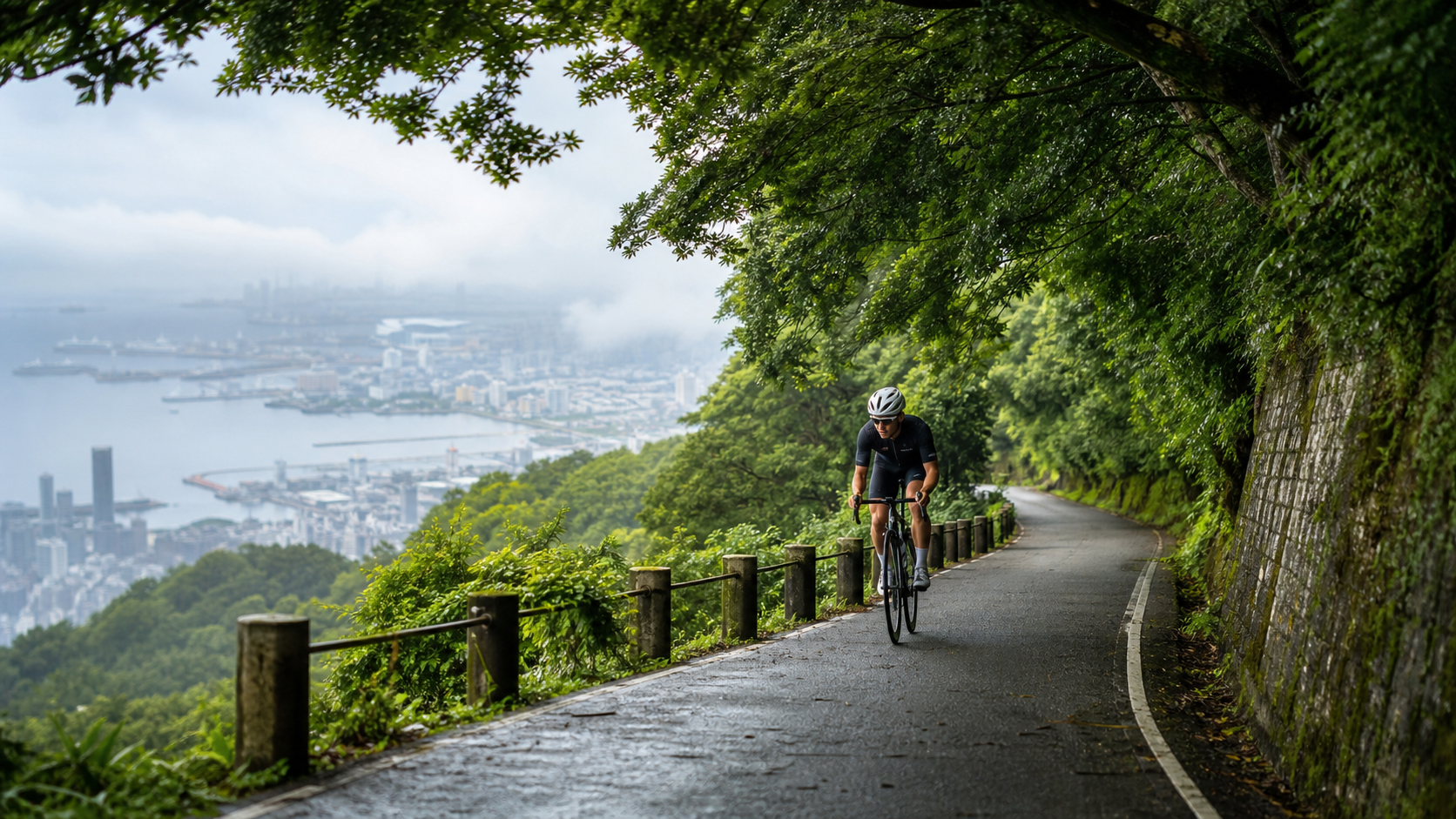
Some mountains you conquer; some mountains you converse with. Mt. Rokko is both.
For anyone who cycles in the Kansai region, the name “Mt. Rokko” carries a complex emotion. It stands directly behind Kobe’s city center, visible the moment you look up, so close it feels like the city’s ceiling. And the Omote Rokko Driveway—this 4.7-kilometer route with 414 meters of elevation gain and an 8.8% average gradient—is the road where countless Kobe cyclists begin their dialogue with this mountain.
It’s not long, just 4.7 kilometers; but it’s steep enough—that 8.8% average gradient makes every breath honest. This piece isn’t about pace charts or gear ratios. It’s about this: when you point your handlebars toward that mountainside and pedal from the clamor of a harbor city all the way into the mist and greenery, what exactly happens within those 4.7 kilometers.
Setting Out from Behind the Port City
Kobe is a city backed by mountains and facing the sea. The sea is its face; Mt. Rokko is its back.
The story of Omote Rokko begins at the foot of the mountain in Nada Ward. You first pass through the city’s edge—residential areas, narrow alleyways, the occasional torii gate of a shrine peeking out—and then the road begins to tilt. It tilts quickly. Even before the official start of the climb, the road leading to the mountain pass reminds you with gradients approaching 20%: this is Rokko, don’t expect an easy ride.
I still remember that first morning. The city was half-asleep, and I was already gasping for air on the slope, sweat dripping from my chin onto the handlebars. Looking back, the outline of Kobe Port slowly unfolded in the morning light, the sea surface shimmering with flecks of gold. In that moment, I understood—Rokko’s most captivating quality is that it lets you suffer while granting you a view of the entire city.
A Century of History as the City’s “Backyard Garden”
Mt. Rokko is no ordinary mountain. It is one of the cradles of modern Japanese mountaineering and outdoor culture.
In the late nineteenth century, foreigners residing in Kobe brought Western mountaineering, summer resort, and golf culture up this mountain. Japan’s first golf course, early villa communities, and summer retreats were all born on Rokko’s ridgeline. To the people of Kobe, Rokko has never been just a mountain—it is a “city’s backyard garden,” a place to escape to and breathe cool air during humid, sweltering summers.
When you ride the paved roads of Omote Rokko, you can feel that the road itself carries a certain quality of “having been well cared for.” It’s smoother, wider, and offers more open views than Rokko’s other routes. This is no coincidence—it’s what a mountain cherished by the people of Kobe for over a century deserves.
As you ride past, you’ll occasionally catch glimpses of old villa rooftops among the trees, weathered stone steps, and old signposts half-swallowed by greenery. These are fragments of the mountain’s memory. You’re not the first person to gasp for air here, and you won’t be the last.
The Middle Section: Entering a Green Tunnel
Past the initial urban fringe, the road turns into the forest, and the world suddenly falls quiet.
This is my favorite section. The gradient remains unforgiving, with 8–11% recurring, but the trees on both sides weave a green tunnel overhead, filtering sunlight into scattered dapples on the ground. The city’s sounds vanish, leaving only the low hum of the chain, your own breathing, and the occasional car slowly passing by.
In that stillness, climbing becomes a deeply personal affair. You start talking to yourself—“Just one more corner,” “Hold through this breath,” “Legs still have it.” This is the most honest and most healing part of climbing: no one can pedal for you, and no one can deceive you. The mountain strips you down to nothing but your most essential self.
Japanese mountain roads throw one switchback after another, each turn like flipping a page. You never know whether the next corner hides a steeper wall or a brief reprieve. That uncertainty is exactly what makes climbing addictive.
The Final Steep Wall, and That Breath Saved for the End
The last third of Omote Rokko is where its true character lies.
Here, the gradient rises without mercy—12% becomes the norm, with local sections surging to 16–17%. This is a pure test of willpower. All the saving, all the restraint from earlier, was for this moment. Your legs burn, your heart pounds like a drum in your ears, and your speed slows to what feels like a standstill.
But it’s precisely in this near-static slowness that you see more—a cluster of wildflowers by the roadside, mist rising from the valley, the sea faintly visible in the distance. When you ride slowly enough, the mountain is willing to hand over its details.
Then, the T-junction at Tenjinyama appears ahead. The gradient finally releases its grip on your throat. You cross that invisible line, ease off the pedals, and it feels like surfacing from water to take a breath.
That feeling of completion is hard to describe. It’s not the flamboyant sense of “winning,” but a quiet satisfaction of having made peace with the mountain. You didn’t conquer it—you were simply granted passage.
The Summit Reward: Cool Breeze, Sea of Clouds, and Something Hot to Drink
Reaching the main ridgeline of Mt. Rokko, the Kansai air suddenly turns crisp. In summer, when it’s over thirty degrees at the base, it’s cool enough up top to need an extra layer; that temperature difference alone is the first reward Rokko gives to climbers.
Along the ridgeline, there are observation decks, shops, and sweeping views overlooking Kobe and Osaka Bay. On clear days, the entire Hanshin Plain spreads out beneath your feet, the bay like a silver mirror; come evening, this is home to Japan’s famous “million-dollar night view”—city lights stretching from the mountain’s foot all the way to the sea, as if someone had poured the entire Milky Way onto the earth.
I usually find a spot at the summit, sit down, sip a hot drink I brought up, and let the sweat slowly dry. No words are needed in that moment. Every bit of effort from those 4.7 kilometers is redeemed in the scenery before your eyes.
Four Seasons of Rokko: Four Different Mountains
- Spring, the city below awakens from winter, and fresh greenery emerges on the mountain—the gentlest climbing season.
- Summer, the city below is humid and unbearable, but this is precisely when Rokko is needed most—it’s Kobe’s refuge from the heat, where a single cool breeze on the mountain can redeem an entire afternoon.
- Autumn, Rokko dons a coat of red and gold, and the cool, dry air turns climbing into pure pleasure—in my mind, Rokko’s most beautiful season.
- Winter, the mountain may see frost or even snow, making the road treacherous, yet it transforms Rokko into a silver-white, tranquil forest belonging to the few.
The same 4.7-kilometer road can give you four completely different moods across the year. That’s why Kobe’s cyclists return here again and again—they’re never climbing just the same mountain.
Side Trip: Turning a Climb into a Full-Day Story
After riding Omote Rokko, don’t rush home. The Mt. Rokko range is well connected—you can descend via Ura Rokko to Arima Onsen, soak in the gold and silver springs to wash away the fatigue, and enjoy the local hot spring cuisine; or follow the ridgeline to explore other viewpoints, stringing the day into a complete Rokko loop.
Or simply descend back to Kobe Port, find a seaside café, sit down, and watch the mountain you just climbed turn red in the sunset—that sense of dislocation, of “suffering at its foot in the morning, now just background scenery by evening,” is the most luxurious romance cycling has to offer.
Epilogue: Why We Keep Coming Back
Omote Rokko is only 4.7 kilometers. As a “climbing route,” it’s so short it barely counts as a warm-up.
But its value has never been about length. It lies in the fact that—it’s right behind the city, reachable at a moment’s notice; it lies in that 8.8% gradient being honest enough to force you face your limits; it lies in that summit view overlooking all of Kobe; it lies in the fact that every ascent, in every season, is a new conversation.
People ask me, after climbing it so many times, what’s left to climb?
I always answer: this mountain is different every time, and the me going up each time is different too.
That, I suppose, is why we keep pointing our handlebars toward Rokko.
Route data: Omote Rokko Driveway, 4.7 km, 414 m elevation gain, 8.8% average gradient, located in Nada Ward, Kobe City, Hyogo Prefecture—the classic frontal route where Kansai cyclists converse with Mt. Rokko.
Between Harbor and Mountain: The Dual Character of Kobe
To truly understand Omote Rokko, you must first understand the city of Kobe.
Kobe is a long, narrow city sandwiched between the sea and the mountains. It’s so narrow that from the coast to the mountain’s foot, sometimes a short walk is all it takes. This unique topography has shaped a distinctive way of life for Kobe’s residents—their daily existence embraces both the openness of the sea and the intimacy of the mountains. In the morning, you can sip coffee by the harbor watching ships; by afternoon, you can ride up Rokko’s slopes. That kind of luxury is something residents of most major cities can hardly dream of.
It’s precisely for this reason that Mt. Rokko has never been a distant mountain requiring a special expedition for the people of Kobe. It’s right there in the backdrop of daily life, visible at a glance, accessible at any time. The reason Omote Rokko is climbed repeatedly by so many Kobe riders is that it’s a place you can immediately escape to “after work, on weekend mornings, or when feeling down.” It’s the city’s pressure-release valve, the shortest passage between citizens and nature.
When you ride Omote Rokko and look back at that city spreading between sea and mountain, you understand why the people of Kobe love this mountain so much—it’s not just scenery; it’s part of their lives, the way this city breathes.
That Earthquake, and a Mountain’s Vigil
When talking about Kobe, the 1995 Great Hanshin Earthquake is unavoidable.
That earthquake devastated Kobe, claimed many lives, and leveled parts of the city. But the people of Kobe persevered, rebuilding the city brick by brick with remarkable resilience. Throughout it all, Mt. Rokko stood silently behind the city, like a steadfast guardian who never wavered.
I know some of Kobe’s veteran riders who say that after the earthquake, climbing Rokko took on a different meaning for them. When you stand on the mountain and look down at this city reborn from the ruins—those relit lights, those streets running again, that harbor brimming with renewed vitality—you’re struck by an indescribable emotion. This mountain witnessed the city’s wounds, and it witnessed its rebirth.
So, for the people of Kobe, every summit of Omote Rokko is not merely conquering a slope—it’s a silent dialogue with the city and its history. You’re not just climbing a mountain; you’re climbing a city’s memory and resilience.
The Million-Dollar Night View: A Gift for Those Who Persevere
If you have the chance to climb Omote Rokko in the evening and stay at the summit until nightfall—then you’ll receive Rokko’s most magnificent gift: the million-dollar night view.
Rokko’s night view, along with Hakodate and Nagasaki, is ranked among Japan’s “Three Great Night Views.” When darkness falls, the lights of the entire Hanshin Plain spread from the mountain’s foot to the sea, thousands upon thousands of lights merging into a dazzling sea of brilliance, the bay’s outline appearing and disappearing within it. It’s a spectacle no photograph can convey—when you’ve just climbed those 4.7 kilometers of steep slopes with your own legs, standing drenched in sweat at the summit, gazing at this sea of city lights shining for you, the emotion strikes you straight in the heart.
I’ve always believed this night view belongs exclusively to “those who persevere to the end.” People who drive up can see it too, of course, but the feeling is absolutely different. Only when you’ve paid the price of that 8.8% gradient, only when your legs still radiate warmth from the effort, does this sea of light feel so hard-earned, so moving.
The hardship of the climb is, in that moment, fully redeemed as brilliance before your eyes. This is Omote Rokko’s most romantic ending.
The People You Meet on the Slope
Having climbed Omote Rokko so many times, I’ve gradually come to realize that the “people” on this slope are just as worth recording as the scenery.
In the early morning, Omote Rokko always has its regulars. There’s the elderly gentleman who treats climbing as his daily ritual after retirement, spinning an easy gear unhurriedly, wearing the calm that only decades of familiarity with a mountain can bring; there’s the office worker who leaves before dawn to squeeze in a ride before work, a dress shirt hidden beneath the jersey, snapping a photo at the summit before rushing down to change; there are groups of students riding together, racing each other up the steep walls, laughing and cheering one another on.
I particularly love that moment on the steep wall when you pass a stranger on a bike. Everyone is too breathless to speak, but when your eyes meet, there’s always a firm nod or a strained smile—a wordless understanding shared only between those who are suffering the same way. “You’re climbing too,” “Yeah, let’s keep going together”—no language needed; a single glance says it all.
Climbing may look solitary, but it’s never lonely. On this slope, there will always be fellow fools who choose to fight gravity with their own legs. And it’s these fools who give a cold, lifeless mountain its warmth.
Once, when I was about to give up on the steep wall, an elderly rider I’d never met slowly passed me, turned his head, and said, “もうすぐやで (Almost there),” before disappearing around the corner. Just that one simple sentence, and it carried me through those final few hundred meters. I never saw that old gentleman again, but I remember those words to this day. That’s the human warmth of the mountain—a chance encounter, offering you just the right word of encouragement at the moment you need it most.
Four Seasons, My Private Memories of Omote Rokko
- Spring blossoms: In April, Kobe’s cherry blossoms bloom. Riding up from the mountain’s foot, you occasionally catch a glimpse of pale pink blossoms peeking over walls. Amid the hardship of climbing, there’s an extra touch of season-limited softness.
- Summer green: In high summer, the city below is as humid as a steam room, but halfway up, once you enter that green tunnel, the coolness beneath the canopy snaps you awake. This is my favorite season to escape up the mountain.
- Autumn red: In November, Rokko’s autumn leaves dye the entire mountainside red, and the cool, dry air turns climbing into pure enjoyment. This is Omote Rokko’s most beautiful and most comfortable time of year.
- Winter stillness: In deep winter, the mountain may see frost or light snow, visitors are scarce, and the whole mountain falls silent except for the wind. This is when Omote Rokko belongs to the few riders undaunted by cold, carrying a solitary beauty—but be sure to ride within your limits and watch for icy roads.
The same 4.7-kilometer slope, climbed countless times across different seasons, has left me with different memories each time. That’s why I never feel it’s “short”—because what it gives me has long surpassed its length.
After the Epilogue: On the “Home Mountain”
Every cycling enthusiast should have a “home mountain” in their heart—a mountain you can escape to anytime without special planning.
For Kobe’s riders, Rokko is that home mountain, and Omote Rokko is the most direct, most honest road to it. It doesn’t require a long expedition; it’s right behind the city, with an 8.8% gradient, ready at any moment to catch all your emotions—whether you want to vent stress, seek solitude for thought, challenge your limits, or simply take in that familiar night view.
I think this is Omote Rokko’s true value. It may not be the longest, the highest, or the most spectacular climb. But it is “home”—the place you return to again and again, and every time you go back, you feel grounded.
May you find your own home mountain. And if you happen to be in Kobe, Omote Rokko is waiting for you.
A Stranger’s Rokko: A Taiwanese Rider’s Perspective
I came to climb Rokko carrying the climbing memories of Taiwan.
In Taiwan, we have Wuling for its magnificent high-altitude endurance rides, Yangmingshan and Fengguizui as urban-suburban training climbs, and the Beiyi Highway as a classic road route. These mountains raised my legs and shaped my imagination of climbing. So when I first stood at the foot of Omote Rokko’s slope, I was actually a little unconvinced—just 4.7 kilometers, how hard could it be?
Then that 17% steep wall gave me a proper lesson.
But what truly struck me wasn’t how steep the slope was—it was the relationship between this mountain and this city. In Taiwan, the mountains we climb are mostly a distance from the city center; climbing is often an “expedition” that requires planning. In Kobe, the mountain sits directly behind the city, so close it feels within arm’s reach. This intimacy of “zero distance between city and mountain” is something I rarely experience in Taiwan. How fortunate the people of Kobe are, to have a home mountain they can reach at a moment’s notice.
Climbing a slope in a foreign land, I often think of Taiwan’s mountains. I think of the sea of clouds above Wuling, the damp cold morning mist of Fengguizui, every familiar corner on the Beiyi Highway. It turns out that no matter where you climb, that core of “conversing with yourself, conversing with the mountain” is universal. Gravity is just as fair in Kobe as it is in Nantou, and sweat is just as salty abroad as it is at home.
This, perhaps, is the most beautiful thing about cycling—it takes you to faraway places, yet always brings you back to the most familiar corner of your heart. Having climbed Omote Rokko, I miss Taiwan’s mountains even more; and carrying that longing for home’s mountains while climbing foreign slopes gives those slopes a different warmth.
If you’re also a Taiwanese rider and get the chance to visit Kobe, you must climb Omote Rokko once. Not for times, but to experience the intimacy between another city and its home mountain—an intimacy we may have once had but never fully cherished. After the climb, you might, like me, come to better appreciate loving the mountains of Taiwan that have always stood watch over us.
After all, mountains know no borders. Those who love mountains can find their way home anywhere.
A Final Note: A Letter to My Future Self
I’d like to end this piece about Omote Rokko with something a bit more personal.
If, many years from now, I can still ride, I hope I’ll come back to climb Omote Rokko once more. Perhaps by then my legs won’t be as strong as they are now, perhaps that 17% steep wall will make me climb slower and more breathless than ever. But I believe that when I once again stand on that summit overlooking all of Kobe, gazing at that familiar city and bay, the emotion in my heart won’t be one bit less.
Because climbing has never been about “speed.” It’s about “whether you’re still willing to hit the road.” As long as you’re still willing to throw a leg over the bike, still willing to face that slope, still willing to sweat for the view at the top—then you’re still young, still in love with this world.
What Omote Rokko ultimately taught me is this: What matters isn’t how fast you climb, but whether you keep climbing. Life is the same. We all encounter our own steep walls, those moments when we can’t see the top and just want to give up. But as long as you remember the wisdom of climbing—hold back your ambition in the early stages, keep your breathing rhythm steady, keep your gaze close, and push forward corner by corner—no wall is truly insurmountable.
May we all, on every slope life puts before us, keep riding this way—steady, unhurried, yet never stopping. And when we finally reach the summit and look back at the winding road behind us, we’ll be deeply grateful to the self who, at the moment of wanting to give up most, chose to pedal one more time.
The mountains of Kobe will remember everyone who has sweated for them. And you, too, will become a warm page in this mountain’s long story.
Related Reading
- Riding Around to the Mountain’s Back: 7.7 Kilometers of Ura Rokko, Hydrangeas, Deep Forest, and a Thousand-Year Hot Spring
- Omote Rokko Driveway Complete Guide: Segment Pacing, Gear Ratios, and Steep Wall Strategy for 4.7 km at 8.8% Average Gradient
- Ura Rokko Guide: Endurance Pacing, Gear Ratios, and Using the 100-Meter Markers for 7.7 km at 6.5% Average Gradient
- A Kanto Rider’s Rite of Passage: Yabitsu Pass, a Sacred Ground That Measures Your Fighting Spirit
2024 如來神掌 百人約騎挑戰!feat. 秘境單車社團 / 神人們太可怕 / 全程錄影 x 完整坡度解析 / 公路車 / CT Yeh
2 年前
台北闊瀨陡坡 騎旅 / 日本單車雜誌編輯車友臨時加入!/ 髮香才是最強的 / feat. 北迴歸線小隊 / 公路車 CT Yeh
6 個月前
大武山後門26%歡樂陡坡!JJSC南台灣單車行Day2 / 被颱風追著跑 / 公路車 / CT Yeh
2 年前
2025 乘鞍 KOM 登山賽挑戰實錄 / 日本公路最高 ! 賽前探路篇 / 比富士山厲害,無敵絕景!/ 40週年 / 中文YT首發 / 公路車 / CT Yeh #乘鞍ヒルクライム
11 個月前
水金九不厭五分 10度寒流冷到不願停!feat. 卡卡 / 公路車 / CT Yeh
6 個月前
嘉義大埔、阿婆灣挑戰賽,美到以為在日本!ft. 環騎5 Cool 西拉雅188 / 公路車 / CT Yeh
7 個月前
司馬庫斯 | 單車員工旅遊 | 比武嶺還接近上帝的路 | 2021 全面實況 路況解析 | 空拍 櫻花炸開超濃密 | 財伯觀光果園 | CT Yeh
5 年前
阿里山塔塔加 兩倍特濃版!全新隧道開通! 進喔!公路車 | CT Yeh
3 年前