A Volcanic Road Opened 1,300 Years Ago: Hot Springs, Legends, and Wild Riding at Nasu-Tōge no Chaya
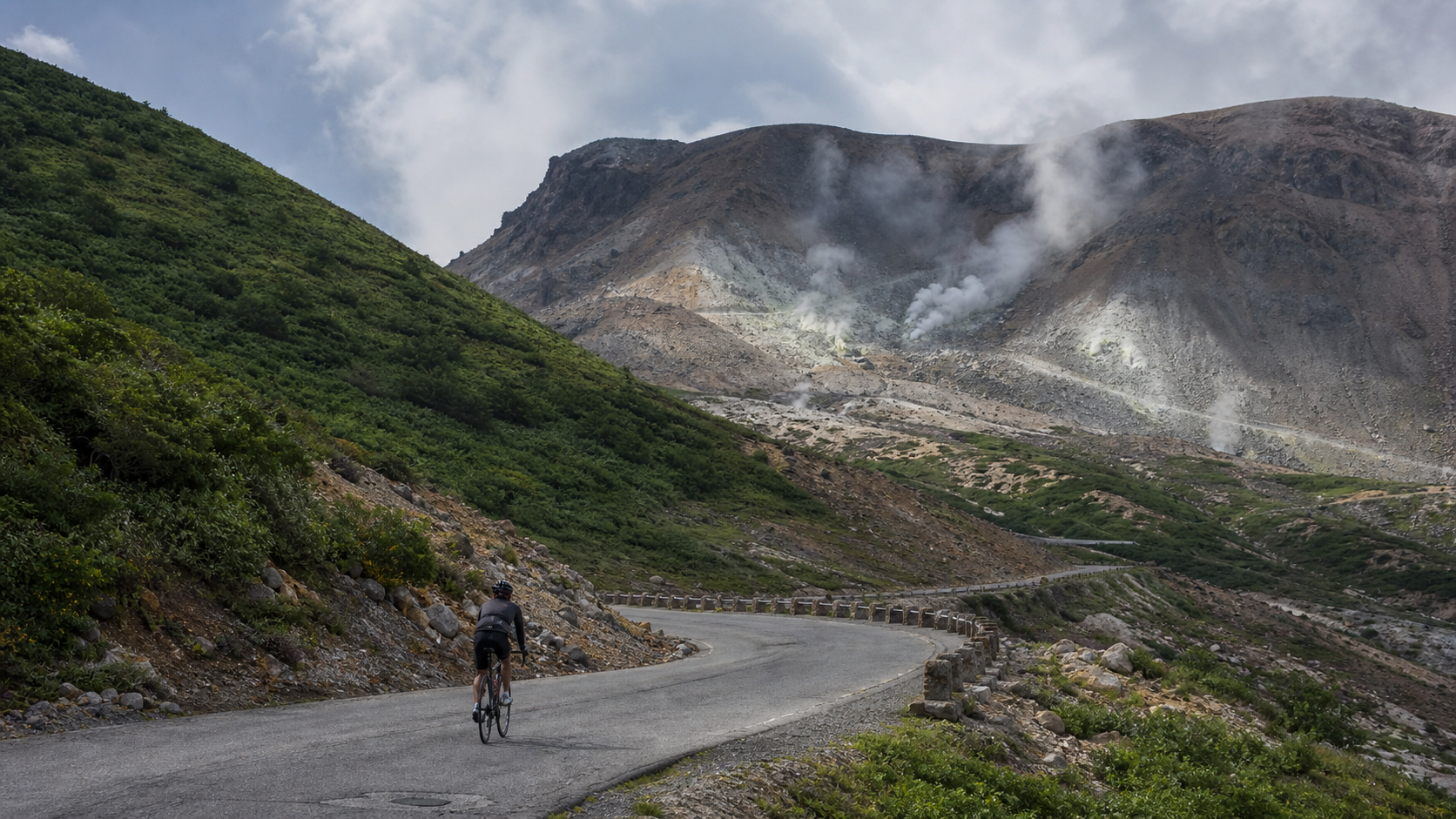
A Volcanic Road with 1,300 Years of Hot-Spring History: My Climbing Pilgrimage on the Nasu Highlands
Some routes you forget after riding them; others you remember for a lifetime. Nasu-Tōge no Chaya belongs to the latter. Not because it’s particularly hard—at 20.5 km in total length, roughly 995 m of climbing, and an average gradient of just 3.2%, the numbers are even mild—but because it unfolds like a slowly playing film, carrying you from the wispy white steam of a hot-spring town all the way up into the volcanic wilderness of Mount Nasu, finally ending at Tōge no Chaya at an elevation of about 1,462 m, where, amid the sulfur and cold wind, you experience a stillness that borders on the sacred.
This piece isn’t about power numbers or gear ratios. I want to take you into the land behind this route—the 1,300-year history of hot springs on the Nasu Highlands, the legend of the nine-tailed fox, the forest receding along the volcanic road, and the slow dialogue a rider carries on with this land between pedal strokes.
The Nasu Highlands taught me one thing: climbing isn’t just about conquering elevation—it’s about passing through a narrative of time and geology. Every turn of the pedals takes you toward something older, more primal.
Why Nasu? A Highlands Cherished by Time
Before writing about this route, I kept wondering: with so many climbing routes in Japan, why is Nasu-Tōge no Chaya worth a dedicated trip? The answer lies in the depth of time carried by the two characters “那須” (Nasu).
The Nasu Highlands aren’t one of those overnight internet-famous scenic spots; it’s a highland slowly cherished by time, with layers upon layers of character built up over the ages. With over 1,300 years of hot-spring history, the tradition of soaking, recuperating, and escaping the summer heat on this land predates the histories of many nations. Generations of imperial families, literati, and travelers have left their footprints here, while Mount Nasu, an active volcano, has been quietly shaping everything on a far more distant geological timescale—the hot springs, the terrain, the vegetation, and even the volcanic road that captivates riders.
When you climb this route, you’re simultaneously crossing two timescales: one is human, the millennia-old history of hot-spring faith; the other is geological, the tens-of-thousands-of-years saga of volcanic evolution. This dual depth of time is the most unique gift the Nasu Highlands offer a rider. You’re not just exercising—you’re drawing your own line with your tires across a living, breathing scroll written jointly by a volcano and by people.
A Gentle Slope Reaching Out from Tokyo
From Tokyo, the Tōhoku Shinkansen takes you to Nasushiobara in about 70 minutes. This contrast—metropolis and highlands separated by just a single rail line—is one of the most enchanting things about the Nasu Highlands. You might be in Tokyo’s concrete jungle in the morning, and by afternoon, your tires are already on a prefectural road leading up to an active volcano.
The Nasu Highlands have long been a renowned highland resort. With a hot-spring history exceeding 1,300 years and the “Nasu Seven Hot Springs” group, it has been a favored summer retreat for Japan’s imperial family and cultured elites since ancient times. When you set off from the lower-elevation resort area, those seemingly gentle climbs in the early section are actually setting the stage for you—setting the stage for a journey of volcano, faith, and wilderness.
The gentle forest slope of the first 5 km is the most “tender” part of this route. Dense woods and scattered vacation villas line both sides, with sunlight filtering through the branches to cast dappled shadows. I always like to deliberately slow down on this stretch, letting myself shift from the city’s rhythm to the highlands’ rhythm. The air here is sweet, carrying the dampness of the forest and the scent of grass and trees.
The Morning Before Departure: The Moment the Highlands Awaken
I love setting out in the early morning most of all. The Nasu Highlands have a special stillness in the morning—the mist hasn’t lifted yet, the forest air is cold and crisp, and the silhouette of Mount Nasu flickers in and out of view in the dawn light. Wheeling your bike out the door at such a moment, you feel as if the entire highland is still asleep, and you are the first person to set foot on this volcanic road.
The morning chill makes warming up essential. I usually deliberately take it slow on the early forest slope, letting my body gradually warm up while my eyes and mind awaken as well. When the first rays of sunlight pierce the treetops and spill onto the damp pavement, that feeling of being gently roused by nature is something no indoor trainer can give you.
It’s also on such mornings that I often meet other early-rising riders near the start. We nod to each other in greeting—no words needed, a glance says it all: we’re all here for the same mountain, the same volcanic road. This silent camaraderie is one of the most moving parts of cycling culture.
Nasu-Yumoto: White Steam, Sulfur, and the Legend of the Nine-Tailed Fox
Around the 5 km mark, you enter Nasu-Yumoto Onsen. This is the most “human” spot on the entire route—white steam rises from the hot-spring streets, the air carries the smell of sulfur, and shops and bathhouses line the way.
There are two landmarks here you need to know.
The first is Kano-no-Yu. It’s one of the symbols of the Nasu hot springs, with its origins said to date back to the era of Emperor Jomei, around 630 AD. Imagine this: when your carbon-fiber road bike comes to a stop in front of this thousand-year-old bathhouse, a profound sense of time suddenly washes over you. You’re riding the most cutting-edge machinery, yet standing within a hot-spring history that spans more than a millennium.
The second is Sesshōseki (Killing Stone). It’s a barren field of sulfurous steam vents where nothing grows, filled with a faint volcanic odor. Behind it lies a famous legend—the story of the nine-tailed fox. According to the tale, a nine-tailed fox spirit that had taken the form of a beautiful woman named “Tamamo-no-Mae” was exposed, fled to the Nasu Plain, and ultimately transformed into a “Killing Stone” that released poisonous gas, killing any living thing that came near. Standing before this wasteland, with the smell of sulfur interwoven with the atmosphere of legend, you feel that this land holds some ancient, mysterious power.
Stop at Sesshōseki, turn off your bike computer, and take a deep breath of sulfur-laced air. You’ll suddenly understand that climbing on the Nasu Highlands was never just exercise—it’s a journey through legend and geology.
From Forest to Wilderness: The Dramatic Transition of the Volcanic Road
Past Nasu-Yumoto, the route’s character begins to change. This Tochigi Prefectural Route 17, the “Nasu Kōgen Line,” has a more imposing old name—Volcano Highway (ボルケーノハイウェイ). That name isn’t a romantic metaphor; it’s precise realism.
As the elevation climbs higher, you witness a slow transition firsthand: the dense forest gradually thins, the trees grow shorter and sparser, replaced by exposed rock, barren slopes, and the volcanic landscape of Mount Nasu (Chausu-dake). Mount Nasu is an active volcano, and its presence becomes utterly real on this stretch—you can see its outline, smell the stronger sulfur, and feel the near-lunar desolation above the treeline.
After Daimaru Onsen, the gradient begins to climb relentlessly—this is the steepest, most punishing section of the entire route. But curiously, the harder the effort, the more breathtaking the scenery. When your legs are burning and your breath is ragged, yet before you lies an open, almost lonely volcanic wilderness, the stark contrast between physical suffering and visual grandeur becomes strangely addictive. This area also has the Nasu Ropeway, carrying hikers up toward Chausu-dake.
I’ll never forget the feeling of riding this section for the first time: the world seemed to shrink to just me, my breathing, and this road winding across the volcanic landscape. That solitude wasn’t loneliness—it was an amplified sense of existence.
Mount Nasu: A Mountain Still Breathing
Mount Nasu deserves a few extra words. Mount Nasu (main peak Chausu-dake) is an active volcano, and that word “active” is the key to understanding the soul of this route. It isn’t a dormant, dead mountain—it’s a living entity that is still active, still venting geothermal steam.
When you ride the volcanic road, see the exposed rock on the slopes, smell the sulfur in the air, and glimpse the white steam rising from fumaroles in the distance, you realize: you are riding on the flank of a live volcano. This feeling is hard to put into words—it’s both magnificent and tinged with awe. Human civilization seems so small and fleeting in the face of this mountain; and yet, by the strength of your own legs, you’re climbing step by step toward its trailhead—that in itself is an act full of tension.
Mount Nasu is served by the Nasu Ropeway, which carries hikers up near Chausu-dake. As you labor up the climb, you might see the ropeway cars moving slowly overhead, carrying another group of people who want to get close to this active volcano. Riders use sweat, hikers use footsteps, the ropeway uses steel cables—different people approach this mountain in different ways. This image of “different paths, same destination” is also part of what makes Mount Nasu so appealing.
Tōge no Chaya: Standing at the 1,462-Meter Trailhead
Finally, you arrive at Tōge no Chaya, at an elevation of approximately 1,462 meters — the trailhead for Mount Nasu. As you stop your bike, legs still trembling, the cold wind hitting your face, you’ll immediately understand why seasoned riders always warn you: “You must bring a thermal layer.”
The Tōge no Chaya area is the starting point for hikers and the finish line for cyclists. Looking back at the road you’ve climbed, the Volcano Highway hangs sinuously across the volcanic slope, with layered mountain ranges and highlands stretching into the distance. You’ve just carried yourself on your own legs from the hot-spring town all the way to the doorstep of an active volcano.
Standing at Tōge no Chaya, I often think: hikers begin their journey here, and I end mine here. The same spot is where two different challenges converge. This image of “one person’s finish is another’s start” gives this place a special sense of ritual.
Seasonal Scenery Along the Way
The Nasu Highlands are a stage that changes its costume with the seasons. Riding here at different times of year offers completely different experiences.
- Early Summer (May–June): Fresh greenery is at its peak, the forest sections are impossibly lush, and the highland air is crisp — the most comfortable riding season.
- Midsummer (July–August): It’s hot at the base, but the temperature drops as you gain elevation, making the Tōge no Chaya area a natural summer retreat. This is also the liveliest time for the Nasu Highlands as a resort destination.
- Autumn (mid-to-late October): This is the Nasu Highlands’ golden moment. Volcanic wasteland paired with mountains of crimson maple leaves — the sight of autumn foliage coexisting with sulfurous barren land is a spectacle you won’t see anywhere else. But this is also the season when temperatures begin to plummet, making a thermal layer absolutely essential.
- Winter: The road to Mount Nasu may be closed due to snow accumulation, marking the season’s end for this route.
Local Culture and Side-Trip Suggestions
The Nasu Highlands aren’t just a climbing route — they’re an entire resort area worth exploring slowly. After your ride, consider turning it into a two-day, one-night mini getaway.
Hot Springs: Since you’ve arrived at the hot-spring town home to the “Nasu Seven Hot Springs,” a soak is a must. The hot springs around Nasu-Yumoto wash away the fatigue of the climb in a pool of warm water — the perfect ending to this journey. (There are many specific bathhouses; it’s best to choose on-site based on daily operating conditions.)
Highland Strolling: The Nasu Highlands offer farms, art museums, amusement facilities, and forest trails, suitable for families or non-cyclist companions. This also makes it one of the few destinations where “one person rides while the whole family plays” can all be accommodated.
Side Trip to Mount Nasu: If you have energy and time to spare, park at Tōge no Chaya, take the Nasu Ropeway or hike up Mount Chausu, and gaze down over the entire highland from the crater rim. Riding up by bike and summiting on foot is the complete way to experience this active volcano.
Long Ride Culture: The Nasu Highlands also host Long Ride–type cycling events that attract riders from all over. With its varied routes and rich layers of scenery, it’s an excellent base for planning long-distance rides.
The Afterglow After Descending: Let Body and Mind Settle Together
The story of a climb doesn’t end the moment you reach Tōge no Chaya. What truly completes the journey is the afterglow that follows the descent.
As I carefully glide back down from the volcanic wasteland to Nasu-Yumoto, my body temperature gradually warming from the mountain-top chill, that feeling of “returning to civilization” is subtle and strange. The steam rising from the hot-spring streets, the lights of the shops, the aroma of food in the air — everything seems more vivid than when I set out — as if my senses, stripped clean on the volcanic wasteland, now perceive the warmth of human life more deeply.
I’ll find a hot spring and let the warm water envelop my aching legs. In that moment of soaking, the fatigue of the climb, the pain of the final stretch, and the solitude of the summit all dissolve into this pool of water nourished by Mount Nasu’s geothermal heat. It’s an experience where body and mind are healed simultaneously. You’ll find yourself replaying every scene from the day’s volcanic highway while feeling a grounded sense of satisfaction.
A complete Nasu climb is the sum of three things: “climbing up + coming down safely + soaking in a hot spring.” Without that final touch of hot-spring afterglow, this route’s story would lack its gentlest ending.
Side Trips and Lodging: Turn It Into a Slow Journey
If time permits, I strongly recommend against making it a day trip. Instead, stay a night in the Nasu Highlands and turn this ride into a slow journey.
Lodging: The Nasu Highlands offer accommodations of every type, from hot-spring inns to highland resort lodgings. Staying overnight, you can truly experience the highland’s changing expressions from dawn to dusk — the evening glow, the starry night sky, the morning mist. (There are many specific lodgings; it’s best to search and book in advance based on season and budget.)
Suggested Itinerary:
- The Day Before Riding: After arriving, take an easy ride through the lower-elevation areas of the highland, visiting farms or art museums to let your body acclimate to the altitude.
- Ride Day: Tackle the Volcano Highway in the early morning, reach the summit before noon, and soak in a hot spring in the afternoon to rest.
- The Day After Riding: Take the Nasu Ropeway up Mount Chausu and gaze over the entire highland from the crater rim, bringing the journey to a magnificent close.
This rhythm turns Nasu–Tōge no Chaya from a gritted-teeth challenge into a highland vacation you can savor.
What This Route Means to a Cyclist
After riding many climbs, I’ve come to realize: the routes that truly stay with you aren’t necessarily the steepest or the most painful — they’re the ones that “tell a story.” Nasu–Tōge no Chaya is exactly that.
Over 20.5 kilometers, it arranges a complete narrative arc for you: starting from a forested resort area on the edge of civilization, passing through thirteen hundred years of hot-spring history and the legend of the nine-tailed fox, climbing into the wasteland of an active volcano, and finally stopping at the 1,462-meter trailhead. The gentle early slopes let you relax and settle; the mid-section’s hot-spring town lets you converse with history; the final volcanic ramps let you receive magnificence through pain.
For me, Nasu–Tōge no Chaya is not a route to be “conquered” but a route to be “experienced.” You’re not here to defeat it — you’re here to let it carry you through a stretch of time, a stretch of geology, a stretch of legend.
The Nasu Seven Hot Springs: A Geology Lesson in Hot Water
If you’re willing to take the time to understand, the hot springs of the Nasu Highlands are themselves a vivid geology lesson. Here you’ll find the “Nasu Seven Hot Springs” — a series of springs nourished by the active volcano Mount Nasu, each with its own distinct water quality, color, and temperature. As you ride past Nasu-Yumoto and catch the sulfurous smell in the air, you’re actually breathing evidence of the geothermal energy beneath Mount Nasu.
Volcano, hot springs, and climbing — these three are inseparable in the Nasu Highlands. Mount Nasu’s geothermal heat created the thousand-year-old springs, the volcano’s magma-formed terrain created the Volcano Highway, and the cyclist’s legs string all three together into a single journey. When you see white smoke rising from the valley in the distance during your climb, that’s not a cloud — that’s geothermal steam, proof that this active volcano is still breathing.
I love the moment after the ride, when I sink into a hot spring, to imagine the workings of the land beneath my feet: rainwater seeping into the volcanic rock layers, heated by geothermal energy, then surging back to the surface as the pool of warm water that washes away my fatigue. This sense of connection to geology is something you can never experience in the city.
A One-Man Volcanic Highway: On Solitude and Focus
The latter section of this route is often sparsely populated. The closer you get to Tōge no Chaya, the fewer fellow riders and vehicles you encounter, until it’s just you and this road winding across the volcanic slope. For some, this solitude might be daunting; but for me, it’s precisely the most precious part of Nasu–Tōge no Chaya.
On the stretch where the forest recedes and the wasteland opens up, I often enter a peculiar state of focus. No traffic to contend with, no urban noise — only the sound of breathing, the whir of the chain, and the wind sweeping across the volcanic wasteland. My legs turn in a steady rhythm while my thoughts become remarkably clear. Many things I couldn’t work through in daily life find their answers during this solitary climb.
Some say climbing is a conversation with yourself. On the volcanic wasteland of Nasu–Tōge no Chaya, that saying becomes profoundly true. There’s no audience here, no applause — just you and this active volcano, and the reason you set out in the first place.
This experience of “a one-man volcanic highway” makes Nasu–Tōge no Chaya more than just a cycling route — it’s like a moving meditation. When you turn off your bike computer and set aside your performance mindset, you’ll discover that what this route gives you is far more than a number.
From Sesshōseki to Tōge no Chaya: A Road Paved by Legend
Looking back, the narrative of this route is actually strung together by a series of legends and history.
It starts from a hot spring town with 1,300 years of history, passes through Kano-yu, which dates back to the era of Emperor Shōmu around 630 AD, crosses the wasteland of Sesshōseki carrying the legend of the nine-tailed fox, and finally ends at Tōge no Chaya at the trailhead of Mount Nasu. Along the way, you’re not just gaining elevation—you’re traveling deeper into time: from contemporary resort villas, back to medieval hot spring faith, and further back to the primordial wasteland at the dawn of volcanic formation.
The Japanese have a special affection for “tōge” (mountain passes). A tōge is the boundary between two places, a checkpoint for travelers to cross, and since ancient times, teahouses have stood there for wayfarers to rest. The name Tōge no Chaya itself carries this imagery of a midway stop, a place of rest and transition on a journey. When you arrive here, you are literally stepping onto the same ground where countless ancients paused to rest while crossing mountains. This connection to historical travel gives the finish line an extra layer of depth.
Nasu Highlands for Non-Riding Companions
What makes the Nasu Highlands special is that it’s one of the few destinations where “riders get their fill, and family can have fun too.” If your travel companion doesn’t ride, they won’t be bored here at all.
The Nasu Highlands area has ranches where you can get close to animals, art museums and various themed facilities, forest trails for hiking, and hot springs for relaxation. While you’re sweating it out on the Volcano Highway, your family can spend a leisurely day on the highlands, then reunite for a soak and a meal in the evening. This travel model of “each takes what they need, reunite at dusk” makes the Nasu Highlands the top choice for many riding families.
It’s precisely for this reason that in my mind, this route has never been just a “training route,” but a highland getaway to be shared with loved ones—I just happen to have chosen cycling as the way to get to know this land’s most primal and magnificent side.
For Those Preparing to Go
If you’re planning to add this route to your riding list, here are a few words from the heart:
- Slow down: The value of this route lies not in the numbers on your cycling computer, but in every transition along the way. Pause before Sesshōseki, take a look at Mount Nasu where the forest recedes, and look back at the road you’ve traveled from Tōge no Chaya.
- Bring enough warm layers: The temperature difference between the summit and the base is a real challenge—don’t let hypothermia ruin your beautiful ending.
- Leave time for a hot spring: Since you’ve come to a thousand-year-old hot spring town, leaving without a soak would be a shame.
- Choose the right season: The fresh green of early summer, the coolness of midsummer, and the autumn foliage each have their own charm.
The Nasu Highlands will repay every rider willing to ride slowly and look slowly with its hot spring steam, volcanic wasteland, and thousand-year legends. The moment you stand at Tōge no Chaya, surrounded by cold wind and awed by the wasteland, you’ll understand—this climb was worth it.
Related Reading
- Nasu–Tōge no Chaya Guide: Full Breakdown of Pacing and Gear Ratios on the 20.5 km Volcanic Highway
- The Coming-of-Age Ritual for Kanto Riders: Yabitsu Pass, a Sacred Ground That Measures Your Fighting Spirit
- Riding Above the Three Great Springs of Japan: Tour de Kusatsu-Shirane, a Hot Spring Journey from Yubatake’s Steam to the Snowy Highlands
- The Sacred Mountain That Awakens Only in Summer: A Ride Up Mount Norikura, a Dialogue to the Clouds at 2,720 Meters
台北闊瀨陡坡 騎旅 / 日本單車雜誌編輯車友臨時加入!/ 髮香才是最強的 / feat. 北迴歸線小隊 / 公路車 CT Yeh
6 個月前
阿里山塔塔加 兩倍特濃版!全新隧道開通! 進喔!公路車 | CT Yeh
3 年前
京都!99%人不知道的秘境玩法!租 E-Bike 騎進探訪宇治抹茶原鄉 刺激好玩絕美的山林古道 鬼滅之刃的場景探訪 / CT Yeh
12 天前
那瑪夏x茶山 阿里山系深山單車行 Day2 累積爬升6000M | 🥶超陡連續下坡 整路看隊友刷 | 爬升一座西進武嶺 | JJSC | 公路車 | CT Yeh
3 年前
半日 小台灣 極限單車路線挑戰實錄
7 年前
2025 乘鞍 KOM 登山賽挑戰實錄 / 日本公路最高 ! 賽前探路篇 / 比富士山厲害,無敵絕景!/ 40週年 / 中文YT首發 / 公路車 / CT Yeh #乘鞍ヒルクライム
10 個月前
大武山20%魔王陡坡【JJSC南台灣遊騎Day2】!屁股真的要裂開了...凡士林抹滿也沒用?神秘金教堂還有超便宜夜市
3 個月前
水金九不厭五分 10度寒流冷到不願停!feat. 卡卡 / 公路車 / CT Yeh
6 個月前