Riding into the Embrace of the Jōmō Three Mountains: The Story of Mount Haruna HaruHiru, Lake Haruna, and That Bowl of Mizusawa Udon
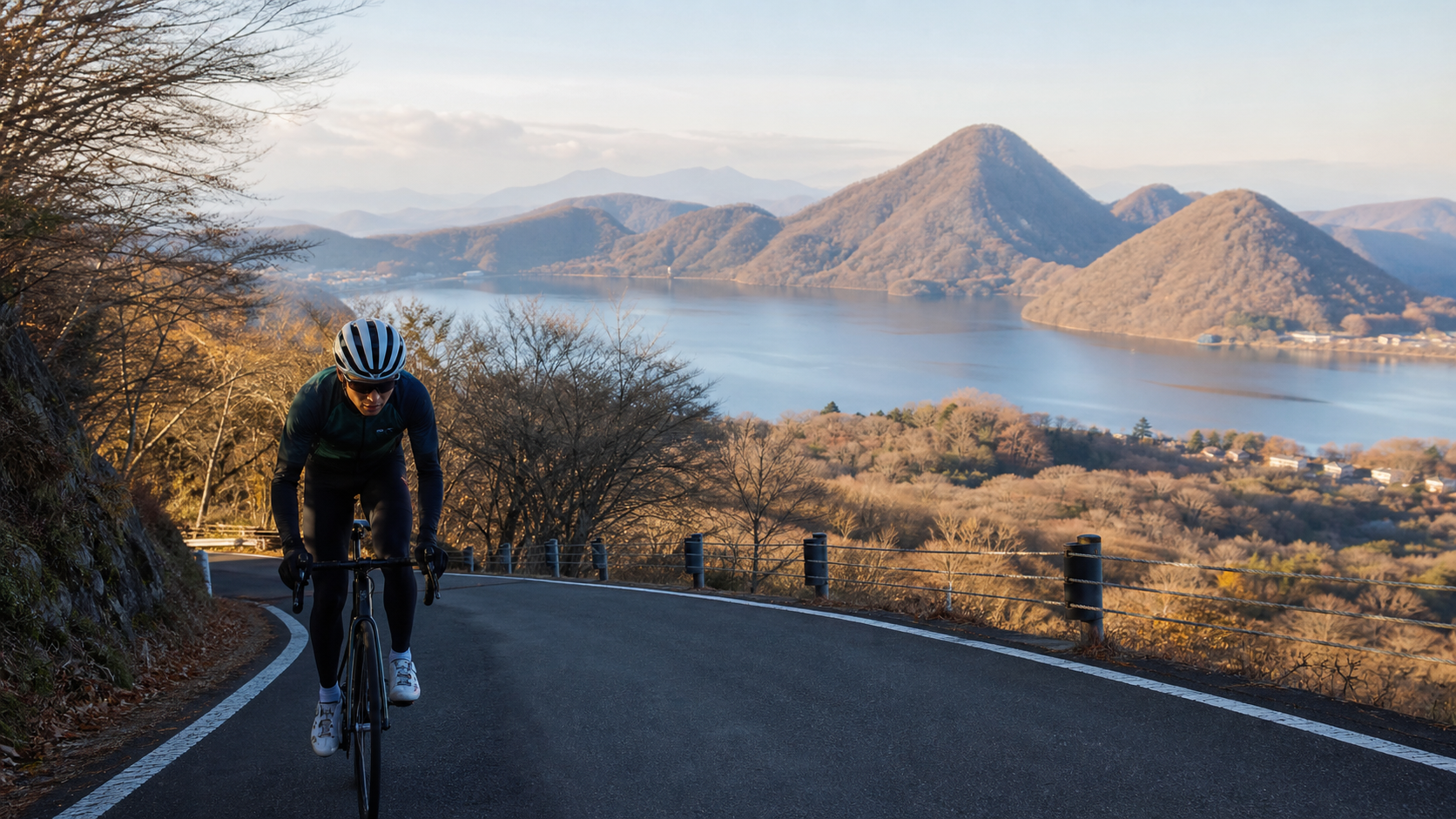
The night before departure, I bought two rice balls at a convenience store in Takasaki City. Standing at the store entrance, I watched the distant mountain silhouette gradually fade into the twilight. That was Mount Haruna—one of the “Jōmō Three Mountains” as the people of Gunma call it, and the opponent I would measure myself against with my legs the next day. On the map, starting from the Takasaki City Haruna Branch Office, the route climbs all the way to Lake Haruna at an elevation of about 1,100 meters. This HaruHiru Lake Haruna course stretches approximately 14.7 to 16.1 kilometers with a total elevation gain of about 907 meters and an average gradient of 6.0%, and hidden within it is a tough stretch of 4.7 kilometers with an average gradient of a full 10.0%. I had long since memorized the numbers, but what truly brought me here by train from Tokyo was never these figures.
It was the mountain itself. The steam of the hot springs within the mountain, the wind across the lake, and a legendary bowl of udon noodles.
The Jōmō Three Mountains: The Three Pillars in the Hearts of Gunma’s People
In Gunma, you can hardly look up without seeing mountains. Akagi, Myōgi, and Haruna—these three renowned peaks, collectively known as the “Jōmō Three Mountains,” are scenery that nearly every child in Gunma grows up singing about, drawing, and gazing at from afar. They are not merely geographical markers; they are like three stabilizing pillars of this land, holding up the entire skyline of the Jōshū Plain.
Among them, Mount Haruna has the softest contours and the most “story.” It is not a single peak but an entire volcanic group, with a quiet crater lake resting at its center—Lake Haruna. This lake sits at an elevation of about 1,100 meters, embraced by surrounding peaks, its surface reflecting the elegantly shaped volcanic cone affectionately nicknamed “Haruna Fuji.” When I finally rode to the lakeshore, leaned my bike against the railing, and gasped for air, I understood why the Japanese would build a road all the way up this high for the sake of a lake.
Some mountains are meant to be conquered, and some are meant to be embraced. Mount Haruna is both—it earns your respect with a 10% steep slope, then earns your forgiveness with a tranquil lake.
From Town to Forest: A Slope That Sews Two Worlds Together
Anyone who has ridden the HaruHiru knows that the most captivating thing about this road is how it sews two completely different worlds together with a single climb.
Around the starting point near the Takasaki City Haruna Branch Office, the scenery is still ordinary suburbia: houses, fields, and the occasional small truck passing by. You warm up here, steady your breathing, your legs still fresh and your mood still light. But as the gradient climbs section by section, the houses grow fewer, the trees more numerous, and the air cooler—you can clearly feel yourself “leaving the human world and climbing into the mountains.”
And that 4.7-kilometer stretch at 10% is the watershed of this journey. It appears when your legs are already a bit sore but not yet truly exhausted, like a question the mountain poses to you. I remember on that slope, I could only stare at my front wheel, listening to my own increasingly heavy breathing, shrinking the entire world down to the few meters of asphalt before me. Just as I felt I couldn’t hold on any longer, a mountain wind rushed down through the treetops, sending a chill through me—it was the mountain saying to me: “Almost there, don’t stop.”
Mizusawa Udon: The Gentle Strike of Japan’s Three Great Udon Noodles
If you think a trip to Mount Haruna is only about sweat, then you’ve missed its gentlest part. Along this route lies the “Mizusawa Udon Street,” home to a bowl of deliciousness capable of soothing every ache.
Mizusawa Udon is one of the “Three Great Udon Noodles of Japan,” alongside Akita’s Inaniwa Udon and Kagawa’s Sanuki Udon. This is no tourist gimmick but a craft passed down for centuries. The noodles are prized for their springy, translucent texture, said to be inseparable from the region’s excellent water and climate—after all, a place that can nurture such a mountain and such a lake seems naturally destined to produce a fine bowl of noodles.
I planned my descent after summiting as a reward journey “with noodles as the destination.” When a bowl of chilled Mizusawa Udon was set before me, the noodles gleaming with an almost translucent sheen under the light, dipped into a refreshing sauce and sliding into my stomach emptied by the climb—in that moment, I was nearly ready to forgive everything that 10% slope had done to me.
Everyone who climbs knows one thing: the view from the summit is certainly beautiful, but what truly makes you want to return the following year is often that steaming hot—or refreshingly cold—reward at the foot of the mountain. Mizusawa’s udon is a love letter from Mount Haruna to weary riders.
Ikaho Onsen: The 365 Steps of Stone Step Street
Another signature of Mount Haruna is the Ikaho Onsen at its foot. This is a hot spring town with a unique character, its most famous landmark being the “Stone Step Street” that ascends the hillside layer by layer—an entire hot spring shopping street built of stone stairs, flanked by long-established inns, souvenir shops, and small amusement stalls, where rising steam interweaves with the nostalgic atmosphere of the Shōwa era.
For a rider who has just climbed a mountain with legs like lead, what could be a more healing finale than soaking in a hot spring? I secured my bike, slowly walked up Stone Step Street, letting each stone step remind me of what my legs had accomplished that day. As the hot spring water seeped into my aching muscles, that sensation of unwinding turned all the gritted teeth of the day into a sweetness tinged with pride.
The presence of Ikaho Onsen gives the Mount Haruna journey a perfect “introduction, development, turn, and conclusion”: setting off from the town (introduction), the trial of the steep slope (development), the stunning lake view (turn), and the hot spring reward (conclusion). This is a road that knows how to care for a rider’s body and mind.
That Lake, and the Wind of May
When I actually reached Lake Haruna, there was no fireworks or cheering as I had imagined. Only the wind, and a lake so quiet it felt almost sacred.
Lake Haruna sits within the volcanic crater, its waters reflecting the sky and the nearby Haruna Fuji, like a mirror carefully tucked away among the peaks. The fatigue of the summit push and the self-doubt during the climb suddenly seemed small and distant in the face of this stillness. I sat by the lake, took out the remaining rice ball, and ate it slowly, bite by bite, watching the wind trace fine ripples across the water’s surface.
Every spring, especially around May, this place welcomes its liveliest moment of the year—the Mount Haruna Hill Climb (HaruHiru) is an extremely popular climbing race in the Kantō region, drawing riders from all over to Takasaki, turning this road into a flowing, gasping, mutual-cheering river of people. The event offers multiple courses, from Lake Haruna to Haruna Shrine, and even routes for beginners, allowing people of all levels to find their own line. Although the day I came was not race day, standing by the lake, I could almost imagine the gritted teeth, the cheers, and the tearful smiles of those crossing the finish line.
What This Road Means to Me
Some people ask me, is a 4.7-kilometer slope really worth a special trip from Tokyo?
My answer is: this was never just about 4.7 kilometers.
Mount Haruna sews so much into this single road—it lets you traverse between town and forest, lets you discover your limits and resilience on the steep slope, lets you learn stillness by the lake, and then pieces you back together at the foot of the mountain with a bowl of udon and a soak in the hot spring. Riding Mount Haruna, you don’t conquer a mountain; you conquer an entire journey from tension to release, from self-doubt to self-reconciliation.
That lake won’t remember how fast you rode, but you will forever remember that moment when a cool wind swept down the valley, and on that 10% slope, you chose not to get off your bike.
Suggested Side Trips: Turning a Climb into a Mini Journey
If you’re planning a trip to Mount Haruna, consider upgrading it from “a climb” to “a journey.” Here’s my personal list of recommended stops:
- Stay in Takasaki the night before: The city center is convenient for transport, with plenty of supply and accommodation options, making it a great base for preparation before departure. Access from Tokyo to this area is quite convenient—a friendly distance for Kanto cyclists to say “let’s go this weekend.”
- Eat light before the climb, indulge after: Don’t eat too much before setting off; save your food budget for after the descent. Before summiting, focus on easily digestible energy.
- Must-try Shibukawa Udon: When descending, stop at the Shibukawa Udon street, find a shop that catches your eye, sit down, and enjoy a hearty bowl—this is the soul of the journey.
- Soak in an Ikaho Onsen: Let the steam and hot water of the stone-step street properly soothe the soreness from the climb. Take a stroll up that layered stone staircase and soak in the Showa-era nostalgic atmosphere.
- Leave room for the lakeside: After reaching Lake Haruna, don’t rush off after taking photos. Stay for 20 minutes, just sitting, watching the lake, feeling the breeze, and letting your mind wander. That is the most precious gift this mountain offers to those who pedaled up with effort.
The best climbing routes are never just a combination of altitude and gradient, but a memory woven together by mountains, water, hot springs, food, and people. For me, Mount Haruna is exactly such a road—it tests me with a brutal 10% section, asking “can you make it?” and then welcomes me back with the mountain’s full gentleness.
May you too, on some cool, breezy day, ride up this road, reach that quiet lake, and then descend with a smile, carrying sore legs and a belly full of udon. Mount Haruna will remember everyone willing to sweat for it.
The Secret of the Crater Lake: Lake Haruna and Haruna Fuji
While catching my breath by the shores of Lake Haruna, I kept wondering: how does such a large lake exist at such a high elevation?
The answer lies in the mountain’s history. Mount Haruna is a volcanic group, and Lake Haruna is a crater lake carved out by volcanic activity over millennia. It rests quietly in the mountain’s embrace at an elevation of about 1,100 meters, gently cradled by the surrounding peaks. On the lakeshore stands a graceful volcanic cone with a rounded summit, whose silhouette resembles Mount Fuji, earning it the affectionate nickname “Haruna Fuji.”
As I gazed at the reflection of Haruna Fuji on the lake’s surface, I suddenly gained a deeper appreciation for the name “Jomo Sanzan” (Three Mountains of Jomo). The ancestors of Joshu (the old name for Gunma) looked up daily at the three mountains—Akagi, Myogi, and Haruna—weaving them into songs, painting them on folding screens, and treating them as symbols of home. Among them, Haruna, because it harbors such a lake and such a mini-Fuji, carries a softness nourished by water that the other mountains lack.
Volcanoes are violent, but time grinds violence into gentleness. Lake Haruna is proof of that—it was once a volcano’s wound, yet today it is the quietest, most healing mirror in all of Gunma.
The Higher You Go, the Wilder; the Higher You Go, the Purer
During my climb up Mount Haruna, I gradually experienced a subtle shift: the higher the elevation, the fewer traces of human life, and the stronger a certain purity becomes.
The town at the foot is noise and daily life; the Shibukawa area on the mountainside still carries the cooking smoke of udon shops and the laughter of visitors; higher up, houses thin out, replaced by denser forests, cooler air, and a quieter world. That 10% brutal section happens to sit right in this process of “leaving the human world,” pushing you to your most painful limit—as if the mountain wants to confirm you truly wish to ascend before finally granting you the stunning lakeside view at the end.
This process of “trading pain for purity” is precisely the most captivating metaphor of climbing. The trivialities, anxieties, and distractions we carry at the foot of the mountain are washed away by sweat, section by section. By the time we reach the lakeshore, what remains in our minds is often only the simplest things: the wind, the light, the water, and a heart beating hard yet remarkably calm.
The Warmth of the Event: One Road, One Community
Although the day I visited wasn’t race day, the presence of the Haruna Hill Climb as a popular Kanto climbing event was palpable throughout the ride. Occasional markers along the roadside and the sparkle in local cyclists’ eyes when mentioning the event all spoke to the annual excitement this road hosts.
Every spring, especially around May, this place welcomes its most fervent moment of the year. Cyclists from all over Kanto gather in Takasaki, turning this usually quiet climb into a flowing, breathing, mutually encouraging river of people. The event offers multiple courses, from Lake Haruna to Haruna Shrine, and even courses designed specifically for beginners, allowing people of all levels to find their own line, their own threshold, and their own pride in finishing.
I particularly appreciate the existence of “beginner courses.” It shows that this mountain and this event are not just an arena for a select few elites, but a stage that opens its arms to welcome anyone who wants to challenge themselves. That warmth—“no matter how fast or slow you are, as long as you’re willing to pedal up, this mountain accepts you”—is what truly makes the Haruna Hill Climb moving.
Scenery and Landmarks Along the Way: Beads Strung on a Road
If you imagine a trip to Mount Haruna as a necklace, then every landmark along the way is a bead strung upon it. Let me count them out for you one by one:
- Takasaki City Center (Starting Point): An ordinary yet familiar Kanto suburb, the starting line of this journey and the base for supplies and preparation.
- Shibukawa Udon Street: A food belt with cooking smoke drifting on the mountainside, home to one of Japan’s three great udon varieties, and the most worthwhile stop after descending.
- The 4.7 km Brutal Section (The Trial): The soul-testing challenge of the entire journey, where a 10% gradient lays your willpower and physical condition bare for examination.
- Lake Haruna and Haruna Fuji (The Scenic Reward): A crater lake at approximately 1,100 meters above sea level, the ultimate prize exchanged for all your sweat.
- Ikaho Onsen Stone-Step Street (The Finish): A hot spring town at the mountain’s foot, providing the perfect ending for weary legs with a hot bath and a nostalgic stone staircase.
Each bead has its own color and warmth. And the thread that strings them together is the journey you complete with your own legs, your own sweat, and stroke after stroke of the pedals. This is why cycling trips are always more profound than passing through by car—because every bead is truly “earned” with your body.
Tourists see scenery; cyclists see themselves. On the same road up Mount Haruna, passing by car is just a stretch of landscape, but measuring it with your legs becomes a chapter of life. This is my reason, time and again, for loading up my bike and chasing after mountains.
The Morning of Departure: First Encounter with a Mountain
I will always remember the morning I took on Mount Haruna. The sky still held a hint of grayish blue, and the streets of Takasaki were as quiet as if they hadn’t woken up yet, with only the convenience store lights glowing. I stuffed two rice balls into my pocket at the store entrance, took a sip of a warm drink, and looked up at the mountain silhouette gradually sharpening in the morning light.
My feelings at that moment were hard to capture in a single word. There was anticipation, a touch of nervousness, and a near-ritual solemnity. I knew I was facing a 4.7 km stretch with an average gradient of 10% that day; the numbers were already memorized, but standing at the mountain’s foot and looking up at it, those figures suddenly became flesh and blood. It was no longer just data, but a real mountain standing before me, a question waiting for me to answer with my legs.
I did my final checks—tire pressure, brakes, gear ratios—confirming each item one by one, just like every climbing morning. Then I mounted my bike, took a deep breath of the crisp mountain air, and rode toward that mountain silhouette. That morning, Mount Haruna and I officially met.
Self-Dialogue on a 10% Grade
When you truly ride into that 10% steep section, the world shrinks rapidly.
First, your field of vision narrows—your eyes begin to fixate only on the few meters of asphalt just ahead of your front wheel, and everything else recedes to the edge of your awareness. Then your thoughts narrow—those stray worries, annoyances, and to-do lists that usually spin through your mind are all squeezed out by heavy breathing and burning legs. In the end, your entire world is reduced to just three things: breathing, cadence, and that voice whispering in your ear, “Do you want to stop?”
That voice and I engaged in a long tug-of-war on the climb. It said, “You can’t do this,” and I said, “One more pedal stroke.” It said, “It’s fine to get off and walk a bit,” and I said, “Let’s see what’s past this corner.” This is what makes climbing both the most captivating and the most cruel—no one can help you. Not your coach, not your teammates. Only you, in that most painful moment, make the choice to continue or to quit.
Just as I felt I was about to lose to that voice, a mountain breeze swept down through the treetops, so cool it gave me a shiver and pulled me out of that spiral of self-doubt. I suddenly realized: this climb will eventually end. The pain is finite. And if I got off my bike right now, what I’d take home wouldn’t be the pride of “I conquered it,” but the regret of “I was so close.” So I gritted my teeth, narrowed my goal to just the next corner ahead, and corner by corner, carried myself to the top.
The Three Mountains of Jōmō: Three Pillars Anchoring a Land
To truly understand Mount Haruna, you first need to know the “Three Mountains of Jōmō.”
In Gunma—historically known as “Jōshū” or “Jōmō”—there are three famous mountains collectively called the “Three Mountains of Jōmō”: Akagi, Myōgi, and Haruna. They are the scenery that nearly every person from Gunma grew up gazing at from afar, the most distinctive skyline across this plain, and the deepest coordinates of homesickness in the hearts of locals. School songs sing of them, folding screens and paintings depict them, and when travelers return home, seeing their silhouettes tells them “you’re home.”
Each of these three mountains has its own character. Myōgi is known for its perilously rugged rock peaks, Akagi for its gracefully gentle foothills, and Haruna, with the lake hidden in its volcanic crater, carries an extra tenderness nourished by water. They are like three pillars holding up the sky over the entire Jōshū plain. As I climbed Haruna and became part of this landscape, I felt, for a brief moment, welcomed into the long memory of this land.
Layers of Scenery Along the Way: A Journey of Gradual Transformation
The most captivating thing about the Mount Haruna journey is the experience of “scenery transforming layer by layer.” It’s not a monotonous climb, but a gradual journey from the human world, into the mountains, and finally to the lakeshore.
- The town streets at the start: Familiar, ordinary, full of everyday life. Houses, fields, the occasional small truck passing by—a warm beginning to the journey.
- Cooking smoke on the mountainside: Entering the Mizusawa area, the air begins to carry the smoke from udon noodle shops, and the faint laughter of visitors can be heard—the last warmth of the human world.
- The forest as you climb: The higher you go, the sparser the houses, the denser the trees, the cooler the air. You can clearly feel yourself leaving the human world and climbing into the pure mountain.
- The trial of the steep grade: Just when you’re half-tired, that 10% section pushes the entire journey to its emotional and physical peak.
- The stunning view at the lakeshore: Survive the steep grade, and Lake Haruna and Mount Haruna-Fuji at approximately 1,100 meters above sea level are the quiet, almost sacred reward that all your sweat ultimately buys.
This distinct layering of scenery makes riding Mount Haruna more than just a physical challenge—it’s like reading an essay with a clear beginning, development, turn, and conclusion. Each stretch of scenery corresponds to a stage of your body and mind. And when you reach the lakeshore, only then is the full essay complete. That complete sense of fulfillment is something fragmented sightseeing can never piece together.
Haruna Shrine and the Faces of the Four Seasons
The spiritual heritage of Mount Haruna is equally worth mentioning. Nestled in the mountain area is the historic Haruna Shrine, hidden among towering ancient trees and surrounded by an atmosphere of tranquility and solemnity. To the ancients, a mountain like this—with its crater lake and swirling clouds and mist—was inherently divine, and the shrine was where people expressed their reverence for the mountain. If you have energy to spare after reaching the summit, stepping into that precinct embraced by ancient trees and feeling that stillness steeped in years will add a layer of depth to the journey, one belonging to faith and history.
Mount Haruna’s four seasons each have their own expression. In spring, fresh greenery sprouts across the mountain and the climate is pleasant—the lively season when the HaruHiru race is held and cyclists gather in droves. In summer, it’s sweltering at the base but cool on the mountain, making it an ideal escape for climbing. In autumn, the mountainside is dyed layer upon layer in crimson foliage, a paradise for photographers—but beware of hypothermia on the descent after summiting. In winter, the mountain may be covered in snow and ice, silent to the point of isolation, left only for those who know it best. I’m grateful I chose to come in a season of pleasant cool breezes, so that the mountain’s most comfortable face is now firmly etched in my memory.
A mountain keeps drawing you back, not because it’s beautiful at any single moment, but because it wears a different face in every season. Mount Haruna is exactly like that—you can always come again and meet a version of it you’ve never seen before.
Related Reading
- Haruna Mountain HaruHiru Guide: Full Analysis of the 4.7 km, 10% Average Grade Steep Section—Pacing, Gear Ratios, and DNF
- A Volcanic Road with 1,300 Years of Hot Spring History: Nasu-Tōge no Chaya’s Onsen, Legends, and Wild Plain Riding
- The Midpoint of Taichung’s Big Three: Mount Baimao, a Journey of Continuity Hidden in Xinshe’s Mountain Forests
- Riding Above the Three Great Springs of Japan: Tour de Kusatsu-Shirane, a Hot Spring Journey from the Steam of Yubatake to the Snowy Highlands
帶「咩」一起騎玩日本熊本 上天草市 / 單車旅行、賞海豚、釣魚、高空滑索通通有!/ 公路車 / CT Yeh /
1 年前
新竹羅平 x 天湖部落 大禹嶺級變態陡坡! 4K超高畫質 空拍 | 公路車
5 年前
4K 東眼山 x 水蜜桃冰沙 百人單車約騎! 操完再吃冰 多爽快
7 年前
嘉義大埔、阿婆灣挑戰賽,美到以為在日本!ft. 環騎5 Cool 西拉雅188 / 公路車 / CT Yeh
7 個月前
2025 乘鞍 KOM 登山賽挑戰實錄 / 日本公路最高 ! 賽前探路篇 / 比富士山厲害,無敵絕景!/ 40週年 / 中文YT首發 / 公路車 / CT Yeh #乘鞍ヒルクライム
10 個月前
半日 小台灣 極限單車路線挑戰實錄
7 年前
單車 梅山36灣 坡度介紹 路段介紹 空拍 (相關遊記影片,請參考說明或我的頻道喔,歡迎訂閱)
6 年前
司馬庫斯 | 單車員工旅遊 | 比武嶺還接近上帝的路 | 2021 全面實況 路況解析 | 空拍 櫻花炸開超濃密 | 財伯觀光果園 | CT Yeh
5 年前