Riding into the Realm of Myth and Volcanoes: A Cycling Chronicle of Ebino Plateau, a Highland Pilgrimage Through the Kirishima Mountain Range
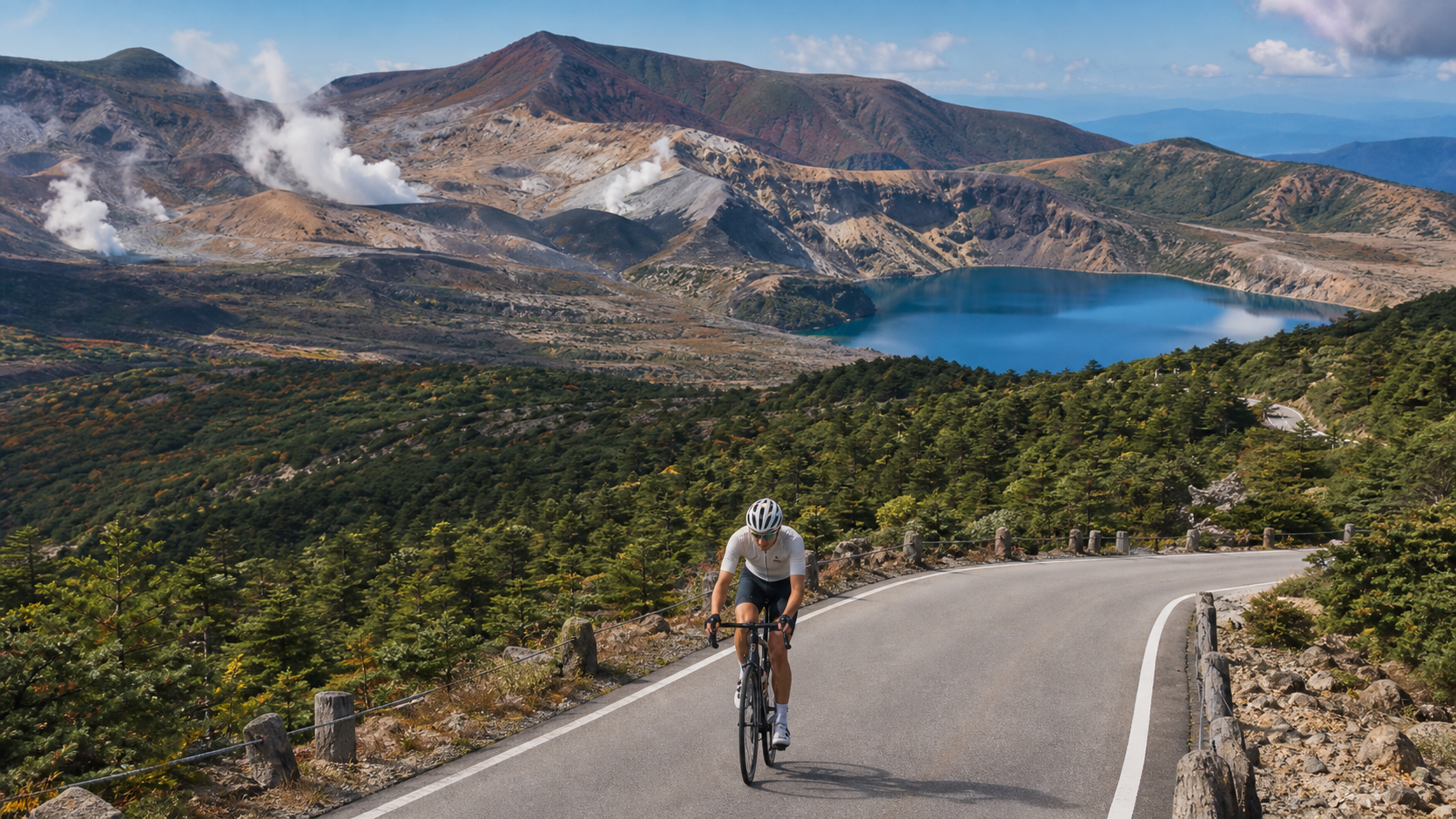
When Two Wheels Enter the Realm of Myth and Volcanoes: A Cycling Chronicle of Ebino Plateau
Some routes, you remember the numbers after riding them; others, you remember the scenery. Ebino Plateau belongs to the latter.
Located in Kirishima City, Kagoshima Prefecture, Kyushu, Japan, it is a volcanic highland at an elevation of about 1,200 meters. As you wind your way up Prefectural Route 1, the “Ebino Skyline,” passing through forests, crossing the steaming Mount Iō, and finally pushing open the view to see the highland embraced by a chain of volcanic peaks, you suddenly understand: the meaning of this ride was never just about the 861 meters of climbing and the 12 kilometers of distance. It is a journey through myth, geology, and time.
This article doesn’t discuss pacing or gear ratios. I want to introduce you to this road through a different lens—its geography, its history, its scenery and people along the way, and the things you can gain that numbers cannot measure when you surrender yourself to this highland.
Some ride for results, some ride for scenery, and in Kirishima, you’ll find these two can actually be the same thing.
A Highland Standing on the Shoulders of Volcanoes
To understand Ebino Plateau, you first need to understand the land beneath it.
Kirishima is an entire volcanic group, composed of more than twenty volcanoes, including the towering Mount Karakuni (からくにだけ)—the highest peak of the Kirishima mountain range—and Mount Iō, which still emits steam and carries the scent of sulfur. Ebino Plateau sits nestled within these volcanoes, a highland that truly “stands on the shoulders of volcanoes.”
Because of this geological backdrop, the entire Kirishima area has been designated a Geopark. This is not just an ordinary tourism title, but a formal recognition of the geological value of this land. As you ride through it, every inch of asphalt beneath you and every exposed rock along the roadside bears witness to the long history of this volcanic land. On some sections, you’ll smell sulfur drifting in the air and see faint white steam rising from the slopes—evidence that the earth is still breathing. For a rider from Taiwan, this experience of “cycling on a living volcano” is a thrill that flatlands and ordinary mountain roads simply cannot deliver.
Hidden on the highland is another gift reserved for clear days: the volcanic crater lake. When the weather is clear and the light is just right, the lake’s water takes on an almost surreal cobalt blue (コバルトブルー), lying quietly among the peaks. Many riders make the long climb to this highland just to catch a glimpse of that blue. It’s not guaranteed to appear every time—clouds, fog, and light all change its appearance—but precisely because of that, when you do encounter it, the surprise feels all the more profound.
Where Myth Takes Root: The Spiritual Fabric of Kirishima
What makes Kirishima moving is not just its geology, but its mythology.
In Japanese mythology, the Kirishima area is a key stage for the legend of “Tenson Kōrin” (the Descent of the Heavenly Grandson). According to the legend, Ninigi-no-Mikoto (ニニギノミコト), grandson of the sun goddess Amaterasu, descended from Takamagahara (the High Plain of Heaven) to the human world, landing among the peaks of Kirishima and beginning his rule over the earth. This myth has cast a sacred aura over the entire Kirishima mountain region, making it a holy land of faith since ancient times.
Not far from Ebino Plateau stands Kirishima Shrine, which enshrines Ninigi-no-Mikoto. This shrine is grand in scale, its vermilion halls set among towering ancient trees, and it lies at the heart of Kirishima’s faith. Many riders make a special detour to Kirishima Shrine before or after challenging the highland, offering a deep bow before the torii gate to pray for a safe journey. When you stand before the shrine and look up at the peaks half-shrouded in mist, it’s hard not to imagine how people a thousand years ago gazed upon this mythical mountain with reverence.
Cycling in Kirishima, you’re not just pedaling against gradients—you’re traversing a land steeped in myth. This depth quietly transforms how you feel about the journey.
This atmosphere of “myth and nature intertwined” is Kirishima’s most enchanting quality. It turns a simple climb into a pilgrimage with a sense of ritual. You’re not here to conquer a mountain; you’re here to visit a sacred land that has been revered since ancient times.
Scenery Along the Way: Forests, Steam, and the Vast Highland
Starting from the hot spring town, the scenery along the Ebino Skyline unfolds in layers.
The opening forest section is flanked by dense woods, with sunlight filtering through the branches to cast dappled shadows on the road, the air fresh and moist. At this point, you’re still in the mountain’s embrace, surrounded by greenery, with birdsong and wind in your ears—the most tranquil prelude of the entire journey.
Climbing to the middle section, the forest gradually thins and the views begin to open up. You’ll start to see the undulating ridgelines in the distance, and when you look back, the road you’ve just ridden hangs like a spiraling ribbon on the mountainside. This is the unique reward of climbing—every bit of effort buys you a wider view.
Near Mount Iō, the landscape shifts dramatically. The sulfur smell in the air grows stronger, exposed volcanic terrain and rising steam appear on the slopes, and the vegetation becomes low and sparse. A desolate yet magnificent volcanic landscape unfolds before you. This is the most dramatic stretch of the entire route, and the moment that most powerfully reminds you, “I am inside an active volcano.”
Arriving at Ebino Plateau, the view opens up in a sweeping reveal. The vast highland, the encircling peaks, and on clear days that cobalt-blue crater lake together compose a scene that belongs only to the heights. When you stop here, catch your breath, and look around, you’ll feel a sense of awe: “So this is how vast the world can be.” At this moment, all the climbing becomes meaningful.
And if you visit in autumn, Kirishima’s famous fall foliage adds another layer of intense color to it all. The hillsides and valleys painted in layers of red and gold, interwoven with the gray of the volcanoes, the blue of the sky, and the cobalt of the lake, create the most magnificent palette of a Kyushu autumn. This is a seasonal spectacle, and the reason many people make the trip for just a few weeks each year.
Local Culture and Side Trips: Turning a Ride into a Journey
What makes Kirishima so captivating is how naturally it extends “cycling” into “travel.” The following side-trip elements can enrich your highland adventure.
Soaking in Hot Springs: Let the Volcano Heal Your Legs
Besides volcanoes and mythology, Kirishima is most famous for its hot springs. Kirishima Onsen Village sits at the foot of the climb, and its thermal waters are a gift from the volcanoes. Imagine this: after a full day of battling gradients and strong winds on the highland, you soak in a steaming volcanic hot spring in the evening, letting your tired legs slowly unwind in the sulfur-rich water—this is a uniquely Kirishima experience that perfectly blends “exercise” and “healing.” For cyclists, it’s an almost unmissable closing ritual.
Shrine Visits: Leaving a Token of Gratitude for the Journey
The aforementioned Kirishima Shrine is not just a place of worship, but also a cultural space worth exploring at a leisurely pace. Towering ancient trees, vermilion shrine halls, and the thin mist that often lingers in the mountains create a serene and solemn atmosphere. Praying for safety before the challenge, or returning to give thanks after completing the ride, will add an unforgettable memory to your journey.
Taste: Rewarding Yourself with Local Flavors
Kyushu is a land of great food, and the Kirishima area is no exception. Whether it’s hot meals and drinks at the rest facilities on the highland or the local cuisine in the hot spring town below, you’ll find plenty to replenish your energy and satisfy your palate. (For specific restaurants and dishes, it’s best to go with the actual situation at the time of your visit—don’t pin your expectations on any one place in advance, and let local serendipity become the surprise of your journey.)
From the Airport to the Foothills: A Rider-Friendly Arrival
For riders coming from afar, Kagoshima Airport is a reassuring starting point. This airport is quite bike-friendly and well-equipped, located only about 25 kilometers from the base of the climb. This means you can bring your own bike or rent one, and from the airport, with a gentle warm-up ride or a short shuttle, you can reach the gateway to this highland.
This “transport-friendly” quality greatly reduces the difficulty of trip planning, and makes Ebino Kōgen one of the top choices for many international riders on a Kyushu itinerary. You don’t need complicated transfers or long-distance shuttling to stand at the foot of this volcanic highland—something that is actually quite rare among the world’s famous climbing routes.
| Side Attractions | Details | Significance for Riders |
|---|---|---|
| Kirishima Onsen Town | Volcanic hot springs at the foot of the mountain | The perfect finale to soothe your legs after the ride |
| Kirishima Shrine | The spiritual heart enshrining Ninigi-no-Mikoto | Pray for safety and feel the depth of mythology |
| Crater Lake | Cobalt blue on clear days | A highland-exclusive visual surprise |
| Autumn Foliage | Forests painted in layers of color | A season-limited spectacular landscape |
| Kagoshima Airport | ~25 km from the start, bike-friendly | A friendly arrival and transfer point |
A First-Person Riding Narrative
Allow me to take you through this road in the first person.
Early morning, I set out from Kirishima Onsen Town. The air carried a faint sulfur scent from the hot springs—that is the smell of a Kirishima morning. The forest in the early section was very quiet, with only the steady sound of the chain and my own breathing. I deliberately rode slowly, letting my body warm up gradually, and letting my mind settle down as well.
Climbing into the middle section, the trees opened up, and when I looked back for the first time, I was startled by the winding road behind me—I had already climbed this high. Distant mountains stacked layer upon layer, morning mist drifting through the valleys. At that moment I stopped, did nothing, just looked. This right to “stop and take in the scenery” is a luxury only climbers understand.
Approaching Mount Iō, the sulfur smell grew stronger, white steam rose from the slopes, and vegetation became sparse. I knew I was riding beside a living volcano—that feeling of both grandeur and awe is hard to put into words. My legs kept turning the pedals, yet my mind was unusually calm.
Finally, as I pushed onto Ebino Kōgen, the view opened up completely. The vast highland spread out before me, ringed by peaks, with the sky high above. I leaned my bike against something and walked to a spot where I could see the crater lake—I was lucky that day; the water was glowing cobalt blue, lying quietly among the mountains. I stood there for a long time, so long that I forgot the fatigue of the climb.
At that moment, I suddenly understood: what this highland gives you is never a time or a result, but an image that will stay in your memory for a very, very long time.
The Meaning of This Route: Why It’s Worth a Dedicated Ride
Back to the original question: why make a special trip to ride Ebino Kōgen?
Because it stacks so many wonderful things together. It has just the right amount of challenge—12 kilometers, 861 meters of climbing, enough to take seriously, but not enough to intimidate; it has an irreplaceable geological landscape—an active volcano, steam, a cobalt-blue crater lake; it has a deep mythological and spiritual foundation—the legend of the descent of the heavenly grandson, the solemn Kirishima Shrine; it has healing hot springs, season-limited autumn foliage, and a rider-friendly arrival route.
Taken individually, any one of these elements would be reason enough for a trip. And Ebino Kōgen gives you all of them at once.
If some routes make you stronger, then a route like Ebino Kōgen makes you more complete—it feeds your legs, your eyes, and your heart all at once.
So, if you ever have the chance to set foot in Kyushu, don’t just put it on the “someday” list. Bring your bike, or rent one locally, and head up the Ebino Skyline. When you stand on that highland embraced by volcanoes, looking at the cobalt-blue lake, smelling the sulfur in the air, and thinking of the deities who settled here thousands of years ago, you will be sincerely grateful for every pedal stroke you took.
This is not just a climbing route; this is a journey through mythology and volcanoes. And you will be part of it.
Time on the Highland Moves More Slowly
Many riders from the city, on their first time up Ebino Kōgen, find themselves unconsciously tamed by that sense of “slowness.” Down on the flats, we are used to speed, used to efficiency, used to one traffic light and to-do item after another. But when you give yourself over to this highland, you discover that time here moves more slowly—slowly enough that you’re willing to stop for a cloud drifting over a peak, slowly enough that you’ll stay an extra half hour for a rare moment of clear skies over the lake.
This “slowness” is the gentlest gift the highland offers to modern people exhausted by the rat race. It doesn’t urge you on; it simply sits there quietly, waiting for you to let go of your own pace. And when you truly let go, you begin to hear sounds you normally can’t—the rustle of wind across the grassland, the faint hiss of volcanic steam rising in the distance, the rhythm of your own heartbeat gradually settling. These sounds are the highland speaking to you.
I often feel that the reason climbing is so captivating is precisely because it forces you to slow down. You can’t rush a mountain; you can only get to know it step by step, pedal by pedal. And in that process, you are forced to face yourself—face your physical limits, face your willpower, and face the thoughts inside you that are usually buried under busyness. The version of you who reaches the top of the highland often knows what you want more clearly than the version who set out.
Four Seasons, Four Different Faces of Ebino Kōgen
If you think Ebino Kōgen has only one face, you’re underestimating it. This highland changes its attire completely with the seasons, and each season deserves a dedicated visit.
Spring on the highland is the season of awakening. Snow melts, plants sprout, and the air carries a fresh, moist breath of new life. Visibility is often excellent at this time—distant mountains are crisp, the sky is clear, making it a perfect time for photography and long views. If you dislike the cold and want to avoid the crowds, late spring is an ideal window.
Summer on the highland is a paradise for escaping the heat. While the plains of Kyushu are sweltering, the 1,200-meter highland enjoys cool breezes. The climb is tough, but the coolness that greets you at the top makes it all worthwhile. Summer is when the highland is at its greenest, with grasslands spreading out like a carpet—the most vibrant season of all. The only thing to watch for is afternoon thunderstorms; setting out early and returning early is a smart choice.
Autumn on the highland is the most spectacular season. The foliage mentioned earlier paints the entire mountain area in reds and yellows. Layer upon layer of autumn color, set against the gray of the volcano, the blue of the sky, and the cobalt of the lake, creates a scene that only Kirishima can offer. This is also the busiest time of year, but if you’re after that ultimate visual feast, autumn is absolutely worth a little crowding.
Winter on the highland is the harshest and purest season. Frost, snow, and icy roads greatly increase the risk of riding, and it’s generally not advisable to attempt it. But if you simply want to admire the quiet serenity of the snow-covered landscape from afar, winter Kirishima has its own desolate, sacred beauty. In any case, if you do go up in winter, safety must come first—if road conditions are uncertain, don’t hesitate to turn back. The mountain will always be there.
| Season | Highland Character | Who It Suits |
|---|---|---|
| Spring | Awakening, clear views, excellent visibility | Riders who dislike cold and want to avoid crowds |
| Summer | Cool escape, most vibrant greenery | Those who want to flee the plains’ heat |
| Autumn | Spectacular foliage, visual peak | Photography-minded riders chasing ultimate scenery |
| Winter | Snowy and harsh, desolate and sacred | Best viewed from afar; riding requires extreme caution |
Ride with Awe, Leave with Gratitude
Finally, I want to talk about an attitude.
Riding across a land like Kirishima—wrapped in volcanoes, mythology, and faith—the most fitting posture is not “conquest” but “visitation.” Every mountain here, every wisp of steam, every hot spring has existed longer than any of us and will continue to exist long after we’re gone. We are merely brief passersby, fortunate enough to measure a small stretch of its slopes with our wheels, fortunate enough to catch a glimpse of its cobalt-blue eyes on a clear afternoon.
So, ride with awe—respect the volcanic warnings, respect local regulations, respect the sacredness of this land. And leave with gratitude—grateful that your legs carried you through, grateful that the weather gifted you good views, grateful that this highland was willing to show its most beautiful side on the day you visited.
When you descend and soak in one of the volcanic hot springs of the Kirishima Onsen district, letting your aching legs slowly unwind in the sulfurous water, you’ll carry a deep sense of fulfillment. It’s not the conquering feeling of having taken a mountain, but the happiness of having been embraced by a beautiful land. The two are profoundly different.
Ebino Highland may not be the steepest climb you’ve ever ridden, nor will it be the stage where you break records. But it very well might be the road you still remember clearly years later—remembering the vastness of that highland, the blue of that lake, the smell of sulfur in the air, and the version of yourself that slowed your heart down at the summit.
May you one day stand on that highland surrounded by volcanoes and experience all of this for yourself. Then you’ll understand why some people say: Some routes aren’t about the gradient you climb, but a chapter of life you ride through.
A Few Words for Taiwanese Riders Visiting for the First Time
If this is your first time planning a cycling trip to Kyushu and you’re putting Ebino Highland on your itinerary, allow me to add a few words of hard-earned advice to make your first experience even more complete.
First, don’t overpack your schedule. Many Taiwanese riders share a common tendency—trying to cram as many routes as possible into a limited vacation, as if determined to conquer several mountains in a single day. But a place like Ebino Highland deserves some blank space. Leave time for idling at the summit, time for soaking in the hot springs, time for paying respects at the shrine. The quality of a trip often isn’t determined by how many kilometers you rode, but by whether you were truly “present” in that place.
Second, respect local riding etiquette. Japan’s road culture is highly orderly—riding close to the edge, obeying traffic signals, not occupying lanes, and nodding in acknowledgment to drivers who yield to you. These small details make you a welcome visitor. We represent not just ourselves, but to some degree, the impression Taiwanese riders leave abroad. Carry this thoughtfulness with you, and you’ll find this land responds with the same kindness.
Third, be mentally prepared to adjust your plans at any moment. Volcanoes, weather, road conditions—these are variables we can’t fully control. Perhaps you’ve traveled a great distance only to find thick fog locking away that cobalt-blue lake; perhaps a volcanic warning has temporarily closed a section of road. When these moments come, don’t be frustrated—treat them as another face this land is showing you. The mountain isn’t going anywhere, and good scenery is worth a second visit. Learning to coexist with uncertainty is itself a gift travel gives us.
Finally, and most importantly: treasure every present moment. When you stand on the highland, wind brushing your cheeks, the chain of volcanic peaks stretching before you, an indescribable emotion will well up inside you. In that moment, there’s no need to rush for photos or posts—put your phone away first, and use your eyes, your breath, your heart to carve that scene into memory. Photos fade, social media feeds get washed away, but the awe of standing at altitude, surrounded by overwhelming grandeur, will stay with you for a very long time.
This is Ebino Highland—a highland that will gently transform you with its volcanoes, its mythology, and its vastness. May the day you set foot on it bring clear skies, blue lake water, and a you who is exactly ready.
Related Reading
- Kirishima Ebino Highland Climb Strategy Guide: Full Data Analysis of the 12km, 861m Volcanic Highland Climb
- Riding to the Land of Tenson Korin: The Cycling Story of Takachiho-kawara, a Journey from a National Treasure Shrine to a Mythological Sacred Mountain
- The Sacred Mountain That Awakens Only in Summer: Riding Mt. Norikura, a Conversation to 2,720 Meters in the Clouds
- A Volcanic Road with 1,300 Years of Hot Spring History: Nasu-Tōge no Chaya’s Onsen, Legends, and Wilderness Riding
台北闊瀨陡坡 騎旅 / 日本單車雜誌編輯車友臨時加入!/ 髮香才是最強的 / feat. 北迴歸線小隊 / 公路車 CT Yeh
6 個月前
宇老大滿貫(改)/ UBike神人 / 太離譜了!出大景 差點被擊落 / feat. 神秘密境單車團 / 公路車 / CT Yeh
2 年前
帶「咩」一起騎玩日本熊本 上天草市 / 單車旅行、賞海豚、釣魚、高空滑索通通有!/ 公路車 / CT Yeh /
1 年前
2025 乘鞍 KOM 登山賽挑戰實錄 / 日本公路最高 ! 賽前探路篇 / 比富士山厲害,無敵絕景!/ 40週年 / 中文YT首發 / 公路車 / CT Yeh #乘鞍ヒルクライム
10 個月前
嘉義大埔、阿婆灣挑戰賽,美到以為在日本!ft. 環騎5 Cool 西拉雅188 / 公路車 / CT Yeh
7 個月前
大武山20%魔王陡坡【JJSC南台灣遊騎Day2】!屁股真的要裂開了...凡士林抹滿也沒用?神秘金教堂還有超便宜夜市
3 個月前
日本公路最高登山賽,台灣首位YT挑戰實錄,乘鞍登山賽40週年,賽前篇完整版,請到我的YT收看 #公路車 #cycling
10 個月前
水金九不厭五分 10度寒流冷到不願停!feat. 卡卡 / 公路車 / CT Yeh
6 個月前