Sea of Clouds, Cattle Herds, and Sculptures on the Grassland: A Day of Poetry Riding Up the Utsukushigahara Plateau
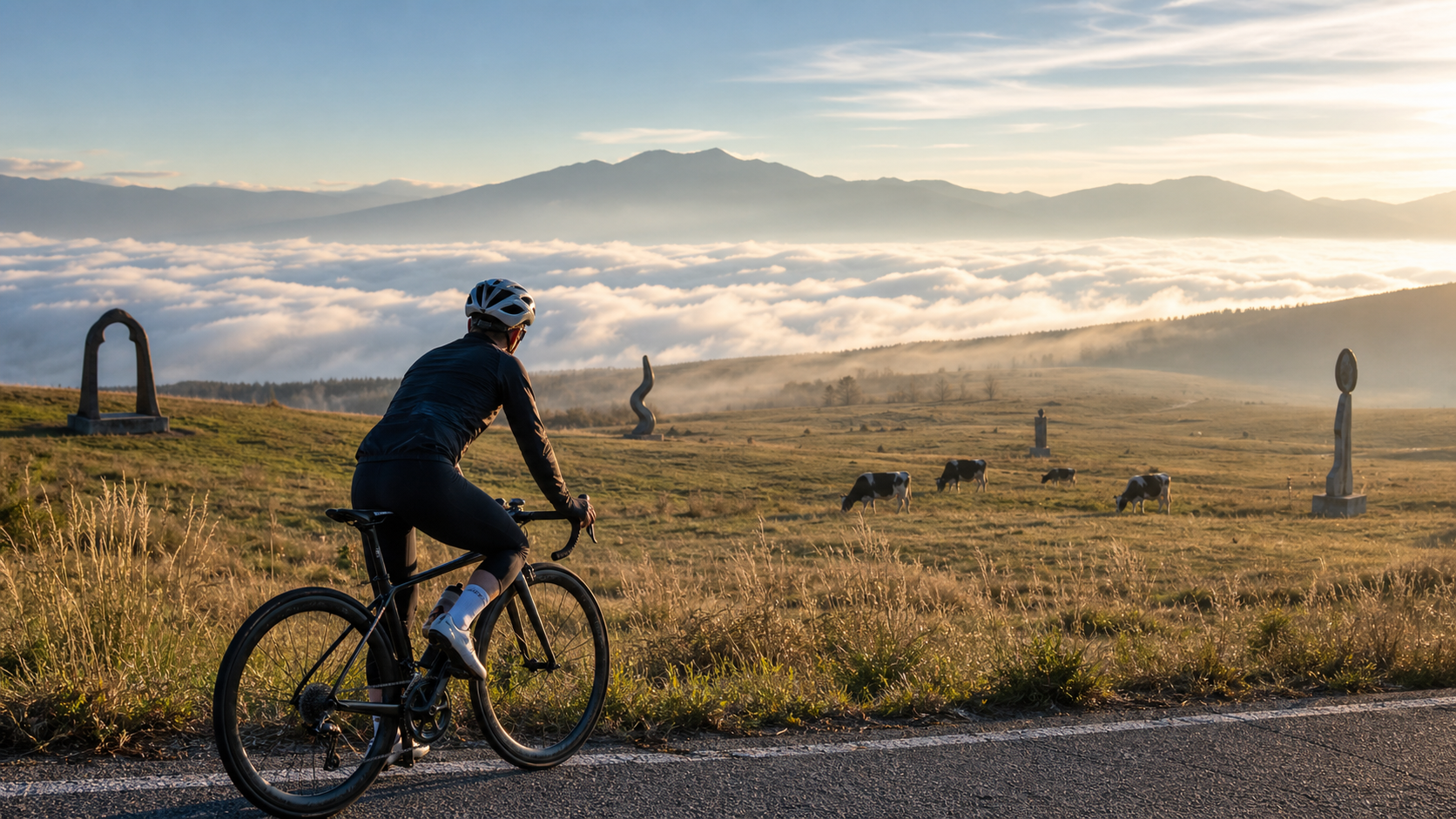
There is a kind of climb where the gap between suffering and beauty feels almost unreal. Utsukushigahara is exactly that—it first makes you question your life with a 20% wall, then, just as you’re about to give up, lays out an entire 2,000-meter-high grassland, sea of clouds, and sculptures before your eyes.
If you only treat Utsukushigahara as a brutal battle, that would be a shame. This lava plateau, straddling Matsumoto City and Ueda City in Nagano Prefecture at an elevation of about 2,000 meters, is one of Japan’s most enchanting highlands. Here you’ll find an open-air museum on the grasslands, cattle grazing that began in the Meiji era, refuge towers built for the dense fog, and seas of clouds that photographers wait up all night to capture. In this piece, we put away the bike computer and look at Utsukushigahara anew through the eyes of a traveler.
The Climb Begins from a Hot Spring Town
The starting point for the Utsukushigahara climb is around the baseball stadium parking lot in Matsumoto City, right next to Asama Onsen—a historic hot spring district. It’s a poetic starting point: you set off from a hot spring town veiled in rising steam, climb steadily toward the sky, and finally arrive at the height of the clouds. This vertical journey “from hot springs to the clouds” is precisely the most captivating narrative backbone of a Utsukushigahara cycling trip.
And Matsumoto at the foot of the mountain is itself a city worth extending your stay for—the black keep of the National Treasure Matsumoto Castle and the atmosphere of its old streets can enrich the time before and after the ride. Matsumoto is the cultural heart of Shinshu, and many riders prefer the rhythm of making it their base for the Utsukushigahara trip: strolling the old streets the night before, then heading for the highlands at dawn the next morning.
This “hot spring start” design gives the Utsukushigahara climb an extra layer of ceremony. You don’t depart from a dreary parking lot; you set off from a hot spring street filled with drifting steam and the scent of sulfur. As you push down on the first pedal stroke, behind you lies the misty hot spring, ahead stretches the long slope to the clouds—the scene itself feels like the opening of a film. And when you finish the ride and descend, you return to the same hot spring, soaking the day’s fatigue into the warm water. Setting out from the hot spring and returning to it, this route stitches “labor” and “healing” into a complete circle. This design makes the Utsukushigahara climb more than just a battle against gravity—it becomes a full journey from hot springs to the clouds, and back to the hot springs again.
An Art Museum on the Grasslands: An Open-Air Gallery of 40,000 Tsubo
Once you reach the highland plateau, the first landmark that leaves you speechless is the Utsukushigahara Highlands Museum.
The museum’s backstory is fascinating: it was born in 1981 when the Venus Line scenic highland road opened, established as a sister museum to the Hakone Open-Air Museum. It is an outdoor sculpture museum—on roughly 40,000 tsubo of expansive grassland, about 350 modern sculptures are permanently exhibited.
Imagine this: you’re riding across a 2,000-meter-high grassland, surrounded by unobstructed sky and distant mountains, while massive modern sculptures are scattered across the meadow, their expressions shifting constantly with the movement of light and clouds. This isn’t art “locked away” in a building; it’s art breathing together with the highlands, the weather, and the rider’s gaze. For a cyclist, this is a surreal landscape that makes you forget the agony of the steep climb you just endured.
In a place like this, art and sport find a remarkable intersection. You’ve just used your body to wage a battle against gravity, and then you encounter these silent sculptures on the grassland—between motion and stillness, the highlands seem to tell you that there are many ways to arrive, and climbing up on your own legs is merely the most honest one.
The museum holds another layer of meaning: it turns “viewing” into a physical experience. In a city museum, you view works through climate-controlled glass under artificial lighting; but at Utsukushigahara, you encounter the sculptures in real wind, real light, and real highland air. When clouds drift over, the works darken a shade; when sunlight pours down, metal surfaces gleam. The same sculpture takes on completely different expressions in sunshine, in fog, in the glow of sunset, and across the seasons. This way of viewing, co-created with the weather, is something an indoor museum can never offer. And you—a rider who has just climbed to the highlands—have arrived at this open-air gallery in the most primal way possible, on your own legs, making the encounter all the more precious.
Ōgatō and Utsukushi no Tō: Two Landmarks of the Highlands
The highest peak of Utsukushigahara is Ōgatō, at 2,034 meters, on the western side of the plateau, crowned by several massive radio towers. Standing at Ōgatō, you get a full 360-degree panorama—on clear days, Mount Fuji, the Yatsugatake mountains, and the Northern Alps all emerge one by one on the horizon. That feeling of “standing at the edge of the plateau, taking in the famous peaks of half of Honshu at a glance” is the most generous reward Utsukushigahara offers to those who made the effort to climb.
The other landmark—Utsukushi no Tō—holds a gentler story. This stone tower, about 6 meters tall, was erected because Utsukushigahara is perpetually shrouded in dense fog and had seen numerous mountain accidents in the past; it was built as a refuge tower equipped with a “fog bell.” When thick fog descends and visibility plummets, lost hikers can follow the sound of the bell to find their way. It is also the largest literary monument in Japan. A single tower that serves as both a shelter and a poetry stele—this coexistence of practicality and poetry captures the character of Utsukushigahara well.
Imagine hearing the fog bell ring out, one toll after another, guiding those who have lost their way—the image itself is deeply evocative. It reminds you that this seemingly gentle highland grassland has a serious, even dangerous side. Beauty never comes without a price.
The tower’s dual identity as both a “refuge” and a “literary monument” also symbolizes Utsukushigahara’s dual nature. It pragmatically guides those lost in the fog, while poetically carrying words and emotion. This coexistence of the practical and the romantic is precisely the deep impression this highland leaves on people—it is not merely a scenic spot for photo ops, but a land with history, with stories, and even with life and death. As you move between the grand panorama of Ōgatō and the fog bell story of Utsukushi no Tō, you come to feel that the “beauty” of Utsukushigahara carries weight—and that weight comes from the years it has shared with the people who have passed through it.
Pastoral Scenes: Cattle on the Grasslands
A large part of what makes Utsukushigahara so endearing is the cattle.
Below Ōgatō lies Mikiri Ranch, developed since the Meiji era, where cattle graze on the highland pastures roughly from June to October each year. As you ride along the highland road, watching the cattle leisurely lower their heads to graze with the layered mountain ridges in the distance, that “pastoral” scene makes you instantly understand why the Japanese regard Utsukushigahara as a sacred place for summer retreat and healing. The highland summer is cool and pleasant—the most vibrant season for this ranch, and the moment when the highlands’ gentle character is most palpable.
The sound of cowbells, the scent of fresh grass, the cool highland air—these sensory details make your memory of the climb vivid and three-dimensional. Years later, you may forget that day’s average speed and time, but you’ll remember the moment on that grassland when a cow lifted its head and glanced at you. That’s what Utsukushigahara leaves you with: not data, but images.
This grazing culture also gives Utsukushigahara a distinctive warmth. It isn’t a forbidding peak that makes people feel awestruck; it’s a highland where people live, where animals dwell, and which has been cultivated by generations. When you ride along the road beside the ranch, you’re not an intruder—you’re a passerby within this pastoral landscape. This sense of “living in harmony with the land” is the most healing part of the Utsukushigahara ride—it lets you push your physical limits while being enveloped by a gentle, everyday rhythm.
Sea of Clouds and Dense Fog: Two Faces of the Highlands
Utsukushigahara is a renowned spot for viewing seas of clouds and starry skies. On autumn mornings, when conditions align, the clouds below spread into a surging white ocean, and you stand above the sea of clouds, watching the sunlight gradually dye the clouds gold. This is a scene many people wait for specially. (Actually encountering the sea of clouds still depends on the day’s weather conditions—it’s a matter of luck, not something you can count on.)
After nightfall, far from urban light pollution, Utsukushigahara becomes an exceptional stage for stargazing. At 2,000 meters above sea level with unobstructed views, the stars hang low in the sky—a night sky you’ll never see on the plains. If you arrange to stay one night on the highlands, the morning sea of clouds and the night’s starry sky will double the depth of your cycling trip memories. Imagine finishing a full day of long climbs, then stepping out of your lodging at night and looking up to see a brilliant Milky Way—this reward from heaven and earth is a gift reserved only for those who stay overnight.
For Taiwanese riders, this complete experience on the highlands—“challenging by day, gazing at stars by night, waiting for the sea of clouds at dawn”—is something difficult to replicate in Taiwan. Although Taiwan’s high mountains are magnificent, Utsukushigahara’s combination of “highland plateau + open-air museum + grazing cattle + hot spring starting point” has its own unique Japanese charm. If you want to satisfy both your desire for challenge and your desire for travel in a single trip, arranging Utsukushigahara as a two-day, one-night stay on the highlands is a very worthwhile and rewarding plan.
But the same highlands also have their harsh side. The dense fog mentioned earlier—the very existence of Utsukushino-tō is proof—can descend without warning, swallowing the entire grassland into milky white. This reminds every rider: the beauty of Utsukushigahara has a temper. Its sea of clouds and dense fog are actually two faces of the same weather.
A Climbing Race Spanning a Quarter Century
Utsukushigahara’s significance to cyclists also comes from its annual hill climb race—Tour de Utsukushigahara Kōgen Cycling Race. First held in 2000, this event has now spanned more than a quarter century, making it one of Japan’s major hill climb races, supported by local forces including Matsumoto City, the Matsumoto Chamber of Commerce and Industry, and the Asama Onsen Tourism Association.
Its weight in riders’ hearts comes precisely from the legend of that opening steep slope—with a maximum gradient exceeding 20%—allowing every finisher to proudly say, “I rode Utsukushigahara.” This race stitches a highland plateau, a brutal slope, a small town’s hot spring culture, and its tourism passion all into a single climbing route. When thousands of riders set off from Matsumoto’s baseball stadium on a summer morning, climbing toward the clouds, this road becomes more than just a line on a map—it becomes the pride of an entire region.
Matsumoto in Shinshū: Extending Your Ride into a Journey
At the foot of Utsukushigahara lies Matsumoto—the cultural heart of Shinshū (the old name for Nagano). Extending your Utsukushigahara ride into a two- or three-day trip is the best way to fully absorb this land.
Matsumoto’s most famous landmark is Matsumoto Castle, designated as a National Treasure. This surviving black keep is one of Japan’s oldest existing wooden castles, and its reflection in the moat offers different charms in every season. The day after riding Utsukushigahara, taking a slow stroll through the old streets below Matsumoto Castle and enjoying a bowl of Shinshū soba is the best rest for your legs.
Shinshū’s food culture is also worth exploring. The area is famous for soba noodles, with the crisp mountain water nurturing springy noodles; the highland climate is also ideal for growing fruits and vegetables. Incorporating local cuisine into your itinerary means your Utsukushigahara memories won’t just be the soreness of climbing, but also the taste of Shinshū’s terroir on your palate.
And the Venus Line (Vīnasu Rain) that threads through the entire highlands is one of Japan’s most famous scenic roads. It winds from the foothills up to the plateau, connecting scenic spots like Utsukushigahara and Kirigamine along the way—a scenic thoroughfare coveted by both drivers and cyclists. If you have ample time, extending a longer highland route along the Venus Line will add even more depth to your journey.
Utsukushigahara Through the Seasons: A Highland That Changes Outfits
Utsukushigahara’s charm also lies in how it completely transforms with the seasons.
Late spring to early summer is the season of the highlands awakening. As snow retreats and grasslands turn green, the rhododendrons (Renge-tsutsuji) near the race finish begin to bloom, dotting the grassland with orange-red seas of flowers. The air is fresh and temperatures pleasant—one of the most comfortable riding seasons.
Midsummer Utsukushigahara is a summer retreat paradise. While cities below swelter, the 2,000-meter highlands remain as cool as autumn. Cattle from Sanjō Farm graze across the meadows, and the pastoral scene reaches its most vivid moment. This is also the season with the most riders—everyone wants to escape to the highlands and enjoy that rare coolness.
Autumn sees the highlands don gold and ochre. Grasslands wither to yellow, distant mountains take on color, and morning seas of clouds are common—the favorite season for photographers. As the chill deepens, riders need to start paying attention to staying warm. In this season, Utsukushigahara’s light is especially soft, with long slanted rays casting warm shadows from the grassland sculptures and cattle—the most photogenic time of the year.
Winter buries the highlands under heavy snow, and most roads leading up are closed. This is Utsukushigahara’s season of slumber, reminding people that this gentle highland also has its harsh side. The snow seals the roads and also seals away the highlands’ clamor, until the following spring when melting snow, green grass, and rhododendrons awaken it once again.
Precisely because of these distinct seasonal transitions, Utsukushigahara is, for many riders, a road “worth riding once in each season.” Spring’s rhododendrons, summer’s pastoral scenes, autumn’s seas of clouds—every visit is an encounter with a different highland. This richness of “one road, four faces” keeps Utsukushigahara enduring in riders’ hearts, and makes every return a brand-new encounter.
The same climbing road, ridden in different seasons, offers completely different experiences. This is also why many people ride it again and again without ever growing tired.
What This Road Means to Riders
Utsukushigahara teaches riders the concrete version of “there’s scenery after suffering.”
It doesn’t hide its cruelty—opening with a 20% wall; but it’s equally generous with its gentleness—grasslands, sculptures, cattle, seas of clouds, fog bells. This stark contrast makes every summit feel like a small redemption: you trade the opening pain for an entire expanse of highland openness.
When you stand your bike on the plateau, watching sculptures cast long shadows across the grassland, cattle grazing with heads lowered in the distance, and clouds creeping up from below, you’ll understand: Utsukushigahara isn’t a road for you to conquer—it’s a highland for you to arrive at, then quietly stay. It will use an entire afternoon of light to slowly tell you that the brutal slope you just climbed was worth it.
Why Utsukushigahara Deserves a Dedicated Trip
Japan has countless highland roads, but Utsukushigahara possesses several qualities difficult to replicate elsewhere, keeping it permanently on riders’ bucket lists.
First is intense drama. Starting from the hot spring town, hitting the legendary brutal slope, enduring the mid-section climb, and finally emerging onto the open cloud-level grassland—this road’s emotional arc is like a well-structured film, with lows, turning points, and climaxes. After riding Utsukushigahara, you haven’t just completed a physical feat; you’ve walked through a complete story.
Second is the convergence of art and nature. The open-air sculpture museum spread across the 40,000-tsubo grassland gives this highland a cultural depth found nowhere else. What you encounter here isn’t just mountains and grass, but also artists’ responses to this landscape. This experience of “reaching art with your body” is Utsukushigahara’s unique appeal.
Third is unrivaled panoramic views. Standing at Ōgatō, Mount Fuji, the Yatsugatake range, and the Northern Alps line up in a single vista; autumn morning seas of clouds, night skies full of stars—this 2,000-meter plateau lays out the most magnificent scenery of central Japan all at once before your eyes.
Add these three together, and Utsukushigahara becomes more than just “a hard climb”—it’s a complete journey combining sport, art, and nature. For riders willing to travel for a great road, it’s absolutely worth every bit of the effort.
For Those About to Set Off
If you’re weighing whether to take on Utsukushigahara, let me say this: go—but go with respect.
Respect the steep climb—bring your lightest gearing, warm up thoroughly, allow yourself to go slow, and even allow yourself to dismount and catch your breath on the steepest stretch. Respect the highlands—watch for the changeable weather and thick fog, bring warm layers, and put safety ahead of your time. And carry the anticipation for the journey—don’t just rush through; remember to stop on the grasslands, look at the sculptures, watch the cattle, and see the clouds rolling up from the foothills.
Utsukushigahara will test your resolve with one brutal climb, and reward your persistence with an entire highland plateau. When you stop on the cloud-level grassland and look back at the road you just climbed, you’ll feel genuine gratitude toward the version of yourself that decided to go. That is the most precious gift this Nagano highland leaves with every rider.
And before you actually set foot on this plateau, it’s worth rehearsing the journey in your mind: setting off from Asama Onsen with its rising steam, hitting that brutal climb that leaves countless riders breathless, catching your breath by the shore of Lake Misuzu, crossing Takeshi Pass, and finally reaching that cloud-level grassland with its sculptures, cattle, and fog bell. Every stretch of this road has its own story and scenery; and when you string those stories together with your own legs, they stop being legends told by others and become your own memories.
The reason Utsukushigahara has always held its place among Japan’s many highland routes is precisely because it blends “challenge” and “beauty” so naturally. It doesn’t boast with intimidating elevation or distance—instead, it uses a climb worthy of legend and a breathtaking cloud-level grassland to make every rider fall in love with it willingly. May you, in the right season, with respect and anticipation for this highland, ride Utsukushigahara yourself—and then you’ll understand why so many riders make a special trip for this mountain plateau.
Suggested Side Trips
- Asama Onsen: The hot-spring town at the starting point, ideal for lodging and soaking before and after the ride.
- Matsumoto Castle: The National Treasure keep in Matsumoto City below the mountain; add a half-day extension.
- Utsukushigahara Open-Air Museum: An open-air sculpture museum on the grassland, well worth stopping to stroll through and experience the viewing experience co-created by art and highland weather.
- Venus Line (ビーナスライン): The classic scenic road connecting the highlands, allowing for longer highland routes; a scenic thoroughfare coveted by both drivers and cyclists.
- Highland Lodging for Stargazing and Sea of Clouds: Spend a night on the plateau to catch the morning sea of clouds and the night sky, making the memory of this ride more complete and profound.
Seasonal note: Sections of the highland roads leading to Utsukushigahara are closed or restricted during winter snow season; the best riding season is from late spring to autumn. Check the day’s road openings and weather conditions before departure. Bring warm clothing, because even when it’s warm at the base, the 2,000-meter plateau always keeps a hint of coolness, waiting to gradually cool you down from the heat of the climb.
Related Reading
- Utsukushigahara Climb Guide: Opening Ramp at 20%+, Straight Up Nagano’s 2,000m Lava Plateau
- Riding Above the Three Great Hot Springs of Japan: Tour de Kusatsu-Shirane, a Hot-Spring Journey from Yubatake Steam to a Snowy Highland
- A Volcanic Road with 1,300 Years of Hot Springs: Nasu-Tōge no Chaya’s Springs, Legends, and Wilderness Riding
- Riding into the Realm of Myth and Volcanoes: A Ride Report from Ebino Highlands, a Highland Pilgrimage Across the Kirishima Range
嘉義大埔、阿婆灣挑戰賽,美到以為在日本!ft. 環騎5 Cool 西拉雅188 / 公路車 / CT Yeh
7 個月前
大武山20%魔王陡坡【JJSC南台灣遊騎Day2】!屁股真的要裂開了...凡士林抹滿也沒用?神秘金教堂還有超便宜夜市
3 個月前
2025 乘鞍 KOM 登山賽挑戰實錄 / 日本公路最高 ! 賽前探路篇 / 比富士山厲害,無敵絕景!/ 40週年 / 中文YT首發 / 公路車 / CT Yeh #乘鞍ヒルクライム
10 個月前
大武山後門26%歡樂陡坡!JJSC南台灣單車行Day2 / 被颱風追著跑 / 公路車 / CT Yeh
2 年前
#北橫 + #北進武嶺 最硬的員工旅遊 EP1 | #公路車 #拉拉山 | 明池 | 武嶺 | 武陵農場 | 雲海 | Taiwan Cycling Route Wulin
6 年前
台北闊瀨陡坡 騎旅 / 日本單車雜誌編輯車友臨時加入!/ 髮香才是最強的 / feat. 北迴歸線小隊 / 公路車 CT Yeh
6 個月前
2025 乘鞍岳登山賽 比賽全紀錄篇 / 完整路線攻略介紹 / 日本版武嶺 公路最高點 / 高山空拍絕景 / 明年會開團! / 公路車 / CT Yeh
10 個月前
新竹羅平 x 天湖部落 大禹嶺級變態陡坡! 4K超高畫質 空拍 | 公路車
5 年前