Faith and Pastoral Scenes of Hōki Fuji: A Journey Along Mount Daisen's Loop Road, the Southern Wall at Kagikake Pass, and the Dairy Farms at the Foothills
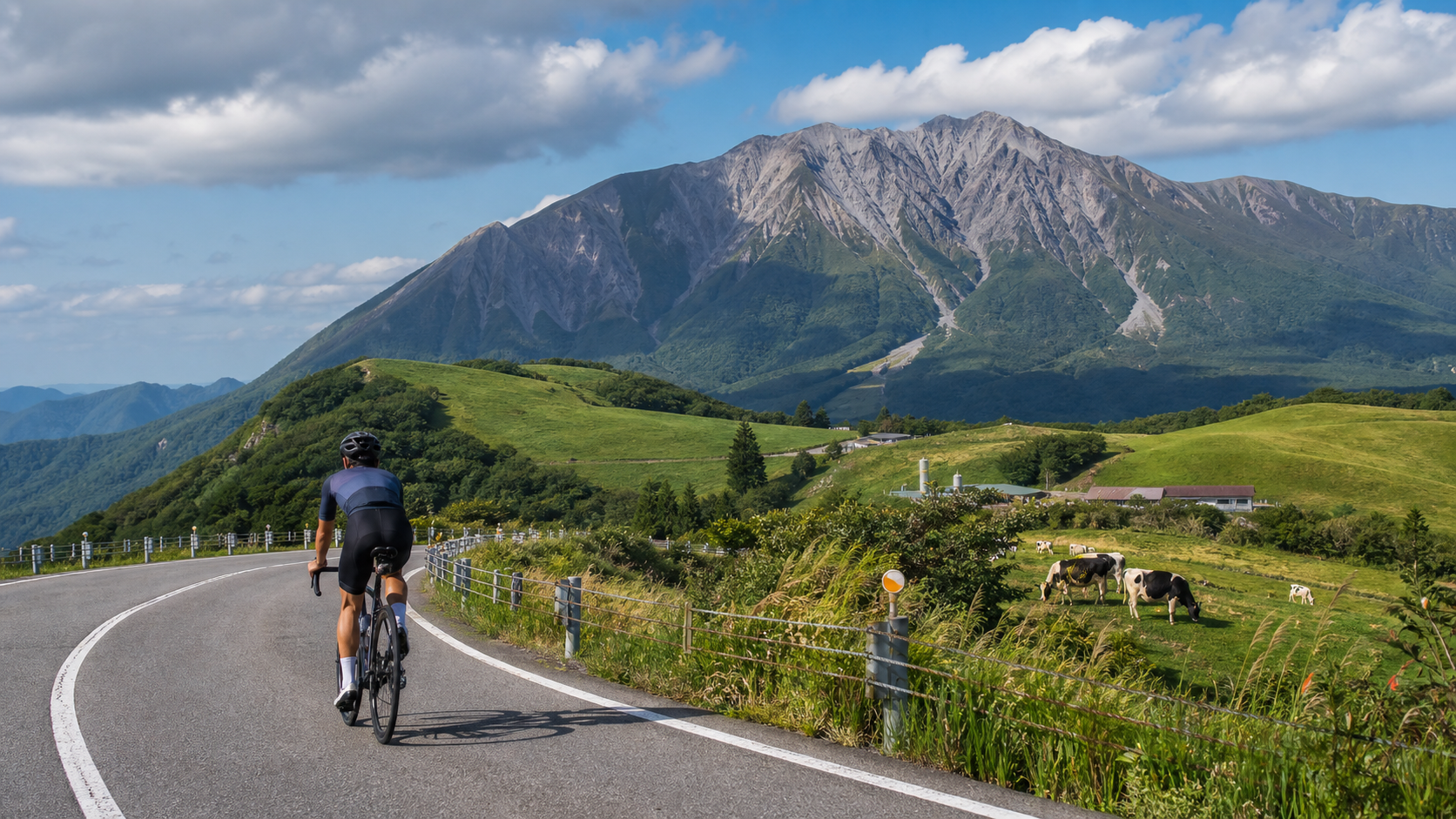
At the heart of the Chūgoku region stands a famous mountain known as “Hōki Fuji.” Riding the Daisen Loop Road that encircles it, you’ll encounter faith, breathtaking views, and pastoral scenes—this is a story about how a mountain has been gazed upon, revered, and lived with for generations. Each lap around is an encounter with a different face of this renowned peak.
Mount Daisen (だいせん), at 1,729 meters, is the highest peak in Tottori Prefecture and the entire Chūgoku region. Because it presents an almost perfectly conical shape from certain angles, it has been called “Hōki Fuji (ほうきふじ)” since ancient times—Hōki is the old name for this land, and calling a mountain “Fuji” is the highest praise one can bestow in Japan. In this piece, we set aside the bike computer and step into the faith, the scenery, and the everyday life behind this “Fuji of the West.”
For those unfamiliar with Daisen, here’s a quick outline: it’s located in Tottori Prefecture and is the highest peak in the Chūgoku region (western Honshu). The “Daisen Loop Road” that circles it is selected as one of Japan’s 100 Best Roads, featuring the Kagikake Pass with its view straight at the southern wall, the thousand-year-old temple Daisen-ji, the largest primeval beech forest in western Japan, and the dairy farms at its base. It’s also home to the largest ski resort in western Japan. This is a mountain that embodies faith, scenery, ecology, and daily life—and cycling around it is the best way to take all of that in at once.
Two Faces of One Mountain: Grace and Ruggedness
The most fascinating thing about Daisen is that it has two completely different faces.
Viewed from the Yonago Plain to the west, Daisen presents a gently sloping, conical silhouette, like a miniature Fuji—this is the origin of its beautiful nickname, “Hōki Fuji.” This side of Daisen is gentle, symmetrical, and serene; it’s the classic pose most often seen on postcards and calendars, and it’s the mountain that generations of local residents have looked up to with pride as their hometown peak. But when you ride around to the southern side and stand at Kagikake Pass (かぎかけとうげ), you’ll see a completely different Daisen—that’s its rugged, wild southern wall, with craggy cliffs and steep, jagged slopes full of raw, primal power. Years of weathering and collapse have given this southern wall a broken, precipitous terrain that looks like an entirely different mountain from the gentle, conical silhouette on the west side. Many people who see Daisen’s southern wall for the first time are astonished that it’s the same mountain as that “mini Fuji” on the postcards.
The same mountain—one side graceful as Fuji, the other as sharp as a blade. This striking duality gives Daisen an indescribable charm. And riding the loop road lets you see both faces of Daisen from different angles. When you stand at Kagikake Pass facing that awe-inspiring southern wall, you’ll forget the effort of the climb and feel only reverence for the mountain.
This “duality” is, to some extent, a shared appeal of all famous mountains. People are often first drawn in by a mountain’s gentle, beautiful side, and then, as they get closer, they discover its stern, dangerous, powerful other side. Daisen’s southern wall is exactly such a place where “the truth is revealed”—it reminds you that this mountain, nicknamed “mini Fuji,” actually possesses a wildness and ruggedness not to be underestimated. And it’s this coexistence of gentleness and ruggedness, this interweaving of beauty and wildness, that makes Daisen a mountain worth visiting again and again, with new insights each time. When you ride around it, you’re not just completing a workout—you’re taking in the mountain’s many faces, lap after lap, and storing them in your eyes and your heart.
A Thousand Years of Faith: Daisen-ji and Ōgamiyama Shrine
Daisen is not just a scenic mountain; it’s a mountain of faith.
Daisen-ji (だいせんじ) was founded in Tenpyō 13, which is to say the distant year 741 AD—this is an ancient temple with nearly 1,300 years of history, and one of the most significant sacred sites in the Chūgoku region. At the height of its historical prominence, Daisen-ji was a vast mountain Buddhist center with numerous monk’s quarters, and its influence extended across the entire Chūgoku region. Sharing its role as a core of faith is Ōgamiyama Shrine (おおがみやまじんじゃ)—this shrine enshrines the mountain deity of Daisen and represents Shinto belief on this mountain. These two sacred sites, one Buddhist and one Shinto, together form the heart of Daisen’s mountain faith, embodying the uniquely Japanese tradition of the fusion of Shinto and Buddhism.
Nearly 1,300 years is an unimaginably long span of time. When Daisen-ji was founded, Japan was still in the Nara period, and the capital at Heian-kyō (Kyoto) had not yet been established. And so this ancient temple has stood at the foot of Daisen, generation after generation, guarding people’s faith in this mountain, right up to the present day. When you ride through the Daisen-ji area and walk on those stone steps trodden by countless pilgrims, you’re literally stepping through a history that spans a millennium.
For centuries, people have regarded Daisen as a sacred mountain, coming to worship and train. When you ride through the Daisen-ji area, you’ll feel an ancient, tranquil atmosphere—this is not just a trailhead for climbers, but a holy site for the faithful. The stone steps, ancient trees, and temple halls all speak of a bond between this mountain and its people that has endured for over a thousand years. This depth of faith adds a layer of temporal weight to every inch of Daisen’s scenery.
In Japan, mountain worship is a profoundly deep and ancient tradition. The ancients believed that mountains soaring into the clouds were where the gods dwelled—sacred realms connecting heaven and earth. And so, one famous mountain after another became a sacred site where people placed their faith and undertook ascetic training, and Daisen was the center of this faith in the Chūgoku region. When you ride around Daisen, you’re actually circling a “mountain of the gods”—this peak is not just the highest point geographically, but also the highest point spiritually and religiously of this land. Understanding this background, every time you look up at Daisen, you’ll feel a bit more reverence; and that reverence will elevate your ride from a mere physical challenge into a profound journey of dialogue with this land and its faith.
Western Japan’s Largest Primeval Beech Forest
Daisen holds another natural treasure—it boasts the largest primeval beech (ブナ) forest in western Japan, distributed between 800 and 1,300 meters in elevation. The fact that this primeval forest has reached the largest scale in western Japan is itself a rare achievement—on Honshu, where human development is dense, preserving such a vast expanse of virgin forest was only possible because this mountain has been protected by faith for a thousand years and spared from overdevelopment.
Riding along the loop road, you’ll pass through this lush primeval forest. In spring, the fresh greenery gleams brightly; in summer, the dense canopy blocks the sun and offers cool comfort; in autumn, the entire forest turns gold and ochre-red in a breathtaking display. The beech forest isn’t just scenery—it’s the backbone of Daisen’s ecosystem. It conserves water, nurtures life, and is the very reason this mountain teems with vitality. Higher up, around the 8th to 9th station, there are also colonies of “Daisen kyaraboku (ダイセンキャラボク),” designated as natural monuments.
Riding through this primeval forest, the largest in western Japan, you’ll feel a healing sense of being enveloped by nature. Sunlight filters through the leaves, wind rustles through the treetops, birdsong rises and falls—this is Daisen’s gentlest side, in stark contrast to the rugged southern wall.
The beech forest’s significance to this land goes far beyond its beauty. Beech trees are called “green reservoirs”—their extensive root systems and thick leaf litter can store large amounts of rainwater, releasing it slowly into streams and groundwater. It’s this primeval forest, the largest in western Japan, that nourishes the abundant water sources at Daisen’s base and sustains the thriving agriculture and dairy industry of the area. When you ride through the woods, the fresh air you breathe and the verdant greenery you see are all the result of this forest’s quiet work. It’s the heart of Daisen’s ecosystem and the secret behind the mountain’s vitality.
And higher up, around the 8th to 9th station, there are colonies of “Daisen kyaraboku (ダイセンキャラボク),” designated as natural monuments—a low-growing evergreen that tenaciously survives in harsh alpine conditions, bearing witness to how life takes root stubbornly even in extreme places battered by wind and snow. From the beech trees at the base to the kyaraboku at the heights, Daisen displays the diversity and resilience of nature through its rich layers of vegetation.
Pastoral Scenes at the Base: Dairy Farming and the Scent of Milk
The base of Daisen is a dairy belt. The climate and pastures here are well-suited for livestock, giving rise to local brands such as Daisen milk and Daisen pork (Daisen brand pork). This dairy culture at the mountain’s foot is the aspect of Daisen closest to everyday life, beyond its faith and scenery—it makes this famous mountain not just a sacred site to be admired from afar, but a land that nurtures its people and is intimately connected to their daily lives.
Riding through the foothills, you’ll see open pastures, leisurely grazing cattle, and catch the faint scent of grass and farm in the air. This pastoral scenery is Daisen’s most down-to-earth, warmest side, beyond its faith and views. After climbing and circling the mountain, stopping at the base for a glass of fresh Daisen milk or sampling local dairy products is one of the most soothing ways to end the ride. (It’s advisable to check the current operating status of each farm facility before your trip.)
The dairy farming at Daisen’s base is the result of generations of stewardship by the people of this land. Clear mountain springs, lush pastures, cool climate—these natural conditions bestowed by Daisen have produced high-quality dairy products and brand pork. When you savor these local flavors, you’re tasting the mountain’s bounty: snowmelt and forests at the summit nurture water, water nourishes the grass, grass feeds the livestock, and it all ends up as that rich, creamy milk or delicious meat in your mouth. This connection “from mountain to table” makes Daisen’s cuisine not just a pleasure for the palate, but a profound appreciation of this land. For cyclists, rewarding yourself with these gifts of the mountain after a sweaty climb is an especially satisfying kind of happiness.
From the faith at the summit, the primeval forest on the slopes, to the pastures at the base—Daisen, through the vertical layers of an entire mountain, shows how nature and people coexist on this land. This completeness is what makes Daisen most moving.
This “vertical coexistence” is actually a beautiful ecological cycle: snowmelt at the summit and forests at higher elevations conserve water, water nourishes the pastures at the base, pastures feed the cattle, cattle produce milk and various dairy products, which ultimately return to people’s tables. And people’s faith in and reverence for the mountain, in turn, protect this nature, sparing it from overdevelopment and destruction. Mountain, water, forest, livestock, people—these five are tightly linked into a complete whole at Daisen. When you ride around this mountain, you’re actually circling a complete world of harmonious coexistence between nature and humanity that has been in motion for centuries. This completeness is a depth that many purely scenic tourist spots lack, and it’s what makes Daisen so memorable.
A Mountain Where You Can Ski
It’s worth noting that Daisen is also home to the largest ski resort in western Japan—Daisen White Resort (だいせんホワイトリゾート), which includes four ski areas: Gōen-zan, Nakanohara, Uenohara, and Daisen Kokusai. In winter, this “Hōki Fuji” is blanketed in heavy snow, becoming a paradise for skiers in western Japan.
Imagine the contrast in this mountain’s appearance across seasons: in summer, it’s a verdant pastoral highland with cattle grazing leisurely; in winter, it’s a snow-covered wonderland with skiers darting about. The same mountain, yet it supports two completely different ways of life. And the “Hill Climb in Daisen” cycling event mentioned earlier has a truly romantic design—starting from the coast of the Sea of Japan at 0 meters elevation, climbing all the way up to the Daisen ski resort. This course lets riders experience the full vertical rise “from sea level to high mountain,” a unique and unforgettable gift from this mountain to those who take on the challenge.
This also means that the Daisen Loop Road and related sections are closed by snow in winter (roughly December to March). So the best seasons for cycling at Daisen are from late spring to autumn—the fresh greenery of spring, the coolness of summer, and the autumn foliage at Kagikake Pass each have their own beauty.
A mountain that can simultaneously be a “summer cycling destination for escaping the heat” and a “winter ski paradise”—this seasonal dual identity is itself fascinating. It tells of how Daisen, through the changing seasons, gives back to those who come to appreciate it in different ways. In summer, it welcomes cyclists and hikers with cool highlands and lush forests; in winter, it embraces ski enthusiasts with pure white snow. And for cyclists, precisely because the mountain is inaccessible in winter, the riding season from spring to autumn becomes all the more precious—seize the season and go meet this famous mountain.
What This Road Means to Cyclists
What Daisen means to cyclists is that it lets you experience the complete soul of a famous mountain in a single ride.
You’ll stand at Kagikake Pass and face its rugged southern wall, feeling the power of nature; you’ll stand before Daisen-ji and touch a faith that spans a thousand years; you’ll be enveloped by western Japan’s largest primeval beech forest; you’ll catch the scent of milk and grass beside the pastures at the base. This “Hōki Fuji,” with its grace and ruggedness, its faith and pastoral scenes, gives cyclists a journey so rich in layers it’s unforgettable.
And all of this is earned with your own legs. You’re not passing by in a car, watching through a window—you’re circling it inch by inch, climbing it, riding shoulder to shoulder with it. This firsthand experience makes Daisen no longer just a name on a map, but a journey etched into your body’s memory. Years later, when you hear the words “Daisen” or “Hōki Fuji,” what comes to mind won’t be someone else’s photos, but your own awe before Kagikake Pass, the healing you felt in the primeval forest, and the satisfaction of that glass of milk at the base.
When you finish riding the road around Daisen and look back at this mountain known as the “Fuji of the West,” you’ll understand: you didn’t just climb a hill—you circled a mountain that people have looked up to, revered, and lived with for centuries. This profound connection to the land is the most precious gift Daisen leaves to every cyclist.
Daisen Through the Seasons: A Mountain That Changes Its Attire
A large part of why Daisen draws people back again and again, never tiring of it, is that it completely transforms with the seasons.
In spring, after the snowmelt, the fresh greenery at the base awakens, and the beech forest gleams with new leaves—a season of renewal and vitality, with crisp air and pleasant weather, perfect for leisurely rides and enjoying the early spring highland scenery. In summer, the high-altitude base of Daisen is cool and comfortable, a summer retreat from the heat of the lowlands; cattle graze lazily in the pastures, the pastoral scenery is at its most vivid, and it’s the season when the most cyclists visit. In autumn, Daisen’s most famous season arrives—the beech forest turns gold and ochre-red, and the southern wall facing Kagikake Pass blazes brilliantly against the autumn foliage, a scene countless photographers and cyclists wait for, arguably the mountain’s most magnificent moment of the year. In winter, this “Hōki Fuji” is covered in deep snow, transforming into western Japan’s largest ski paradise, while the loop road lies closed and dormant until it awakens again the following spring, beginning a new cycle of seasons.
Precisely because of these distinct seasons, Daisen is a road worth riding once in each season for cyclists. Every visit is an encounter with a different face of the mountain. Among them, the autumn foliage ride is, in many cyclists’ hearts, the mountain’s most beautiful season—the image of the hillside beech forest ablaze in red interwoven with the southern wall at Kagikake Pass is worth planning a special trip and waiting for.
Yonago and the Foothills: A Base for Cycling Tours
To properly explore Daisen, the towns at its base are ideal bases. Yonago City to the west is the gateway to this area—it’s convenient, well-equipped, close to Daisen, and offers easy access to dining, lodging, and shops, making it a great place to rest, stock up, and soak in a hot spring before and after riding. From the Yonago Plain, the view of Daisen’s graceful conical silhouette is at its most complete and classic, and it’s the view that best helps you understand the origin of the name “Hōki Fuji.”
Using Yonago as your base, you can rest and stock up the night before, then head out to Daisen early the next morning; after the ride, return to Yonago and cap off your Daisen trip with a local meal and a good night’s sleep. This kind of planning—“using a town as a base and sallying forth to a famous mountain”—gives your cycling tour both the tension of a challenge and the leisure of proper rest.
Suggested Side Trips
- Kagikake Pass: A scenic viewpoint facing Daisen’s southern wall; a must-visit for autumn foliage, and an iconic sight you absolutely cannot miss when circling the mountain.
- Daisen-ji and Ōgamiyama Shrine: A sacred site of faith founded in 741 AD, where you can feel the solemn atmosphere of an ancient temple and shrine.
- Primeval Beech Forest: The largest in western Japan, beautiful in all seasons; the ecological heart and green reservoir of Daisen.
- Masumizu Highland: At approximately 900 meters elevation, with a sky chair lift (operating April–November) offering views of the Sea of Japan and Yonago’s nightscape.
- Dairy Farming Area at the Base: Savor Daisen milk, local dairy products, and brand pork, enjoying the mountain’s bounty.
- Yonago City: The gateway on Daisen’s west side, convenient and well-equipped; an ideal base for cycling tours.
- Kagaminaru and Okudaisen: A highland connection area toward Mount Hiruzen, where you can extend into richer Tottori–Okayama highland routes.
- Daisen Ski Resort (Daisen White Resort): The largest ski resort in western Japan; another face of Daisen in winter.
Ride Around This Famous Mountain with Reverence
If you decide to visit Daisen, I’d suggest this: ride around it once, with reverence.
With reverence for this sacred mountain—it’s a mountain of the gods that has been revered for a thousand years, the highest peak in the Chūgoku region, deserving the devotion of every visitor. With reverence for nature—the southern wall at Kagikake Pass and the largest beech forest in western Japan remind you of the power and preciousness of the natural world. And with reverence for the life on this land—the pastoral dairy farms at the base, the ancient temples of faith on the mountain, and the primeval forest guarded for generations are all testaments to how people and this mountain have coexisted and elevated each other over the centuries.
When you circle this “Hōki Fuji” on two wheels, what you gain will be far more than a climbing time. You’ll carry away the awe of the southern wall at Kagikake Pass, the serenity of the ancient Daisen-ji, the healing of the primeval beech forest, the warmth of the pastures at the base, and the rich flavor of a glass of Daisen milk. These sensations interweave into a journey rich in layers, unforgettable, and worth savoring again and again—a true famous-mountain tour.
Seasonal reminder: The Daisen Loop Road and related sections are closed by snow in winter (roughly December–March); the best riding season is late spring through autumn. Riding the full loop requires carrying ample supplies and warm clothing. With reverence for this “Hōki Fuji,” go ride a journey around the highest peak of the Chūgoku region—it will repay every bit of your persistence and respect with faith, scenery, and pastoral charm.
Related Reading
- Daisen Loop Road Short, Steep Section Guide: A Concentrated 3.5 km Climb at 7.7% on the Slopes of Hōki Fuji
- Riding a World Cultural Heritage Site: The Pilgrimage Road of Fuji Subaru Line and the Sea of Clouds That Rewards Those Who Strive
- West Fuji, East Tsukuba: Riding Toward the Twin-Peaked Mountain of a Thousand Years of Faith on the Kantō Plain
- Ancient Trees and Celestial Ponds in the Mist: A Cycling Pilgrimage to Mount Daxue, Turning Altitude into a Spiritual Practice
嘉義大埔、阿婆灣挑戰賽,美到以為在日本!ft. 環騎5 Cool 西拉雅188 / 公路車 / CT Yeh
7 個月前
大武山後門26%歡樂陡坡!JJSC南台灣單車行Day2 / 被颱風追著跑 / 公路車 / CT Yeh
2 年前
台北闊瀨陡坡 騎旅 / 日本單車雜誌編輯車友臨時加入!/ 髮香才是最強的 / feat. 北迴歸線小隊 / 公路車 CT Yeh
6 個月前
2025 乘鞍 KOM 登山賽挑戰實錄 / 日本公路最高 ! 賽前探路篇 / 比富士山厲害,無敵絕景!/ 40週年 / 中文YT首發 / 公路車 / CT Yeh #乘鞍ヒルクライム
11 個月前
新竹羅平 x 天湖部落 大禹嶺級變態陡坡! 4K超高畫質 空拍 | 公路車
5 年前
#北橫 + #北進武嶺 最硬的員工旅遊 EP1 | #公路車 #拉拉山 | 明池 | 武嶺 | 武陵農場 | 雲海 | Taiwan Cycling Route Wulin
6 年前
2025 乘鞍岳登山賽 比賽全紀錄篇 / 完整路線攻略介紹 / 日本版武嶺 公路最高點 / 高山空拍絕景 / 明年會開團! / 公路車 / CT Yeh
10 個月前
大禹嶺 到 武嶺牌樓 全程前後實況錄影 | 北進武嶺 | 東進武嶺 | KOM | 訓練台 | 坡度分析 | Taiwan KOM Last 10 km HARD | 公路車
6 年前