The Sulfur Scent and Mist of Lengshuikeng: A Cycling Memory of Perseverance on the Eastern Side of Yangmingshan
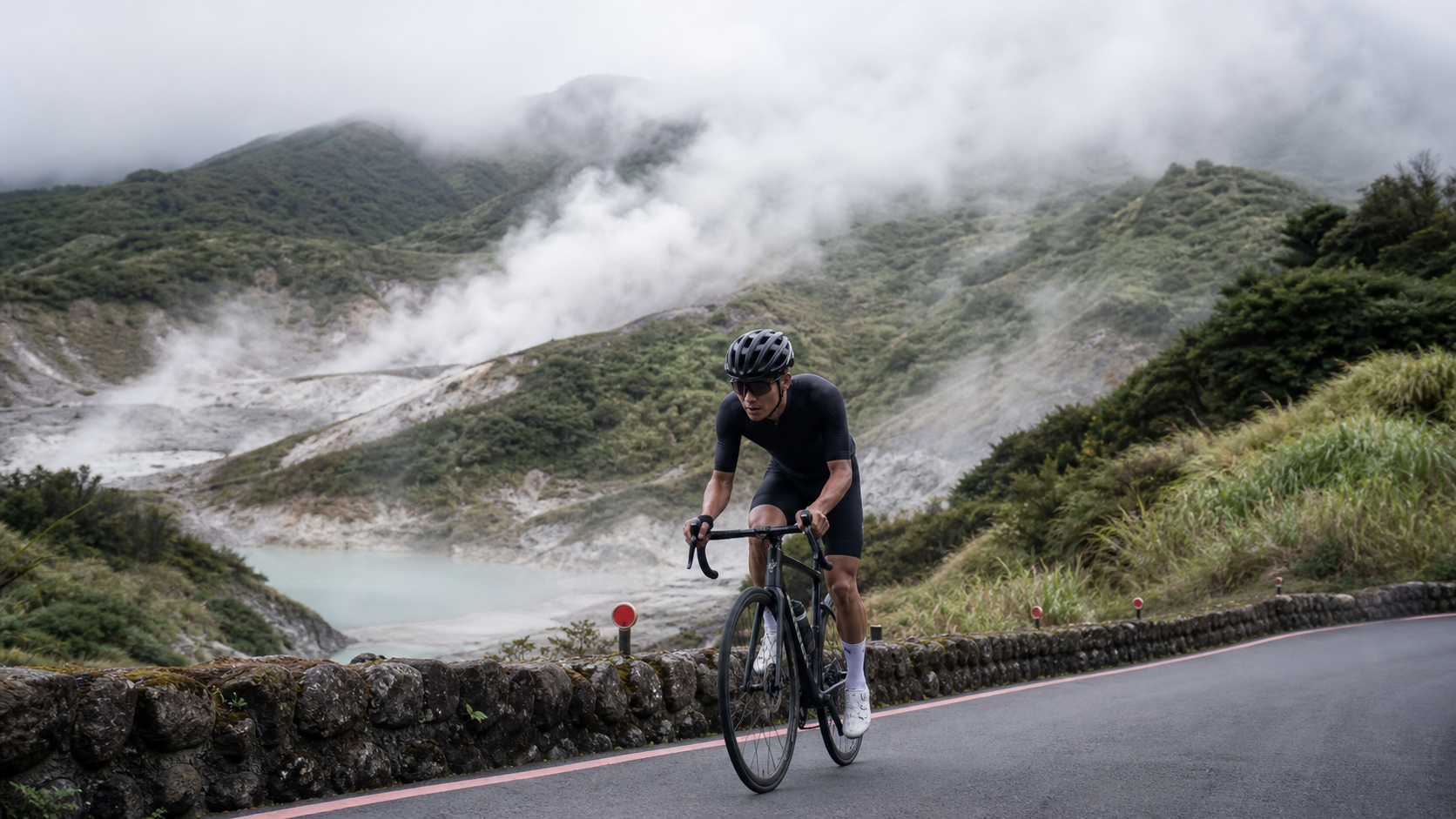
Lengshuikeng, on the eastern side of Yangmingshan National Park, stretches 3,593.1 meters with an elevation gain of 289.6 meters and an average gradient of 7.0%. Every time I ride this stretch, what greets me isn’t just the steep slopes, but also that faint, elusive scent of geothermal steam drifting over from the Sulfur Valley—this is the cycling memory unique to Lengshuikeng.
First Encounter with Lengshuikeng: A First Lesson Shaped by the Geothermal Scent
The first time I rode Lengshuikeng, I was tackling the eastern Yangmingshan route with the senior members of my cycling club. Before we set off, all my senior teammate said was: “This section is tough, average gradient is close to 7%, watch your breathing rhythm when you climb.” Back then, I didn’t have a concrete sense of what “7% average gradient” really meant. It wasn’t until I actually pushed down on those pedals that I understood the weight of that warning.
The opening stretch of Lengshuikeng offers almost no room to ease in. Shortly after setting off, the gradient climbs without mercy, and your legs and lungs are instantly thrown into high-intensity mode. I remember reaching the middle section that day when a faint, slightly pungent smell drifted by on the wind—that was the first time I realized I was riding through one of Yangmingshan’s famous geothermal landscape zones. Though the sulfurous scent wasn’t exactly pleasant, it unexpectedly pulled me back to reality from the pain of high-output effort, reminding me just how special the geography beneath my feet was: this is an active volcanic terrain, and the road under my wheels, along with the surrounding ridges, are all unique landscapes shaped by years of geological activity.
That day I finished the entire climb gasping for air, my legs so weak I could barely stand steady. But after reaching the top and looking back at the steep slope I’d just conquered, framed by the gradually opening geothermal views, that complex mix of exhaustion and awe left an impression on me from that moment on—one completely distinct from any other climbing route I’d ridden.
The Geological Story of Yangmingshan National Park: The Science Behind Sulfur Valley and Milk Lake
To understand why Lengshuikeng has such a distinctive geological landscape and scent, you first need to start with the geological background of Yangmingshan National Park. The Yangmingshan area is part of the Datun Volcano Group. Though currently dormant, the magma chamber beneath the ground continues to release geothermal energy, which is why this region features geological sights like Sulfur Valley and fumaroles. The Lengshuikeng area is one of the concrete manifestations of this volcanic activity—the occasional whiff of sulfur during a ride is the most direct evidence that volcanic activity is still ongoing beneath the earth.
Because of these unique geological conditions, the area also nurtures many distinctive natural landscapes, including bodies of water that take on a special milky-white hue due to mineral deposits. These unusual water colors, formed through geological processes, are among the most representative natural assets of Yangmingshan National Park, and they prompt many riders who visit to linger briefly after their ride to admire these rare geological wonders up close. For official announcements and on-site interpretation, it’s best to refer to the signage; riders interested in learning more are encouraged to visit the interpretive facilities set up by the Yangmingshan National Park Headquarters after their ride to gain a fuller understanding of the scientific story of this land.
For me, every ride up Lengshuikeng feels like a journey that combines a physical challenge with a geological science lesson. While my legs endure the soreness of a 7% average gradient on the steep slopes, my mind is also thinking about how I’m riding along the edge of an active volcano. This experience of “exercise and knowledge coexisting” is one of the key reasons Lengshuikeng keeps drawing me back.
Riding Through Mist and Clouds: Yangmingshan’s Signature Weather Magic
Because of its elevation and terrain, Yangmingshan National Park frequently experiences misty, cloud-wrapped weather, and this creates some of the most unforgettable moments in the Lengshuikeng riding experience. I remember visiting Lengshuikeng one early morning in late autumn. The weather was fairly clear when I set out, but halfway up, mist began to slowly rise from the valleys, and the once clearly visible mountain ridges were gradually shrouded in a thin veil of white fog.
Riding through that mist was a strange and wonderful sensation—though visibility was limited by the fog, the sounds around me were exceptionally clear, leaving only my own rapid breathing, the turning of the chain, and the occasional birdcall. The damp air brushed against my cheeks with a hint of coolness, forming a sharp contrast with my body, which was heating up from the effort of climbing the steep slope. In that moment, I felt cut off from the rest of the world, left only with myself, the steep road ahead, and the quiet mountain forest wrapped in mist.
Of course, such weather also brings challenges to riding—reduced visibility means you need to control your speed and watch the road more carefully, especially on sections with dramatic gradient changes. But it was precisely this tension of needing total focus, combined with the dreamlike visual effect of the swirling mist, that made that ride the most memorable of all my Yangmingshan cycling experiences.
The Road to Qingtiangang: Lengshuikeng’s Special Role as a Gateway
A large part of why Lengshuikeng holds a special place in the hearts of Taipei riders is its role as a key waypoint on the route toward the Qingtiangang grassland and the Qixingshan area. For many riders tackling the full eastern Yangmingshan loop, Lengshuikeng is often the pivotal section that connects the ride—after conquering this steep climb, the view suddenly opens up, transitioning from dense forest-lined mountain roads to the expansive high-altitude grassland scenery around Qingtiangang.
I’ll never forget the first time I finished Lengshuikeng and continued on toward Qingtiangang. While my legs were still trembling from the climb just completed, the scenery before me transformed dramatically within a short distance—the dense forest that had surrounded me gradually receded, replaced by an endless expanse of grassland, with wind rippling through the waves of grass, and in the distance, the occasional sight of water buffalo grazing leisurely. That narrative arc of “enduring a grueling climb, then being rewarded with vast, magnificent scenery” is the most moving part of the Lengshuikeng-to-Qingtiangang stretch, and it’s why this route has become a classic among Taipei riders.
This “bitter first, sweet later” route design, in a way, echoes the core spirit of cycling itself—the most memorable beautiful scenery often requires paying a corresponding physical price to reach. Lengshuikeng’s steep 7.0% average gradient challenge is precisely the threshold that must be crossed before reaching the magnificent grassland views of Qingtiangang.
Lengshuikeng by Season: A Different Flavor in Every Season
Because of its distinctive terrain and climatic conditions, Yangmingshan National Park, where Lengshuikeng sits, displays vivid seasonal changes, and visiting in each season offers a completely different riding atmosphere.
In spring, Yangmingshan is in full bloom. The flowers blossoming across the mountain add a touch of soft color to Lengshuikeng, an area otherwise known for its steep slopes and geothermal landscapes. Along the ride, you can occasionally catch glimpses of blooming trees and plants, offering a visual balm during the high-intensity climb. However, spring is also the busiest tourist season on Yangmingshan, so I’d recommend avoiding peak holiday hours and choosing an early weekday morning instead, so you can enjoy both smooth riding and a tranquil natural atmosphere.
In summer, although mountain temperatures are slightly lower than in downtown Taipei, the sustained high-gradient challenge combined with higher humidity makes the ride especially grueling. But precisely because of that, completing the Lengshuikeng challenge on a summer morning brings an especially unforgettable sense of exhilaration—drenched in sweat while feeling the cool mountain breeze on your skin.
In autumn, Yangmingshan generally enjoys the most stable and comfortable weather, and in my personal opinion, it’s the ideal season to visit Lengshuikeng. The crisp, clear autumn conditions, paired with the occasional misty scenery mentioned earlier and vegetation gradually turning red and gold, make the entire ride feel poetic.
In winter, Lengshuikeng reveals a completely different face. The low temperatures, strong winds, and thick fog brought by the northeast monsoon push the difficulty of this already steep climb to another level. But precisely because of that, the sense of accomplishment after conquering Lengshuikeng in winter is often far stronger than in other seasons. Of course, winter riding demands extra attention to warmth and safety precautions to avoid accidents caused by low temperatures and slippery roads.
Suggested Side Trips: A Complete Itinerary Combining Geological Landscapes and Grassland Scenery
If you’re planning a dedicated trip to ride Lengshuikeng, I strongly suggest planning a more complete itinerary to make full use of Yangmingshan National Park’s rich natural resources. Consider setting off in the early morning on a weekend or during a long holiday, completing the Lengshuikeng climb before the crowds flood in. After finishing, take a short rest to admire the nearby geothermal landscape up close, then decide based on your energy levels whether to continue on toward Qingtiangang to take in the expansive high-mountain grassland views.
For riders hoping to gain a deeper understanding of this land, I’d also suggest slowing down and paying attention to the interpretive signs and facilities set up by the Yangmingshan National Park Headquarters along the way, to more fully appreciate this unique region that combines volcanic geology, ecological landscapes, and cultural history—rather than treating it merely as a training ground for physical challenges.
Reflection by Milk Lake: An Inner Dialogue on Perseverance and Letting Go
Besides the geothermal landscape of Sulfur Valley, another scene around Lengshuikeng that left a deep impression on me is that body of water with its distinctive milky-white hue, formed by mineral deposits—what locals call “Milk Lake.” I’ll never forget the time I stopped to rest briefly by this water after finishing a high-intensity climb. That day I had just gone through an especially difficult ride—the sustained steep slopes in the middle section had nearly drained every ounce of my strength, and the steeper sections later on made me doubt whether I could even finish.
The moment I reached the final stretch and caught sight of that milky-white water, all the exhaustion and struggle from earlier seemed to dissolve in that tranquil scene. I leaned my bike to the side, sat alone in the nearby rest area, and quietly watched the small ripples stirred by the wind on the water’s surface. My thoughts drifted, almost involuntarily, to the various challenges and breakthroughs I’d experienced over the years of my cycling journey. In that moment, I realized that cycling gives people more than just physical training and accumulated mileage—it’s a process of repeatedly facing difficulties, pushing past your own limits, and in doing so, coming to know yourself better.
The unique milky-white color of Milk Lake is a natural wonder slowly built up through years of geological processes. And the riding strength and mental resilience I’ve accumulated through challenge after challenge at Lengshuikeng—isn’t it the same? There are no shortcuts; only through time and sustained effort, settling and accumulating bit by bit, can you eventually produce results that astonish. Every time I think back to that contemplative moment by Milk Lake, it deepens my emotional connection to this route beyond mere physical challenge.
A Contrast with Zhongshe Road: Two Roads, Two States of Mind
After riding both Zhongshe Road and Lengshuikeng, I’ve gradually discovered that these two routes evoke completely different states of mind. For me, Zhongshe Road feels more like a familiar old friend. Though the ride is demanding, the overall atmosphere is warmer and more familiar—the proximity to the city and the cultural ambiance around the National Palace Museum give the ride a touch of everyday warmth. Lengshuikeng, by contrast, delivers a completely different, more primal and majestic natural awe—the geothermal landscapes, the sulfurous scent, the mist-wrapped forests, and the transition to the open views of Qingtiangang grassland all make riding Lengshuikeng feel more like an expedition deep into the hidden wonders of Yangmingshan.
If Zhongshe Road taught me the patience of “steady accumulation and solid, consistent effort,” then Lengshuikeng taught me the courage of “facing bigger challenges and embracing unknown scenery.” These two different yet equally precious insights have shaped how I plan my rides—depending on my state of mind at the time. When I need to settle my thoughts and find a steady rhythm, I return to the familiar Zhongshe Road; when I long to chase more magnificent scenery and push my limits, Lengshuikeng is often my first choice.
This habit of choosing routes based on my state of mind might sound a bit romanticized, but for anyone who has a long-term passion for cycling, every route ridden repeatedly does gradually accumulate its own unique emotional significance. It stops being merely a training ground and becomes a special space carrying all kinds of memories and moods.
Encounters with Fellow Riders at Lengshuikeng: An Unspoken Bond Between Strangers
Yangmingshan National Park is a popular gathering spot for Taipei cyclists, and on weekends the Lengshuikeng area is often filled with riders from different clubs—even complete strangers—coming together. I particularly love this atmosphere: even if you don’t know each other, as long as you’re both in cycling shoes and on road bikes, facing the same steep climb, an indescribable sense of camaraderie and solidarity naturally forms.
I remember one time riding Lengshuikeng solo when I hit the sustained steep middle section and was clearly running out of energy, nearly ready to get off and walk. Just at that moment, a stranger also tackling the climb slowly rode up from behind. Without saying much, he naturally slowed down to keep pace with my crawl, occasionally offering brief words of encouragement: “Almost there, hang in there.” Two people who had never met simply rode side by side through the hardest part of the climb, exchanged brief thanks and words of encouragement at the top, then each continued on their own way. This warmth unique to cycling—one that transcends social distance—is another unforgettable memory I’ve gained from Lengshuikeng.
Similar scenes are actually quite common throughout the Yangmingshan area. Perhaps precisely because climbing is such a solitary and demanding endeavor, it makes it easier for strangers to develop a sense of shared struggle. Every time I think of these fleeting yet mutually supportive encounters with riders I didn’t know, I’m more convinced that the appeal of cycling lies not only in personal physical training and breakthroughs, but also in the human warmth that naturally arises from a shared love of the sport.
Lengshuikeng in the Dead of Night and Early Dawn: Different Faces Under Changing Light
Beyond the seasonal variations, Lengshuikeng also presents completely different atmospheres depending on the time of day you visit. I’ve tried setting out to challenge Lengshuikeng extremely early in the morning, just after daybreak. At that hour, Yangmingshan is extraordinarily quiet, with almost no other riders or tourists in sight. Only the morning light filtering through the treetops onto the damp road, accompanied by crisp birdsong, and the entire climb feels like being alone with the mountain forest. That serene, contemplative atmosphere is a world apart from the bustling holiday crowds, and it makes me treasure these rare moments of solitude.
Visiting in the afternoon, on the other hand, reveals a different face through the changing angles of sunlight—dappled light filtering through gaps in the leaves sways with the wind, casting ever-shifting patterns on the road, making the ride feel like passing through a flowing painting. Of course, the afternoon is also the period with higher risk of thunderstorms on Yangmingshan, so if you choose this time, be sure to keep a closer eye on weather changes and be prepared to adapt at any moment.
These differences in atmosphere at different times of day are another reason I keep returning to Lengshuikeng with such enthusiasm—even on the same route, simply adjusting the time of your visit lets you experience a completely different ride, as if every trip is a new exploration.
Autumn Silvergrass and Grassland Light: Extended Memories Toward Qingtiangang
Although this article focuses on the 7.0% average gradient challenge of Lengshuikeng itself, I’ve always felt that without mentioning the silvergrass scenery along the way toward Qingtiangang, this piece would be missing an important piece of the puzzle. Every autumn, the grasslands around Qingtiangang gradually shift to golden tones, and the silvergrass swaying in the wind, illuminated by the setting sun, creates an almost dreamlike play of light and shadow. I once deliberately chose a late autumn afternoon, and after conquering the Lengshuikeng climb, continued riding toward Qingtiangang just to witness that stunning scene of golden grass waves interwoven with the glow of sunset.
That ride was physically demanding, to say the least—first the sustained 7.0% average gradient of Lengshuikeng, followed by another considerable climb to reach the most open viewpoints around Qingtiangang. But when I finally stopped, breathless, and looked out at that grassland dyed gold by the setting sun, all my exhaustion dissolved in an instant before the beauty before me. That sense of accomplishment—“earning a one-of-a-kind landscape through the effort of your own legs”—is the core reason I keep loving the challenge of Lengshuikeng and its extended routes, and why I never tire of it.
For Those About to Take on Lengshuikeng: Words of Advice from Someone Who’s Been There
If you’re about to tackle Lengshuikeng for the first time, I’d like to offer a few sincere words of advice as someone who has returned to this route for years. First, don’t underestimate its difficulty just because it’s “only 3.59 kilometers.” A sustained 7.0% average gradient is enough to humble many riders who consider themselves in decent shape. Being fully prepared mentally and having the right gear matters far more than blind confidence.
Second, please slow down and take the time to appreciate the unique geological and natural scenery around this route. What makes Lengshuikeng special isn’t just the steepness—it’s that it embodies the most representative volcanic geological features of Yangmingshan National Park. If you treat it merely as a pure training ground and rush off as soon as you’re done, that would be a real shame.
Finally, I want to say this: whether you come with the mindset of pushing your physical limits or simply wanting to get close to Yangmingshan’s natural beauty, Lengshuikeng will not disappoint you. It will test your willpower in the most direct way—through steep gradients—while also healing all the hardship you endure during the challenge in the gentlest way—through mist, sulfurous air, and wide-open grassland views.
Conclusion: What Lengshuikeng Taught Me
Over the years, I’ve lost count of how many times I’ve ridden Lengshuikeng, but every ride brings slightly different feelings and discoveries—sometimes the dreamlike visuals of swirling mist, sometimes the geological awe of the sulfurous scent, sometimes the soul-soothing openness of the grassland views when continuing toward Qingtiangang, and sometimes the warm bond formed with complete strangers through shared struggle.
For many riders, Lengshuikeng’s 7.0% average gradient might just be a “necessary evil” along the eastern Yangmingshan loop. But for me, it has long transcended a mere physical challenge to become a special stretch of road carrying natural landscapes, geological knowledge, human warmth, and memories of personal growth. If you’re a Taipei rider who loves cycling, why not pick a clear day—whether you choose a lively holiday to feel the energy of fellow riders gathering, or a quiet early morning to savor the solitude of the mountain forest—and personally set foot on this steep yet story-filled slope? I’m confident that alongside the soreness in your legs, you’ll also gain your own unique memories of Yangmingshan.
Related Reading
- Lengshuikeng Practical Guide: 3.59 km, 290 m Elevation Gain, the 7.0% Average Gradient Battle on Yangmingshan’s East Side
- Yangjin Highway and Lengshuikeng: A Loop Ride Through Yangmingshan’s Volcanic Landscape
- Yangmingshan Trail Running: A Forest Experience from Beitou to Qingtiangang
- Yangmingshan Trail Marathon: The Complete Guide to Trail Running on Volcanic Terrain
台北闊瀨陡坡 騎旅 / 日本單車雜誌編輯車友臨時加入!/ 髮香才是最強的 / feat. 北迴歸線小隊 / 公路車 CT Yeh
6 個月前
半日 小台灣 極限單車路線挑戰實錄
7 年前
2016/05/13 單車 冷水坑下滑
10 年前
一日北高常見問題大集合 | 攻略 | 路線 | 訓練 | 補給 | 自行車 單車 | 一日雙城 | 雙塔 | TWB北高360 | 屁股痛
6 年前
萬年峽谷! 30% 超激陡坡 里佳部落DAY2 還是很硬! | 公路車 | CT Yeh
3 年前
嘉義大埔、阿婆灣挑戰賽,美到以為在日本!ft. 環騎5 Cool 西拉雅188 / 公路車 / CT Yeh
7 個月前
水金九不厭五分 10度寒流冷到不願停!feat. 卡卡 / 公路車 / CT Yeh
6 個月前
4K 東眼山 x 水蜜桃冰沙 百人單車約騎! 操完再吃冰 多爽快
7 年前