Pingjing Street Winter Cherry Blossom Lane: A Season-Limited Cycling Memory Hidden on the Yangmingshan Slope
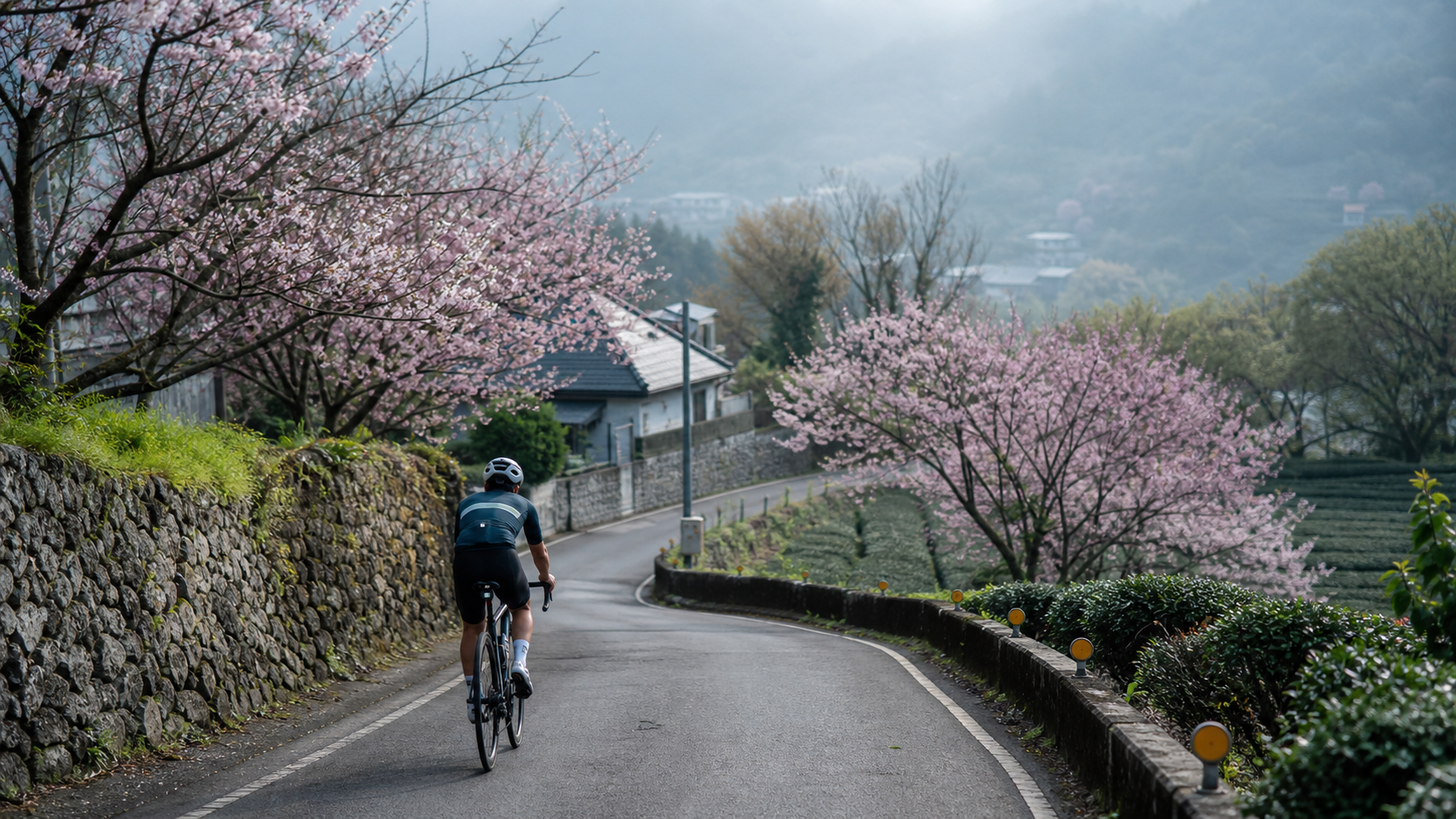
A mountain lane less than five kilometers long, yet it carries the deepest seasonal memory of “Yangmingshan cherry blossom viewing” for the entire Taipei cycling community. This is Pingjing Street—a road whose name you may not know, but whose photos you’ve surely seen.
1. First Encounter with Pingjing Street: An Underrated Shilin Mountain Trail
I first rode up Pingjing Street on an ordinary weekend morning. My original plan was to head straight for Lengshuikeng, with Pingjing Street merely a “pass-through” segment on my route—I didn’t expect much from it. But once I rode in, I realized this road’s presence was far more striking than its length on the map suggested.
Pingjing Street is located in Taipei’s Shilin District, nestled on the hillside zone of the Yangmingshan system, near the settlement around Pingdeng Village. It doesn’t have the heavy traffic and endless tourists of Yangde Boulevard, nor is it known for the sweeping vistas of the Balaka Highway. It is quiet, narrow, and winding, flanked alternately by low residential walls and tea gardens or fruit orchards. Riding through it, you get the illusion of “stepping into a private backyard garden kept by Taipei locals.”
For most people, the administrative district of Shilin conjures images of the night market and the National Palace Museum. Few would imagine that its boundary extends all the way into the heart of Yangmingshan National Park—and Pingdeng Village is one of the core settlements in this mountain area. The residents here have farmed for generations, historically relying on tea, vegetables, and fruit for their livelihood. In recent decades, as Yangmingshan tourism developed, some of the land was converted into leisure farms and scenic guesthouses. Pingjing Street is one of the main roads running through this settlement.
That morning, a thin mist still hung over the mountains. As I rode up this 4.66-kilometer road with an average gradient of 6.3%, I understood within a few hundred meters why route databases label it the “prelude to Lengshuikeng”—the gradient here is solid and not to be underestimated. But what impressed me even more were the old trees and low houses standing quietly along the roadside, as if reminding you that this isn’t just a training climb; it’s a place where generations of people have made their lives.
2. Lane 42 of Pingjing Street: A Shared Seasonal Memory for Cyclists and Flower Viewers Across Taiwan
If you search for “Yangmingshan cherry blossom viewing” in late winter or early spring, Lane 42 of Pingjing Street is a name that appears in nearly every guide. This lane is planted with a large expanse of cold cherry blossoms (kanzakura). When they bloom in full each January and February, pinkish-white and rosy-red hues interweave into a tunnel of flowers, drawing countless photography enthusiasts, flower-viewing tourists, and even couples arriving specifically for wedding photos.
Cold cherry blossoms typically bloom earlier than Yoshino cherries, which is why Lane 42 of Pingjing Street is often called one of northern Taiwan’s “first to report” cherry blossom landmarks. For cyclists, this creates a delicate timing situation—during the blooming season, Pingjing Street looks nothing like its usual quiet self. The narrow mountain road becomes packed with cars of self-driving flower viewers, illegal roadside parking is almost the norm, and pedestrians may step into the middle of the road at any moment to take photos. For riders grinding up the climb who need to focus on their pedaling rhythm, this is a riding scenario that demands extra vigilance.
But from another angle, this is also Pingjing Street’s most enchanting moment. I once deliberately visited on a weekday morning during the blooming season, before the crowds had flooded in. Morning light slanted through the flower path, and cold cherry blossom petals drifted slowly down onto the asphalt in the breeze. That quiet, intimate beauty is something you simply cannot experience during peak hours when the crowds are out. Riding beneath the flower canopy, my pace unconsciously slowed. This road, originally meant for “climbing practice,” became in that moment a landscape worth stopping for—to be felt with the eyes rather than measured by the bike computer.
If you’d like to experience this contrast yourself, my advice is this: separate “flower viewing” from “climbing practice.” On days when you truly want to challenge the gradient and build fitness, avoid the peak of the blooming season. When you want to purely soak in the beauty of the flower path, slow down—or even dismount and walk through the most congested sections, leaving the right of way and space to pedestrians and tourists taking photos. This is a sign of respect for the local environment and other users of the road, and it’s the unspoken etiquette that riders familiar with this road should observe.
3. Scenery Along the Climb: A Landscape Transition from Homes to Tea Gardens
The charm of Pingjing Street lies not only in the cold cherry blossoms of Lane 42—the landscape changes along the entire route are worth savoring in themselves. Riding in from the edge of Shilin’s urban area, you first pass through typical residential settlements, with brick walls and corrugated-iron roofs scattered about, carrying the distinctive lived-in feel of Taiwan’s mountain villages. As you climb higher, the houses gradually thin out, replaced by layered farm landscapes—residents here carry on the farming traditions of their forebears, with some land still planted with vegetables and fruit trees, while other plots have been converted into leisure farms and coffee gardens. This gives the route a bit of visual interest to enjoy between breaths on the climb.
Around the middle of the route, the views gradually open up. Looking back, you can faintly make out the urban outlines of Shilin and Beitou, and on clear days, even catch a distant glimpse of the greater Taipei Basin. This experience of “climbing brings views” is the shared reward of all mountain cycling routes—every bit of effort you put into the pedals buys you a slightly wider vista. This positive feedback loop is precisely why so many riders are willing to take on climbing routes again and again.
Pingdeng Elementary School, serving as the endpoint landmark of this route, is itself a small school nestled in the mountain settlement. It’s not large, but it’s an essential part of daily life for nearby residents. Riding up to it, you’ll notice an atmosphere completely different from urban elementary schools—the campus is surrounded by mountains, and the road children take to and from school might be the very same one you just huffed and puffed your way up. This contrast makes me stop and linger every time I reach the finish, imagining what it must feel like for the children living here to see this scenery on their daily commute to school.
4. Local Culture and the Texture of Daily Life: The Everyday Rhythm of Pingdeng Village
The name Pingdeng Village carries a plain and honest aspiration, and visiting in person, you can indeed feel the slow, grounded pace of life here. This area is part of the settlements surrounding Yangmingshan National Park, where residents’ lives are closely tied to the mountains and farming—far removed from the hurried pace of the city. Riding through in the early morning, you’ll often see early-rising residents tending flowers in their courtyards or delivering freshly harvested produce down the mountain by scooter. These everyday scenes form the most authentic texture of life around Pingjing Street.
The area is also dotted with numerous tourist attractions centered on leisure agriculture, including fruit-picking orchards, tea houses, and restaurants with panoramic night views of the city. Many Taipei residents drive up on weekends specifically to enjoy the fresh mountain air and taste seasonal local ingredients. For cyclists, these spots aren’t necessarily the focus of a ride, but if you’re like me and enjoy blending exercise with slow travel, consider finding a roadside tea house after finishing the Pingjing Street prelude. Order a pot of hot tea, gaze out at the misty mountain scenery, and let your body gradually shift from the high-intensity state of climbing back into a leisurely holiday mood.
I’ve had such an experience myself—one time after completing the full route, with daylight still to spare, I parked my bike in front of a small roadside tea house and ordered a simple tea snack. The owner was a longtime local resident, and as we chatted about the stories of this road, I learned that Pingjing Street was originally just an industrial road connecting the settlement to the city. It wasn’t until the cherry blossom viewing craze took off in the past decade or so that it gradually became known to the outside world. This background of “life first, tourism second” gave me a different kind of respect for this road—it wasn’t built for tourism or sport, but rather a local living road that tourism and sport “discovered.”
5. Seasonal Riding Strategy: When Is the Best Time to Ride
If you ask me for the best time to visit Pingjing Street, I’d answer by splitting it into two scenarios.
If your goal is flower viewing, the cold cherry blossom season in January and February is undoubtedly the best window—but be sure to avoid the peak hours from late morning to afternoon on weekends. Instead, go on weekday mornings or near dusk, when the blossoms are still at their best but the crowds have thinned, so you can truly enjoy that quiet, intimate flower path experience.
If your goal is pure fitness training and climbing practice, I’d recommend visiting in late spring (March–April) or autumn (October–November). In these two seasons, Taipei’s temperatures are relatively comfortable—not as muggy as summer, nor as damp and bone-chilling as deep winter—and mountain air quality tends to be at its best, making them ideal for long outdoor workouts. Summer is rideable too, but be sure to stick to the early morning hours to avoid afternoon thunderstorms and excessively high perceived temperatures.
As for ordinary weekends in winter outside the blooming season, Pingjing Street reveals its most primal face—quiet, cool, and occasionally wrapped in mist. If you enjoy mountain riding with a touch of solitude, this period offers a charm all its own.
6. Suggested Add-Ons: Fitting Pingjing Street into a Full Yangmingshan Day Ride
Visiting Pingjing Street on its own takes about an hour round trip, which for many riders may feel like “not quite enough.” My suggestion is to incorporate it into a more complete full-day Yangmingshan route. The classic combination is to head up from the Shilin or Beitou direction, first ride through Pingjing Street to warm up the legs on the climb, then connect onward to Lengshuikeng or Qingtiangang to enjoy the vast high-mountain grassland views, and finally, depending on how you feel, decide whether to extend toward the north coast in the Jinshan direction or turn back the same way.
If you’re not purely a performance-oriented rider and prefer a more leisurely pace, you could also consider fitting in the tea houses and scenic restaurants around Pingjing Street, or even arrange a half-day ride and half-day walk to enjoy the flowers, giving your body a balance of exertion and rest rather than keeping the entire trip at high intensity.
7. Final Thoughts: What This Road Taught Me
Looking back on my several visits to Pingjing Street, I’ve gradually come to understand that what truly makes this road captivating isn’t its gradient figures, nor just that stretch of blooming winter cherry blossoms, but rather what it represents as a microcosm of life in Taipei’s mountain areas—at the boundary between town and forest, people go about their farming and daily lives as usual, while outside riders and visitors, carrying cameras and bike computers, briefly pass through, document, and then leave.
Every time I ride up Pingjing Street, I remind myself to slow down a little—not just for pacing strategy, but to give myself the chance to truly see the unremarkable yet authentic scenery along the roadside: a freshly tilled vegetable plot, a half-open wooden window, an elderly person sitting by the door enjoying the shade. These images, more than any Instagram-worthy photo of cherry blossoms in full bloom, come closer to the true soul of this road.
If you haven’t ridden Pingjing Street yet, I sincerely suggest finding a clear morning to experience firsthand the first impression this “prelude to Lengshuikeng” leaves on you. It won’t be the longest or steepest road of your cycling career, but it very well might be one of those routes that, years later, you can still clearly recall the scenery and scents along the way. That, in itself, is the most precious meaning of cycling.
8. Pingjing Street with Friends: The Warmth of Climbing Together
Most of my memories of this route are from riding solo, but there have also been a few times when I tackled it with teammates from my cycling club, and the atmosphere was completely different. When riding alone, you focus more on your own breathing and heart rate, hearing the rhythm of your cadence and the sound of wind passing your ears; but when climbing with a group, even though everyone eventually spreads out due to differences in fitness, that psychological support of “knowing there are partners ahead or behind” makes the climb feel far less lonely.
I remember one group ride where we agreed to meet at 5:30 in the morning. The sky wasn’t fully light yet, and everyone had their bike lights on as we rode up Yangde Avenue and into Pingjing Street. In that group, there were newcomers who had just started road cycling and veterans with over a decade of experience. Naturally, everyone’s pace spread out, but the veterans tacitly slowed down, taking turns accompanying the slower riders to make sure no one was left too far behind. When we reached the open area near Pingdeng Elementary School at the top, everyone arrived one by one, high-fiving and taking photos. That sense of accomplishment after finishing, even on such a short route, was infectious for everyone present.
This also made me realize that although Pingjing Street is short, it’s an excellent “introductory route” for newcomers experiencing mountain climbing for the first time. The intensity is enough for beginners to feel the real challenge of climbing, but the length isn’t so demanding that it would make anyone fear or reject mountain riding from sheer hardship. It’s a great “initiation ritual” route. If you have friends who have just started road cycling and haven’t yet challenged mountain routes, by all means bring them to Pingjing Street and let them build climbing confidence in a relatively gentle way.
9. Pingjing Street and Yangmingshan National Park’s Seasonal Scenery
Beyond the winter cherry blossom season, Yangmingshan National Park offers its own seasonal scenery throughout the year, and Pingjing Street, as the gateway into this system, to some extent previews what lies ahead. In spring, besides the cherry blossoms, wildflowers and fresh greenery begin to emerge across the mountain, with the air carrying the scent of new plant growth; in summer, the mountain’s greenery is at its densest, and occasional afternoon clouds and mist lend the entire route a hazy, dreamlike beauty; in autumn, as the silver grass season approaches, although Pingjing Street itself isn’t a primary silver grass viewing section, riding here you can already sense the seasonal transition signals—the mountain breeze growing cooler and the sky becoming clearer; in winter, the occasional low temperatures and even light frost or fog on the mountain give this route a completely different, more desolate yet more evocative character.
Every visit, even riding the same road, offers different scenery and scents depending on the season. This is why, even though Pingjing Street is only 4.66 kilometers long, I’m still willing to return again and again—it’s not a route you “ride once and you’re done,” but one worth revisiting repeatedly, following the changing seasons and experiencing it anew each time.
10. Advice for First-Time Visitors
If you’re planning your first visit to Pingjing Street, here are some practical suggestions based on my own repeated experience.
First, transportation and parking. If you’re not riding up from the city but instead driving or taking a scooter to transport your bike up the mountain before assembling and setting off, I recommend planning your parking location in advance. Especially during flower season, mountain parking is extremely limited, and the later you arrive, the harder it is to find a suitable spot.
Second, timing. Whether to avoid traffic or to enjoy the best light, early morning is always the best time to visit Pingjing Street. The mountain air is fresh and the light is soft in the early morning, making it the most comfortable time of day whether you’re taking photos or simply enjoying the ride.
Finally, mindset. Although Pingjing Street isn’t long, the 6.3% average gradient combined with possible rolling terrain will still be a considerable challenge for riders tackling mountain climbing for the first time. Don’t underestimate it just because the distance is short, and don’t dismiss yourself because the climb is tough—treat it as an opportunity to understand your body’s limits, and you’ll find that the sense of accomplishment after finishing far exceeds what that short 4.66-kilometer number could ever represent.
11. Pingjing Street as Told by the Elders: Place Names and Land Memory
Once, at the doorway of a house along Pingjing Street, I met an elderly man tending his yard. As we chatted, I learned he had lived in this mountain area for over sixty years. He told me that the name “Pingjing” actually reflects the area’s early topography and vegetation characteristics—the hillsides were once extensively planted with tea bushes and bamboo groves, and residents mostly made their living from farming. It wasn’t until a few decades ago, as transportation infrastructure gradually improved and the tourism spillover from nearby Yangmingshan National Park took effect, that this mountain area slowly transformed from a purely agricultural settlement into one combining leisure and tourism.
Listening to these stories, I looked at the winding asphalt road before me and suddenly felt that every rotation of my pedals was layered upon the life trajectories of generations who had lived on this land. For me, this road is a recreational route for burning energy and seeking cardiovascular stimulation on weekends; but for this elderly man and his father and grandfather before him, this road likely carries far more complex and profound memories—it was a commuting route, a route for hauling produce down the mountain to sell, and a route that witnessed this mountain area’s gradual transformation from a simple farming village.
Such conversations have given me a different layer of understanding about “cycling.” We often reduce cycling to the pursuit of data and records—how fast we finished, how much elevation we gained, what heart rate zone we maintained—but if we’re willing to slow down and exchange a few words with the residents along the way, you’ll discover that behind every route lies a story far richer and more deserving of being heard than any data. This is also why, even though I’ve ridden Pingjing Street’s gradient and distance countless times and know the numbers by heart, I’m still willing to return again and again—because every visit might bring encounters with different scenery and stories.
12. To You, the Next Visitor of Pingjing Street
If you’ve read this far and now have a solid understanding of Pingjing Street, I’d like to leave you with one final reminder: don’t treat it merely as a “check-in route” to ride and then leave. Take some time to visit on ordinary days outside the flower season, and see what this road truly looks like without the crowds; find an opportunity to chat with the residents or tea house owners along the way, and listen to their stories of Pingjing Street; and by all means, visit repeatedly across different seasons to experience how the same road presents itself differently through spring, summer, autumn, and winter.
The most precious part of cycling is often not how many personal records you’ve broken, but the scenery and human warmth you unexpectedly encounter along the way. With its mere 4.66 kilometers, Pingjing Street carries one of the gentlest memories within the Yangmingshan system. May you too find your own moment of inspiration on this road.
13. Pingjing Street in the Rain: Another Kind of Quiet Companionship
Beyond the beauty of the flower-lined path on clear mornings, I have also visited Pingjing Street on drizzly days. That day, I had only intended to pass through casually, but the street in the rain offered me a completely different experience. Raindrops struck the leaves along the roadside, producing a fine, rhythmic patter. The air was filled with the mingled scent of rain-soaked earth and vegetation, and the asphalt reflected the gray daylight. The entire street lacked the bustle of sunny days, replaced instead by a stillness that bordered on being frozen in time.
Riding in such weather naturally slows the pace considerably. On one hand, it is a matter of safety—the wet road demands extra caution. On the other hand, the atmosphere itself makes one instinctively want to ease off and fully absorb everything around. Passing by the homes and tea houses that are usually bustling, they felt remarkably quiet in the rain. Occasionally, I would spot a cat sheltering under an eave or a resident hurrying past with an umbrella. These scenes formed a slice of life entirely different from visiting on a clear day.
Riding Pingjing Street in the rain taught me that the charm of this road lies not only in its splendor on sunny days when the flowers are in full bloom, but also in the serene, grounded sense of everyday life it still radiates on overcast, ordinary days. This multi-layered beauty is precisely why this road deserves to be visited and experienced again and again.
14. Beyond the Article: Life Lessons from Pingjing Street
Having visited Pingjing Street repeatedly over the years, I have gradually come to understand certain life principles from this road that seem unrelated to cycling yet are deeply intertwined with it. The most important lesson this road has taught me is the wisdom of “rhythm”—whether it is the rhythm of breathing while climbing, the rhythm of cadence, or the psychological rhythm when facing life’s pressures, a steady, sustained, and unhurried attitude will often carry you further than a momentary burst of sprinting.
Every time I finish riding Pingjing Street and catch my breath near Pingdeng Elementary School, looking back at the mountain road I just climbed, I am reminded of the nervousness and unfamiliarity I felt on my first ride up this road. Compared to now, when I can handle its gradient changes with ease, this trajectory of growth also mirrors the transformations and accumulations I have experienced in other aspects of my life over these years. Perhaps the most fascinating thing about sport is that it shows you your progress and your limits in the most direct and honest way—and Pingjing Street is one of the yardsticks I use to measure my own growth.
Related Reading
- Pingjing Street Climbing Guide: 4.66 km at 6.3% Average Grade, A Complete Breakdown of the Cold Water Pit Prelude
- Pingxi, Jingtong, Shifen Old Street Cycling Trip
- Taipei Yangmingshan Cycling Route: The Climbing Experience from Yangde Avenue to Zhuzihu
- Keelung Nuannuan to Pingxi Route: A Unique Riding Experience Through Northern Taiwan’s Mining Landscape
5 ℃ 櫻花之旅 / 75萬單車直接雨中洗車.../ 平菁街 / 北迴歸小隊 / 公路車 / CT Yeh
5 個月前
太平山單車員工旅遊 | 這樣玩CP值最高!| 公路車
5 年前
虎豹潭!日本老師來台一日約騎 台灣車友熱情招待私房路線 / CT Yeh
20 天前
高雄綠園道鐵路自行車道 / 外地人能輕鬆駕馭 還是整路崩潰? / 2025 全線開通 春節實地探索一次!(附GPS連結)/ 公路車 / CT Yeh
1 年前
觀霧 變好騎了! | 北高車友爆笑大會師 | 公路車 | 單車旅遊 Taiwan Cycling Route GuanWu
6 年前
台北闊瀨陡坡 騎旅 / 日本單車雜誌編輯車友臨時加入!/ 髮香才是最強的 / feat. 北迴歸線小隊 / 公路車 CT Yeh
6 個月前
密境!雙灣自行車道 / 環法日月潭 x YAKIMA 百人大約騎 / 公路車 / CT Yeh
11 個月前
司馬庫斯 | 單車員工旅遊 | 比武嶺還接近上帝的路 | 2021 全面實況 路況解析 | 空拍 櫻花炸開超濃密 | 財伯觀光果園 | CT Yeh
5 年前