Riding Through Namasia: Memories of the Bunun and Kanakanavu Along the Nanzihsian River, and the Resilience of Post-Disaster Reconstruction
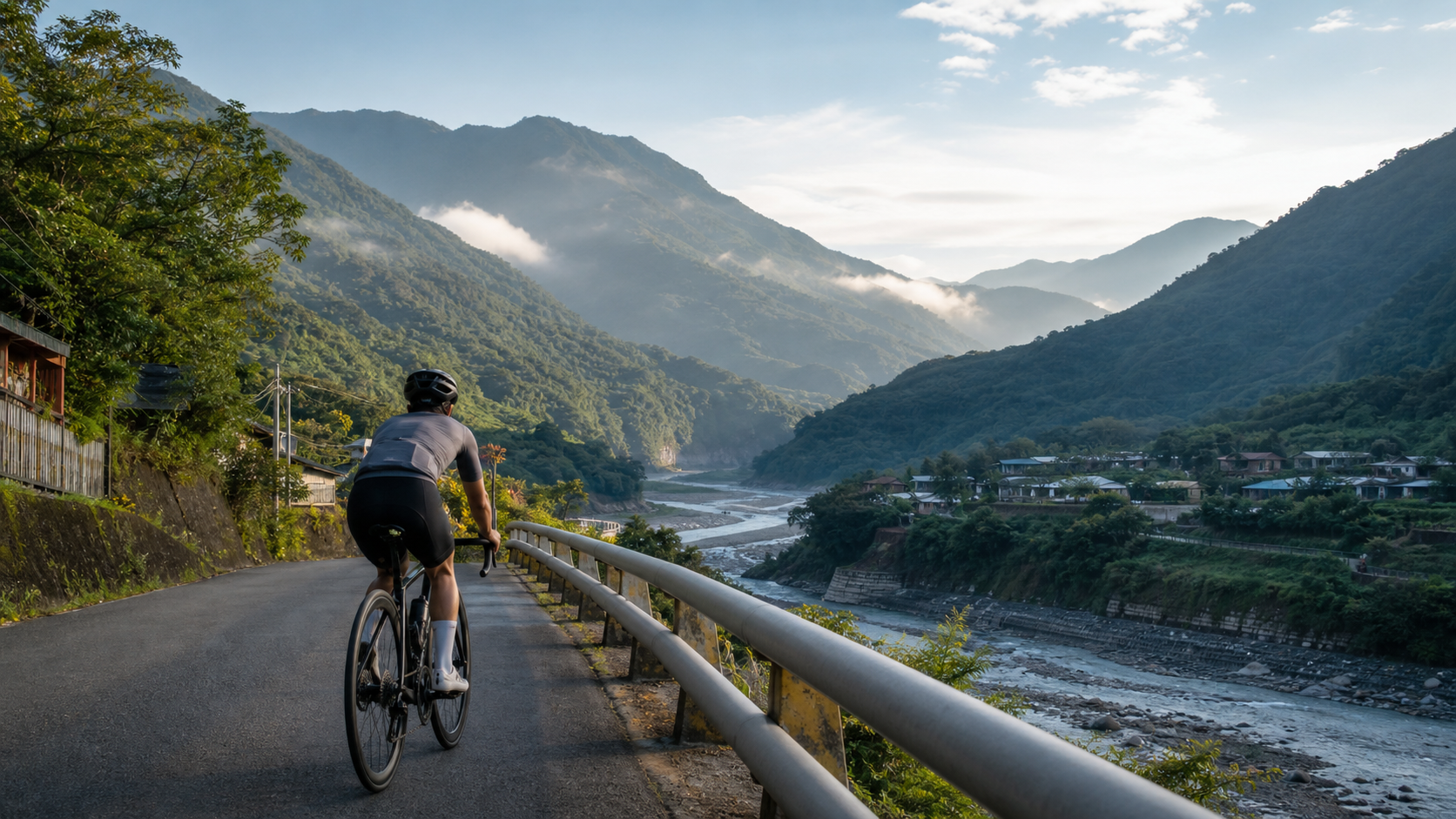
Namasia—the name itself is a story. It originates from the indigenous languages spoken in the Nanzihsian River basin, carrying the memories of generations of Bunun and Kanakanavu people who have lived here. The moment I wheeled my bike out of the Cinghe settlement, the front tire rolled not just over the asphalt of Provincial Highway 20A, but also over a long history woven from nature, ethnicity, and reconstruction.
Departure: A Morning in the Cinghe Settlement
In the early morning, Namasia’s air still carried the distinctive dampness and coolness of the Nanzihsian River valley. Cinghe is one of the important settlements distributed along the river in Namasia District, and it is where this riding story truly begins. After wheeling the bike off its rack, checking tire pressure and water bottles, I stood at the intersection gazing at the layered mountain ridges in the distance. For a moment, I couldn’t quite tell whether I had come for a 13.5-kilometer ride, or for something far harder to put into words.
Namasia District lies at the extreme northeastern corner of Kaohsiung City—the most remote and deepest part of the city geographically, the land closest to the Central Mountain Range. This is the ancestral homeland of the Bunun and Kanakanavu peoples. Over the long passage of time, these two ethnic groups established their own settlements and ways of life along the Nanzihsian River—the upper reaches of the Qishan River. Cinghe, Dakanuwa, Nansalu—these place names may be nothing more than markers on a map to outsiders, but to local residents, each name represents the coordinates of an entire family, an entire life history.
I recalled the research I had done before planning this ride, and learned that the name “Namasia” is actually a relatively recent administrative designation. It is a phonetic transliteration from the local indigenous languages, intended to more closely reflect how the indigenous peoples refer to this land, rather than perpetuating older place names that carried an outsider’s perspective. This single shift in naming alone is enough to make one feel that this land and its people have always been seeking a way to be seen and understood by the outside world that is closer to their own cultural subjectivity.
As I mounted the bike and pushed down on the first pedal stroke, I told myself that this ride was not merely about completing a route, but about passing through with reverence—passing through a homeland where generations of people have lived, passing through a long story written jointly by the land and its people.
Along the Nanzihsian River: A Dialogue with the Land of the Bunun and Kanakanavu
Riding slowly along Provincial Highway 20A, I could frequently glimpse the winding valley of the Nanzihsian River on my right. This river is not merely a geographical waterway; it is the axis of life for the Bunun and Kanakanavu peoples throughout the Namasia region—the people lived by the river, hunted in the mountains, and farmed the land, forming a wisdom of life deeply intertwined with nature.
The Bunun are an indigenous people of Taiwan whose traditional territory spans both sides of the Central Mountain Range, renowned for their exquisite hunting culture and the Pasibutbut (eight-part polyphonic singing). The Kanakanavu, meanwhile, are another important yet long-underrecognized ethnic group on this land. In 2014, the government of the Republic of China officially recognized the Kanakanavu as the 16th indigenous people of Taiwan. This belated yet profoundly meaningful recognition finally granted the Kanakanavu language, rituals, and cultural subjectivity their rightful place and respect within the official recognition system.
Riding along this road, I deliberately slowed down, trying to imagine the figures of the ancestors as they migrated, farmed, and hunted along this river valley over the centuries. This land is not a blank canvas waiting to be developed or observed; it is a homeland already imbued with profound cultural meaning. As a traveler riding in from elsewhere, I reminded myself that perhaps the best way to show respect is to approach with humility and curiosity—not to view the ethnic cultures here through a lens of exoticism or consumption.
Occasionally along the way, I noticed architectural decorations blending traditional totemic motifs with modern design—the people’s way of expressing their culture through contemporary language. I made no deliberate attempt to depict any specific tribal landmark or particular activity, because what I truly wanted to record was the genuine reverence that arose as I rode through—this mountain forest and river valley is a living cultural space, not merely a contour line on a cycling route map.
The sound of the Nanzihsian River’s waters, accompanied by the rhythmic whir of the chain and cassette, formed the most primal soundtrack of this journey. I think this is perhaps the most precious reward of riding a route with such cultural significance—you don’t just measure a distance with your legs; you use all your bodily senses to draw close to the true breathing rhythm of a piece of land.
The Resilience of Reconstruction: Typhoon Morakot and Namasia’s Road to Rebirth
Without mentioning the typhoon that changed this land’s fate in 2009, this riding story would be incomplete. In August of that year, Typhoon Morakot brought record-breaking rainfall to the mountain regions of central and southern Taiwan. Namasia District bore the brunt of the impact and suffered devastating damage. The Nanzihsian River surged, landslides destroyed parts of the settlements, and portions of Nansalu—then known as Minzu Village—were catastrophically devastated. This disaster, known as the “88 Flood” (August 8 Flood), claimed many precious lives and permanently altered the life trajectories of countless residents.
As I rode through the relevant sections of the road, I deliberately slowed down. The pain that occurred here is not material to be consumed or gawked at; it is the real weight borne by this land and its people. After Typhoon Morakot, the people of Namasia faced the dire circumstances of destroyed homes and the forced relocation of some settlements. This was a long and arduous reconstruction process, involving land safety assessments, relocation planning, and the reestablishment of livelihoods—far more complex and protracted than outsiders might imagine.
Yet it was precisely in the wake of such devastation that we witnessed the resilience shown by this land and its people. After years of sustained effort, Namasia gradually rose again from the trauma of the disaster. Residents rebuilt their homes on safe land, restored their livelihoods, and transformed the resilience forged through suffering into a deeper appreciation and guardianship of this land. This is one of the most representative cases in Taiwan’s modern history of major post-disaster reconstruction, and it reminds every traveler passing through: the serene and peaceful mountain forests and river valleys before our eyes have endured tremendous pain and trials.
As a traveler passing through on a bicycle, I have neither the qualification nor the right to trivialize this history through casual consumption. What I can do, perhaps, is pass through with reverence, remember quietly, and—by riding this route—give more people the opportunity to learn about the pain and rebirth this land has experienced, so that they may approach every local community’s efforts to rebuild their homeland with greater humility and respect.
As I continued riding toward Taoyuan District, I noticed that some sections along the route still retain engineering structures related to disaster prevention and soil and water conservation. These seemingly ordinary infrastructure projects are, in fact, concrete efforts made by Namasia and the surrounding areas to safeguard their homeland after the typhoon. They may be unremarkable, yet they silently tell the story of how the people of this land responded to that immense catastrophe through action.
Between the Pedals: A First-Person Narrative of the Scenery
As I rode through the rolling sections in the middle of the route, my breathing began to grow slightly heavier with the gradient, but my view opened up remarkably at that moment. Looking back, the Qinke settlement had already disappeared into the winding mountain contours behind me, while ahead, in the direction of Taoyuan, layer upon layer of dark green mountain ridges stacked into the skyline. Such a scene made me temporarily forget the cold numbers of cadence and heart rate, allowing me to immerse myself purely in the sensory impact brought by this vast and magnificent mountain forest.
The vegetation along Provincial Highway 20Jia is remarkably rich, from the towering native trees lining the roadside to the occasional fruit orchards dotted in between, forming a layered mountain tableau. A gentle breeze swept through the treetops, carrying the fragrance of grass and trees, mingled with the moist air of the stream valley—a memory of scent that can never be replicated in the city. As I pedaled, I tried to imprint the scenery before me, frame by frame, into my mind—this is the most enchanting part of cycling: the speed is just fast enough to penetrate the depths of the geography, yet slow enough to allow the senses to savor every detail along the way.
Along the way, I passed several bends with expansive views, offering distant vistas of the magnificent Nanzihsian River Valley. Under the sunlight, the river water shimmered with rippling light, the cliffs on both banks steep and verdant, with the occasional egret or other stream bird skimming across the water’s surface, adding a touch of vibrant life to this tranquil valley. I stopped the bike, took a sip of water, and stood quietly by the roadside for a few minutes, letting the mountain breeze brush against my cheeks—moments like this might be the most precious harvest of this entire cycling journey.
As I remounted the bike and continued toward Meishankou, my legs began to feel a slight soreness from the rolling terrain, but my mind was unusually calm. Perhaps it was because the scenery before me was so moving that the physical fatigue seemed utterly insignificant. This is the greatest difference between a cultural route and a purely competitive one—you are not just riding gradients and distances, but also a journey of dialogue with the land and its history.
During the ride, I also noticed that along the way, one could occasionally see public art installations and community imagery inspired by traditional Bunun or Kanakanavu patterns, integrated with modern design language. These works did not ostentatiously steal the spotlight but sat quietly at the entrances of tribal villages and around community activity centers, like a gentle yet firm cultural declaration—whose homeland this is, is clear at a glance. Looking at these visual languages that blend tradition and contemporaneity, I could not help but think that cultural inheritance has never been about rigidly replicating the past, but rather about each generation of tribal members continuously interpreting and sustaining their own cultural roots in ways they understand. This dynamic, living cultural practice conveys a people’s authentic and vibrant existence far more powerfully than any static museum display.
As the mountain road continued to ascend, the sound of the stream valley grew nearer and farther with the changing terrain. On several stretches, the river water rushed almost directly beneath the roadbed, the white spray from water striking rocks glistening under the sunlight, like a gift freely given by this mountain forest to every traveler passing through. I tried to hold these moments in my memory—not to capture a perfectly composed photograph, but simply to preserve such sensory memories well within my life experience.
Seasonal Delights: Plum Orchards, Fireflies, and Organic Agriculture
In recent years, Namasia has attracted many travelers to visit during specific seasons under the reputation of being home to one of the world’s largest plum orchards. During the annual plum blossom season, the snow-white sea of flowers covering the mountains drapes this forest in a dreamlike guise, forming a striking and beautiful contrast with the lush green mountain hues of ordinary days. Although the season of my ride did not necessarily coincide with the blooming period, I could still see stretches of plum trees along the way. Imagining the spectacular sight of the mountains covered in white during the flowering season, I already began planning to revisit this route at the right time of year.
Besides plum blossoms, Namasia’s firefly season is equally an annual event eagerly anticipated by many ecology enthusiasts. Every spring, as temperatures warm and humidity rises, the season arrives when fireflies dance actively through the mountain forests, their specks of bioluminescence flickering in the valleys as night falls, composing a romantic and dreamlike natural wonder. To some extent, such ecological abundance also reflects that the local environment of Namasia, through long-term conscientious stewardship, still retains a remarkably high degree of primitiveness and purity.
In terms of organic agriculture, Namasia has actively developed environmentally friendly farming practices in recent years, with sweet persimmons and bird’s-nest ferns being well-known local agricultural products. While riding along, I could frequently see terraced orchards and vegetable fields arranged in layers along the mountain contours—a concrete manifestation of the tribal people’s dedicated stewardship, coexisting and thriving with this land. This path of organic agricultural development not only brings stable livelihoods to local residents but also allows Namasia to gradually forge a sustainable route that combines ecological conservation with local economic development.
As I rode, I thought about how these seasonally limited beauties—whether plum blossoms, fireflies, or organic produce—are all inextricably linked to the resilience of this land after its reconstruction from the disaster. It is precisely because the residents are willing to continue guarding this land and diligently managing its ecology and agriculture that Namasia has been able, after its wounds, to gradually develop such a rich and moving eco-tourism landscape, attracting travelers to return again and again.
For Namasia, the development of eco-tourism is not merely a matter of tourism economics; it is also a process of rebuilding a relationship of trust with the land. After the disaster, residents had to reassess which lands were suitable for habitation, which hillsides needed to lie fallow and recover, and which areas should be reserved for natural ecosystems to restore themselves. This prudent, long-term approach to land use is, to some extent, also reflected in the development strategies of organic agriculture and eco-tourism—not pursuing rapid short-term development, but choosing a slow pace of harmonious coexistence with the natural environment. As I rode past those orchards terraced up the mountain slopes, I could sense that behind these farmlands lies a generation of tribal people relearning how to live well with this land that once brought them pain yet remains their home.
The development of organic agriculture has also given the younger generation of Namasia an additional possibility of staying in their hometown. In the past, young people from mountain tribes often had to leave their villages for the cities to make a living due to limited employment opportunities. But as industries such as eco-friendly farming and eco-tourism gradually take shape, more and more local youth are beginning to consider how to leverage their profound understanding of this land to develop industrial models that sustain their livelihoods while also perpetuating cultural and ecological values. This transformation might be one of the most moving trajectories of recovery for this land after the devastation of the disaster.
Arriving at Meishankou: The End of One Journey, and the Beginning of Another
When the landmark of Meishankou gradually came into view, a complex emotion welled up within me—both a sense of fulfillment at completing this stretch and a hint of reluctance that this journey was drawing to a close. Meishankou is an important landmark of Taoyuan District and a key junction connecting to the higher-altitude sections of the Southern Cross-Island Highway. Many long-distance riders with the Southern Cross as their ultimate goal use this place as an important midway rest stop, pausing briefly to replenish their energy before continuing to challenge the Yakou Pass.
Stopping the bike and looking back at the road I had traveled, the Nanzihsian River Valley had already disappeared behind the layered mountain ranges. This short 13.5-kilometer stretch carried meaning far heavier than its length—it gave me the opportunity, in the most intimate way with the land, to pass through the homeland where the Bunun and Kanakanavu peoples have lived for generations, to witness the magnificent and ever-changing natural scenery of the Nanzihsian River basin, and also to contemplate with reverence the wounds that Typhoon Morakot brought to this land, as well as the astonishing resilience and rebuilding strength the tribal people demonstrated in the aftermath.
For me, the significance of this ride has long surpassed mere exercise or a route challenge. It was more like a pilgrimage of the land undertaken with humility—using the rhythm of my legs and cadence to draw close to a mountain forest full of stories; using my eyes and breath to witness the process of a people’s culture being seen and recognized anew; and using the most sincere respect in my heart to remember the modern history woven from pain and reconstruction.
For Every Rider About to Depart: Ride with Respect
If you are also ready to ride this route from Namasia Qinhe to Taoyuan Meishankou, I want to invite you not to treat it merely as a training route. Every inch of this land carries the profound cultural memory of the Bunun and Kanakanavu peoples; every stretch of river valley here has witnessed a typhoon disaster that changed the fate of countless families, along with the reconstruction process that followed and took years to gradually complete.
As you ride through these mountains and river valleys, perhaps you can occasionally slow down—not just to handle the rolling terrain that may appear in the middle section of the route, but also to leave yourself some time to quietly feel the stories this land wishes to tell. Whether it is the snow-white sea of plum blossoms in bloom, the scattered firefly lights during firefly season, or the wisdom of the indigenous peoples living in symbiosis with the land behind organic farming, these seasonal wonders are proof that this land, after enduring pain, still chooses to face the world with gentleness.
Riding has never been merely the movement of the body. When you complete this 13.5-kilometer journey and arrive at Meishankou, I believe what you take away will not just be a ride completion record, but a deeper understanding of and respect for this land, its peoples, and its history. And perhaps that is precisely the most precious and most worthy meaning of cycling travel—one that deserves to be told again and again.
A Postscript: A Self-Reminder About Respect and Gaze
Throughout the process of writing down this riding experience, I have kept reminding myself of one thing—as a traveler who came from elsewhere and passed through this land briefly, what I can see and understand is, after all, only a small slice of this land’s and its peoples’ stories. The cultures of the Bunun and Kanakanavu are profound systems accumulated over thousands of years, continuously passed down and interpreted by the people themselves—not something any cycling travelogue can fully capture in a few words.
I have been especially careful to avoid depicting any specific ritual scenes, details of tribal activities, or deliberately romanticizing some kind of “exotic” imagery in the article from a voyeuristic or consumptive perspective. Such writing, even when well-intentioned, can easily and imperceptibly fall into the trap of objectifying and labeling indigenous cultures. What I hope this article conveys instead is a humble posture of self-awareness—acknowledging the limits of my own understanding, while also encouraging every reader who is genuinely interested in Bunun or Kanakanavu culture to learn through more direct and deeper channels, such as following cultural promotion activities led by the indigenous people themselves, or reading historical and cultural records written or orally narrated by them, rather than relying solely on fragmented impressions from a cycling travelogue.
Similarly, regarding the narrative of Typhoon Morakot in 2009, I have deliberately avoided overly sentimental or dramatized prose. For many residents who still live in the Namasia and Taoyuan areas, that disaster is not a distant historical event, but a personal pain they truly experienced—some may even have lost loved ones. As a writer, I believe the most basic form of respect is to state the facts honestly—the typhoon indeed brought devastating losses, and the reconstruction process was indeed long and arduous—but without over-dramatizing details, and certainly without consuming this pain as material to attract readers’ attention.
If you finish reading this article and decide to ride this route yourself, I want to invite you to carry this self-reminder with you as well. Appreciate the scenery with your eyes, feel the terrain with your body, but also approach with a humble and open heart the understanding that you are passing through a land with its own complete stories and its own cultural subjectivity—not merely a cycling route waiting to be checked in and completed. Such a ride may be a little slower, with more time spent lingering, but I believe what you take away will be all the richer and more memorable for it.
Related Reading
- Kaohsiung Sanmin to Namasia: A Complete Guide to the High-Difficulty Climbing Route Through Mountain Tribes
- Riding into Dona: Slate Houses, Zhuokou River, and Rukai Tribal Memories After Typhoon Reconstruction
- Ninety Kilometers Riding Along the Pacific: From Zhonghua Bridge to Bawengweng, a Long Journey on the East Coast to Rediscover Place-Name Memories
- The Rebirth Road of Dewen Tribe: A Cycling Journey of Migration, Resilience, and Land Memory
那瑪夏x茶山 阿里山系深山單車行 Day2 累積爬升6000M | 🥶超陡連續下坡 整路看隊友刷 | 爬升一座西進武嶺 | JJSC | 公路車 | CT Yeh
3 年前
大武山20%魔王陡坡【JJSC南台灣遊騎Day2】!屁股真的要裂開了...凡士林抹滿也沒用?神秘金教堂還有超便宜夜市
3 個月前
台北闊瀨陡坡 騎旅 / 日本單車雜誌編輯車友臨時加入!/ 髮香才是最強的 / feat. 北迴歸線小隊 / 公路車 CT Yeh
6 個月前
大武山後門26%歡樂陡坡!JJSC南台灣單車行Day2 / 被颱風追著跑 / 公路車 / CT Yeh
2 年前
藤枝二集團 單車行 Day1 | 南部小武嶺 | 爬坡爬到罵罵叫 | JJSC | 公路車 | CT Yeh
3 年前
#北橫 + #北進武嶺 最硬的員工旅遊 EP1 | #公路車 #拉拉山 | 明池 | 武嶺 | 武陵農場 | 雲海 | Taiwan Cycling Route Wulin
6 年前
嘉義大埔、阿婆灣挑戰賽,美到以為在日本!ft. 環騎5 Cool 西拉雅188 / 公路車 / CT Yeh
7 個月前
一定要騎一次!阿里山最深處:里佳部落!單車旅行 | 2800m爬升 | 深度部落體驗:嗨翻晚會、螢火蟲、銀河 | feat. JJSC & 廢物伙伴 | 公路車 CT Yeh
9 個月前