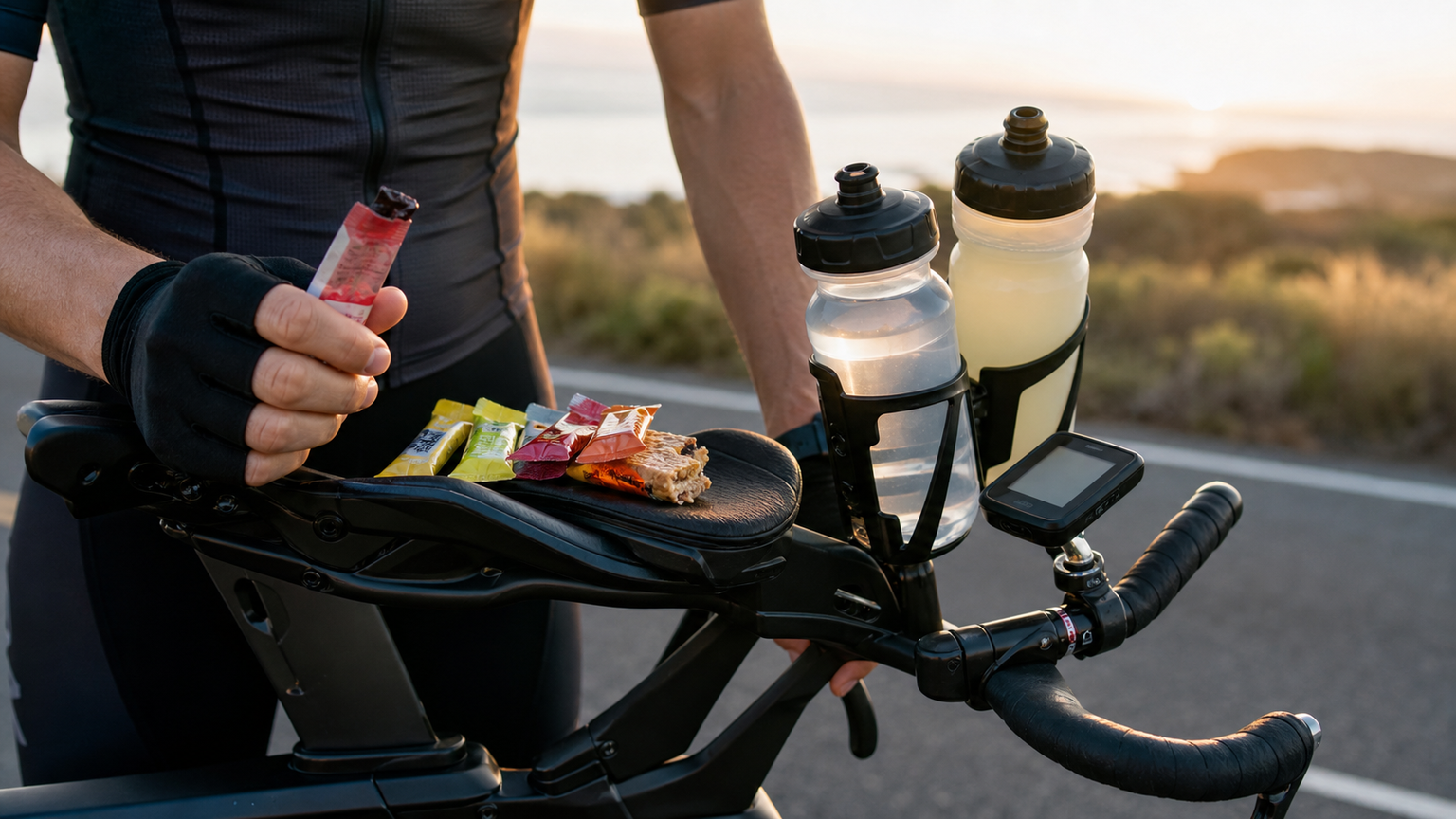
The Run Falls Apart—The Root Cause Is the Bike Leg
Cramping, nausea, and hitting the wall during the 70.3 run are often caused by poor fueling rhythm on the bike leg. The ideal intake for middle-distance racing is 60–90g of carbs per hour, and the bulk of it must be done on the bike, because absorption capacity drops sharply during the run.
The 90km Bike Fueling Pipeline
| km | Action | Carbs/Fluid |
|---|---|---|
| 0–10 | Water only to settle heart rate | 150ml water |
| 20 | First gel | 25g + 200ml sports drink |
| 35 | Solid (half an energy bar) | 20g |
| 50 | Second gel + electrolytes | 25g |
| 65 | Big sip of sports drink | 30g |
| 80 | Last gel | 25g |
| 85–90 | Water only, prepare for transition | 150ml |
Total intake is roughly 145–170g of carbs across the leg (about 30–35g/h for a 5-hour race, reaching the 60g/h target when combined with run-leg supplementation).
The Absorption Advantage of Dual Carb Sources
Mixing glucose and fructose at roughly a 2:1 ratio allows simultaneous absorption through different intestinal transporters, pushing the carb absorption ceiling from about 60g/h up to 90g/h. Check whether your energy gel’s label specifies a 2:1 ratio.
Reduced Fueling on the Run
At each aid station on the run, aim for just 100–150ml of fluid plus half a gel every 25–30 minutes. The focus is on maintaining, not adding.
Anchor the Pipeline to “Time,” Not “Feelings”
90% of “forgetting to eat” comes from relying on feel. Instead, set your watch or bike computer to vibrate every 15 minutes: every beep forces one action (two sips / one bite of gel / one sip of water), even if you’re not hungry. A 2:30 bike leg gives about 10 reminders, spreading 160g of carbs evenly into 16g per point—far better than eating nothing for the first 30km and then cramming for the last 30km. Shut off solids 10 minutes before dismounting and stick to water only, letting your stomach empty before T2. This is the key to not feeling nauseous in the first 3km of the run.
70.3 Bike-Leg Carb Benchmarks by Body Weight
| Weight | Target Carbs/Hour | Total for 2:30 Bike Leg | Suggested Ratio |
|---|---|---|---|
| 55kg | 55–65g | 140–160g | Gels 60% / Solids 40% |
| 70kg | 65–80g | 165–200g | Gels 50% / Solids 30% / Drinks 20% |
| 85kg | 75–90g | 190–225g | Solid ratio can be higher |
Stomach capacity is highly individual—the table is a starting point. Be sure to calibrate your true limit with a simulated brick session before race day.
I’ve reviewed hundreds of 70.3 post-race debriefs: eight out of ten run collapses can be traced back to “forgetting to eat” or “eating too late” on the bike. Treat the bike leg as a conveyor belt feeding the run, execute it mechanically by the kilometer, and don’t rely on feel.
Related Reading
- Bike-Leg Fueling Rhythm: The 90 g/hr Dual-Source Carb (Glucose + Fructose) Formula
- 70.3 Fueling Strategy: The Science and Practice of 60–90g of Carbs Per Hour
- Brick Training Nutrition: After Fueling on the Bike, Do You Still Need to Fuel on the Run?
- 70.3 Half-Ironman Finish Guide: The Breakthrough Rhythm for Middle-Distance Athletes
靠單車減肥35公斤 心得分享與整理
7 年前
西進武嶺 免費訓練分析服務 Intervals | 練不夠還是練過頭?你哪一種類型選手?AI模型告訴你! | 備戰神器 | 公路車 訓練 | CT Yeh
4 年前
半日 小台灣 極限單車路線挑戰實錄
7 年前
單車 一日北高 ( 雙城 ) 肥宅雙人瘋狂行 紀錄片 REACTO
10 年前
Live) 備戰2019彰化經典百K 賽前攻略 (已完賽請看新影片
7 年前
爬陡坡被爆胎的車友跑步超車 #cycling #里佳部落
9 個月前
一日北高前的高裝檢 | 北高 360 | 挑戰11小時的裝備 | 一日雙塔 | 補給
6 年前
水金九不厭五分 10度寒流冷到不願停!feat. 卡卡 / 公路車 / CT Yeh
6 個月前