Introduction
A riding buddy once said something I’ve never forgotten: “A Wuling you’ve never failed on isn’t a complete Wuling.”
At the time, I laughed and called it an excuse. Then my turn to fail came, and I finally understood the weight of those words.
It was late summer in my second year of cycling, my second attempt at a one-day Wuling assault—starting and ending in Puli the same day, no overnight stay, roughly 106 kilometers with 5,600 meters of climbing. Just typing out those numbers makes my current self think I was way too reckless back then.
What Happened That Day
Leaving too late was the first mistake. I set off from Puli at 8 a.m. instead of the recommended 5 or 6 a.m., which meant I hit the strongest UV rays and highest temperatures of midday during the latter climbs.
Everything felt normal until Cingjing Farm, even though the heat was already building—I had shaded rest stops to cool down temporarily. The trouble started after Lushan Village: my water bottles were emptying faster than planned, the next convenience store rest stop was still 12 kilometers away, and I had only half a bottle left.
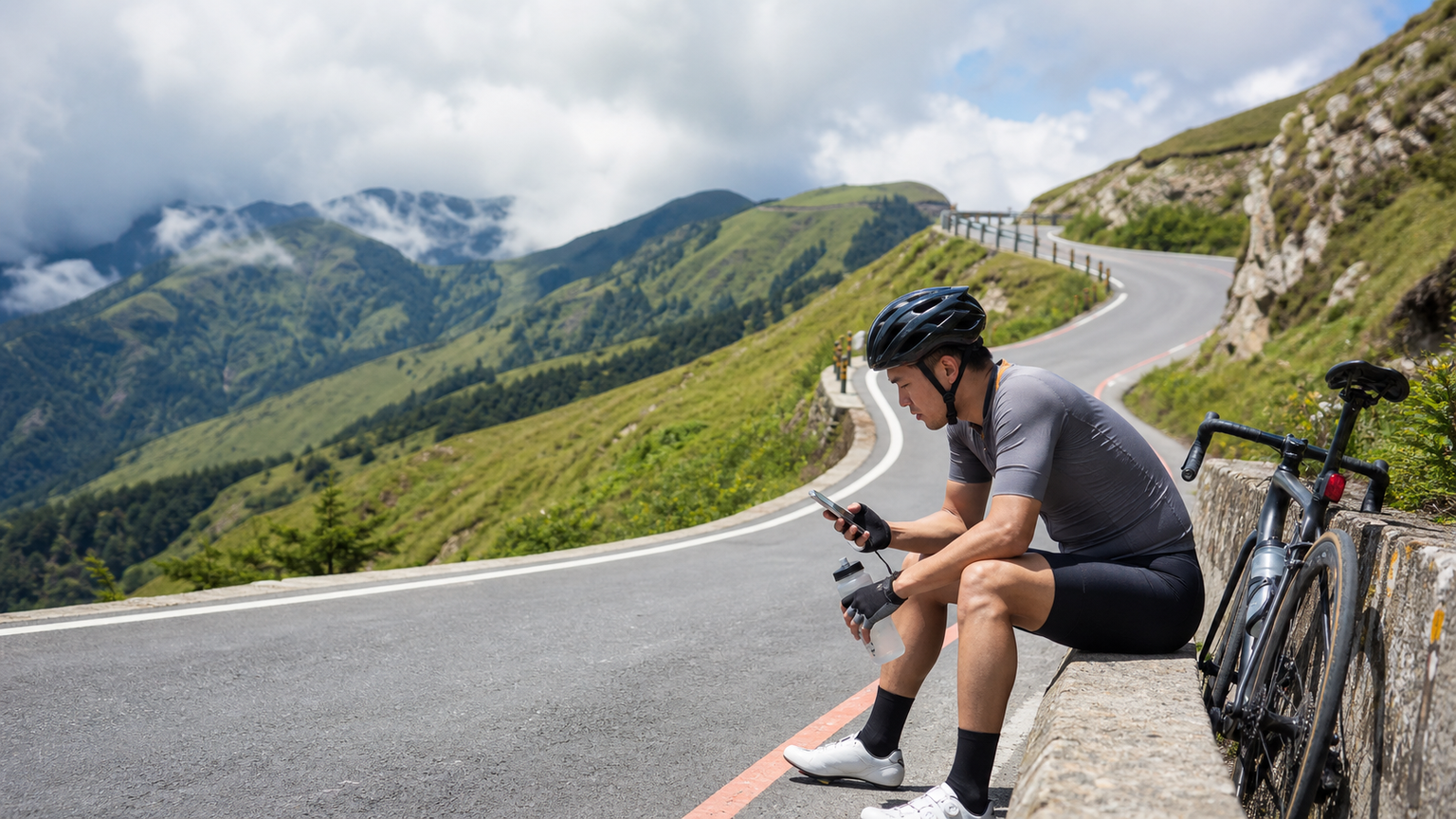
When I reached Hehuanshan Lodge (elevation 2,860 meters), it was 1:30 p.m., five and a half hours after departure, with 7 kilometers still to the summit. By all logic, I should have been able to push through, but my body was telling me otherwise.
A headache set in—not the kind from climbing fatigue, but a dull, pressing pain, with something swelling behind my eyes. Add mild dizziness to that: the moment I stood up, my vision would briefly blur.
| Symptom | Time of Onset | Possible Cause |
|---|---|---|
| Headache (heavy forehead) | 12:30 p.m. | Mild altitude sickness + dehydration |
| Dizziness (upon standing) | 1:00 p.m. | Hypotensive vertigo |
| Nausea | 1:30 p.m. | Early sign of heat exhaustion |
| Weak pedaling | Latter half of the entire route | Insufficient fueling + electrolyte loss |
I pulled over by the roadside, ate two energy gels, drank my last sip of water, and waited 20 minutes. The headache didn’t ease, and the nausea actually got slightly worse.
I pulled out my phone and called my friend waiting in Puli: “I can’t make it. Can you come pick me up?”
The moment I said those words, I felt something indescribably complicated—frustration, shame, but also a strange clarity. I knew I had made the right call.
Post-Failure Analysis: Where Things Went Wrong
Back in Puli, in my friend’s car, I pulled up the day’s data and went through it:
- Departure time: Too late (8:00 a.m., should have been 5:00–6:00 a.m.)
- Water intake: Estimated only 1.2 liters, should have been 2.5–3 liters
- Electrolyte replacement: None at all (should have carried salt tablets or electrolyte powder)
- Food intake: Consumed about 1,200 calories, estimated need was 1,800–2,000 calories
- Training base: Highest single-day climbing I’d ever done was 3,800m; jumping straight to 5,600m was clearly a leap too far
Every single number was a “thing I should have known sooner.”
What That Failure Taught Me
The most important lesson was learning to tell the difference between “I can’t push on” and “it’s not safe to continue.”
Riding always involves fatigue, pain, and the urge to quit—those feelings are normal and can be endured. But headache plus dizziness plus nausea, especially at high altitude, is your body’s safety alarm. It’s not something willpower can fix.
If I’d forced myself to continue, the best-case scenario was riding painfully slowly and miserably; the worst-case was passing out on a deserted mountain road. No goal is worth gambling your health over.
The second lesson: your training volume has to match your goal. A one-day Wuling assault isn’t ordinary difficulty—it requires deliberately “stacking volume.” In the three months before the attempt, you need at least 3–4 single-day rides with over 3,000 meters of climbing, so your body remembers what that kind of fatigue feels like.
Practical Advice
- Never take altitude symptoms lightly: If a persistent headache, dizziness, or nausea occurs above 2,500 meters, stop ascending immediately and assess whether to descend. Do not force yourself to continue.
- Plan your water and electrolyte strategy before you leave: For the full Wuling route, carry 2.5 liters of water plus salt tablets (1 per hour), and force yourself to refill at every rest stop.
- You need a climbing base before attempting a one-day assault: Complete at least two long rides with 4,000 meters of climbing before the challenge to confirm your body can handle prolonged, high-intensity accumulation.
- Tell someone your route and estimated time: If you ever need assistance, having someone know where you are is the most basic safety measure.
Conclusion
Three months later, I set off from Puli again at 5:30 a.m., with plenty of water and supplies, and successfully completed the one-day Wuling assault.
Standing at the Wuling summit, I thought back to where I’d failed last time—that white mile marker by the roadside near Hehuanshan Lodge. Without that failure, I wouldn’t have known where I fell short; without that retreat, I wouldn’t have become the better-prepared version of myself that followed.
Failure is sometimes the most honest coach.
Related Reading
- From First Wuling Defeat to Redemption: A Journey from Failure to KOM
- First Wuling Challenge: The Complete Journey from Shaking Legs to Standing on Taiwan’s Rooftop
- First Wuling Challenge: A Transformation from Sea Level to 3,275 Meters
- Taiwan Cycling’s Hundred Peaks Challenge: A Complete Preparation Guide for Conquering Wuling
雨戰! 西進武嶺員工旅遊 加料 各路段大數據分析 | 同事端出5公斤的公路車來挑戰!? EP1
4 年前
#北橫 + #北進武嶺 最硬的員工旅遊 EP1 | #公路車 #拉拉山 | 明池 | 武嶺 | 武陵農場 | 雲海 | Taiwan Cycling Route Wulin
6 年前
大禹嶺 到 武嶺牌樓 全程前後實況錄影 | 北進武嶺 | 東進武嶺 | KOM | 訓練台 | 坡度分析 | Taiwan KOM Last 10 km HARD | 公路車
6 年前
風櫃嘴時間 預測西進武嶺時間?13000名車友統計數據分析告訴你 !
5 年前
2019 夏季KOM 5小 完賽心得 準備攻略 東進武嶺 夏季登山王之路 Taiwan KOM Challenge
7 年前
Never Stop 西進武嶺 前後雙機 完整全程錄影 訓練台 實境
8 年前
北橫 北進武嶺 單車員工旅遊 EP2
6 年前
FTL 與 SYB 車隊專訪 西進武嶺 實用攻略分享! 2小時 如何練?!你不知道的眉角!新手準備武嶺必看 EP1 | 實力派女車友 | 精華版 | 公路車 | CTYeh
4 年前