Introduction
The motivation for planning that solo ride was, frankly, a bit ridiculous: work stress had been piling up, I’d had a falling out with a few friends, and there was some personal predicament I couldn’t quite articulate. So I drew a line on Google Maps—from Muzha, Taipei to Toufen, Miaoli, 222 kilometers—and set out at five o’clock the following Saturday morning.
I told no one, only sending a message to my family: “Going for a ride today, back in the evening.”
That was my first attempt at 200 kilometers.
Departure: Taipei at Five in the Morning, Just You
At 5 a.m. in Muzha, the temperature was 22 degrees, and there was almost no traffic on the roads. I rode through the empty streets, listening to my own breathing and the sound of tires on asphalt, feeling as if all of Taipei had been lent to me alone.
That kind of stillness is something you rarely get to experience.
For the first 50 kilometers, I deliberately rode slow, averaging 22 km/h, letting my body warm up gradually. Passing through Taoyuan, passing through Zhongli, the sun began to rise, the temperature climbed, and traffic slowly picked up. It was a process of loneliness being diluted, of being re-accepted into the everyday world.
| Segment | Distance | Time | Mental State |
|---|---|---|---|
| Muzha–Taoyuan | 50 km | 5:00–7:30 | Quiet, peaceful |
| Taoyuan–Hsinchu | 50 km | 7:30–10:00 | Loneliness begins to set in |
| Hsinchu–Zhunan | 50 km | 10:00–13:00 | Settling into the solo-riding rhythm |
| Zhunan–Toufen | 70 km | 13:00–17:30 | The biggest physical challenge |
The 100 km Threshold: Loneliness Starts to Speak
After passing Hsinchu, when the odometer hit around 100 kilometers, an emotion I had never felt in training rides emerged—not fatigue, but a profound sense of “you are truly alone out here.”
There was no one to share the moment with, no one who knew where I was, no one who cared about my mileage that day. The gas station workers, the convenience store clerks, the old man on a scooter coming the other way—everyone was living their own lives, with no connection to mine.
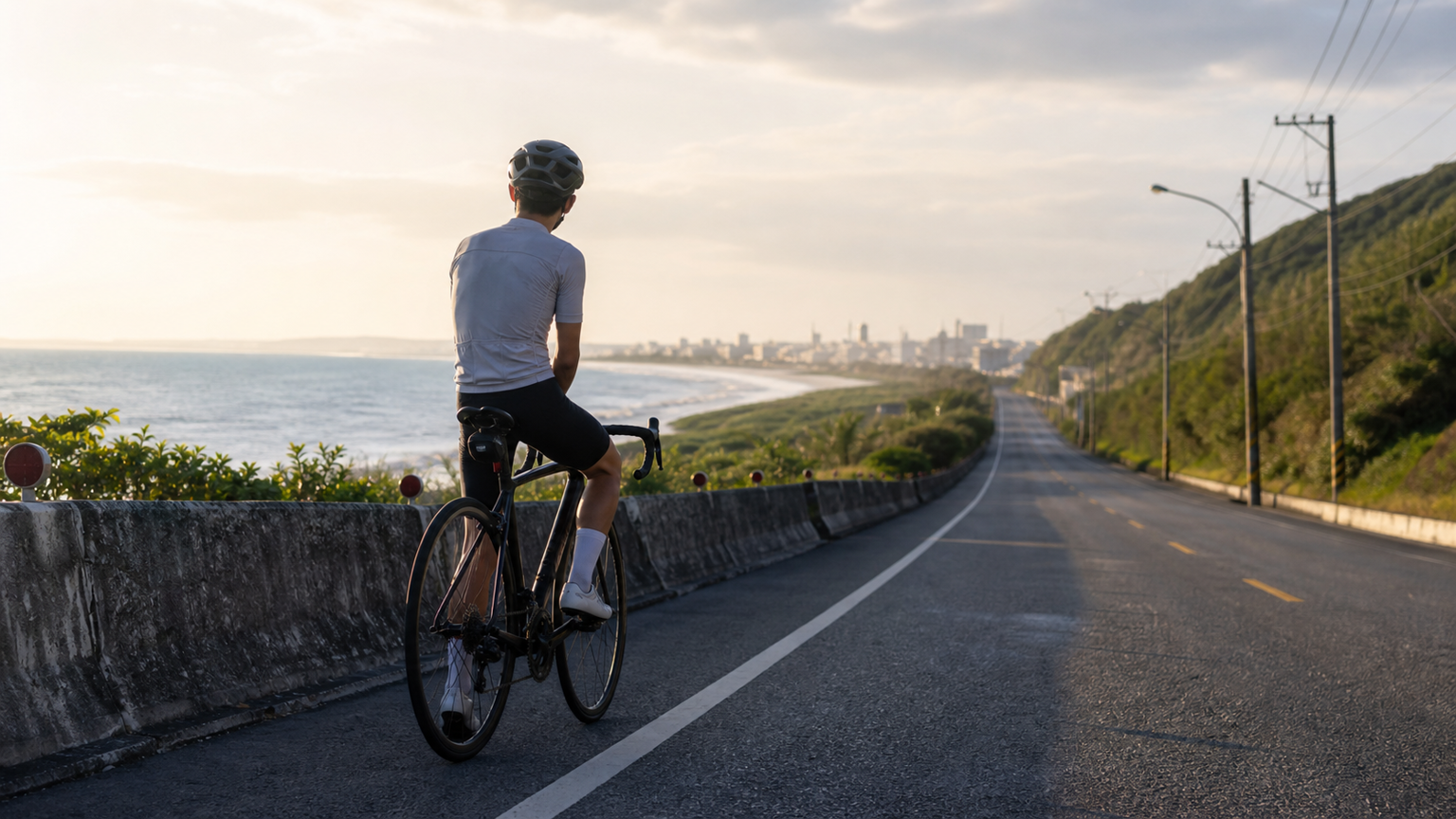
I stopped by the coast in Xiangshan, Hsinchu, sat on the curb, and ate a rice ball while gazing at the waters of the Taiwan Strait. In that moment, I ran through the problems that had been weighing on me, one by one. No one interrupted, no phone notifications, no need to keep up a facade in social settings.
Just me, the sea, and a half-eaten rice ball.
The problems were still there, unresolved. But I felt like I was seeing their true shape for the first time.
The Final 70 km: Negotiating with Physical Limits
After Zhunan, my legs started talking.
It wasn’t that I couldn’t pedal—it was that every stroke came with a reminder: “You know how much distance is still ahead, right?” That feeling turned pedaling from an automatic motion into a constant act of decision-making—every push was a choice to continue.
I hit my biggest mental hurdle 30 kilometers before Toufen. It was around 2 p.m., the temperature was 34 degrees, trucks were rumbling past on the provincial highway, and the heat rising off the road distorted the scenery ahead. I thought about taking the train back—Miaoli to Taipei was less than an hour.
Sitting still was actually the easiest option.
I pulled over, took off my glasses to wipe the sweat, drank a big gulp of water, and swung my leg back over the bike.
There was no grand reason. I just didn’t want to let the version of me that wanted to take the train win.
Practical Advice
- Tell someone your route for a 200 km solo ride: As much as solo riding emphasizes freedom, the baseline for safety is having at least one person know your route and expected return time. Set a check-in point every 4 hours.
- Plan your fueling down to every 30 minutes: On a long solo ride, there’s no riding buddy to remind you, and it’s easy to forget to eat. Set a reminder on your bike computer every 30 minutes to force yourself to take in at least 60–80 calories.
- Mental preparation matters as much as physical preparation: The mental fatigue in the latter half of a 200 km ride is no less than the physical fatigue. Before setting out, think about “why you’re doing this ride”—those with a concrete reason are less likely to fall apart in the final stretch.
- Don’t judge rest by pace: A 200 km ride requires endurance management, not sprint speed. Whenever you get any signal that says “I need to stop,” stop—resting is more efficient than pushing through.
Conclusion
When I arrived in Toufen, the sun was already beginning to set. I had a bowl of noodle soup at a shop near Toufen Station, folded up my bike, and took the train back to Taipei.
On the train, I watched the mountains and the sunset through the window, thinking about today’s 222 kilometers and the problems I’d sat with by the roadside. The problems were still there, but they seemed a little lighter.
Maybe that’s what a 200 km solo ride truly gives you: not answers, but clarity.
Related Reading
- The Loneliness and Self-Discovery of Bike Travel: The Psychological Growth of a Solo Island Circumnavigation
- The Philosophy of Riding Alone: The Freedom and Loneliness Solo Riding Has Given Me
- One-Day Taipei to Taichung (150 km) Challenge Reflections
- Island Circumnavigation Day One: Setting Out from Taipei, Panic, Doubt, Then Finding the Rhythm
半日 小台灣 極限單車路線挑戰實錄
7 年前
虎豹潭!日本老師來台一日約騎 台灣車友熱情招待私房路線 / CT Yeh
19 天前
高雄綠園道鐵路自行車道 / 外地人能輕鬆駕馭 還是整路崩潰? / 2025 全線開通 春節實地探索一次!(附GPS連結)/ 公路車 / CT Yeh
1 年前
台北大雁西飛 約騎挑戰 feat. Doris | 公路車 | CT Yeh
3 年前
單車 一日北高 ( 雙城 ) 肥宅雙人瘋狂行 紀錄片 REACTO
10 年前
公路車 | 塔塔加驚險員工旅遊 | 還好手腳快沒被抓交替!
5 年前
藤枝二集團 單車行 Day1 | 南部小武嶺 | 爬坡爬到罵罵叫 | JJSC | 公路車 | CT Yeh
3 年前
車隊介紹) 台北 一年開團365天 車隊 Apollo Ride 晨騎 好選擇 ( 陽明山 風櫃嘴 冷水坑 平等里 聖人 關渡 大稻埕 ) 找人騎車
7 年前