Core Training for Swimmers: How Plank, Side Plank, and Dead Bug Transfer to Rotational Stability in the Water
Introduction
“Core” is a term that gets used constantly in training circles, yet is often misunderstood. For swimmers, the core is not just the abdominals — it’s the entire muscular system surrounding the spine that provides stability, including the rectus abdominis, transverse abdominis, external and internal obliques, erector spinae, and multifidus. A strong core allows a swimmer to:
- Maintain level, controlled body rotation during the stroke instead of snaking side to side
- Efficiently transfer power from the kick to the upper body
- Hold a streamlined position over long distances without letting the hips sink
This article takes a closer look at the plank, side plank, and dead bug, and how each one translates directly into performance in the water.
Plank: Strengthening the Anterior Chain
The primary target of plank training is the transverse abdominis (the deepest layer of the core musculature) and the rectus abdominis, which provide front-to-back spinal stability and prevent the excessive lower-back arch (sway back) that increases drag while swimming.
Correct Execution
- Forearms flat on the ground, elbows stacked directly beneath the shoulders
- Toes on the ground, body in a straight line from ear to shoulder to hip to ankle
- Gently brace the abdomen inward (keep breathing normally — don’t hold your breath)
- Hips should not pike up or sag down
Common mistakes:
- Holding your breath through the plank: the transverse abdominis can’t stay engaged through continuous breathing, which means it won’t transfer to the water
- Dropping the head: this flexes the neck and rolls the shoulders forward
- Hips too high: this turns the exercise into a back extension and loses its core-training value
Swimming-Specific Plank Variations
Opposite Arm-Leg Raise (Plank): mimics the contralateral arm-leg coordination used in swimming, emphasizing rotational stability. Hold each rep for 3 seconds, alternating sides, 8 reps per side, 3 sets.
Plank Reach: from a standard plank position, slowly extend one arm forward, mimicking the extension of hand entry. 10 reps per side, 3 sets.
Side Plank: The Core of Rotational Stability
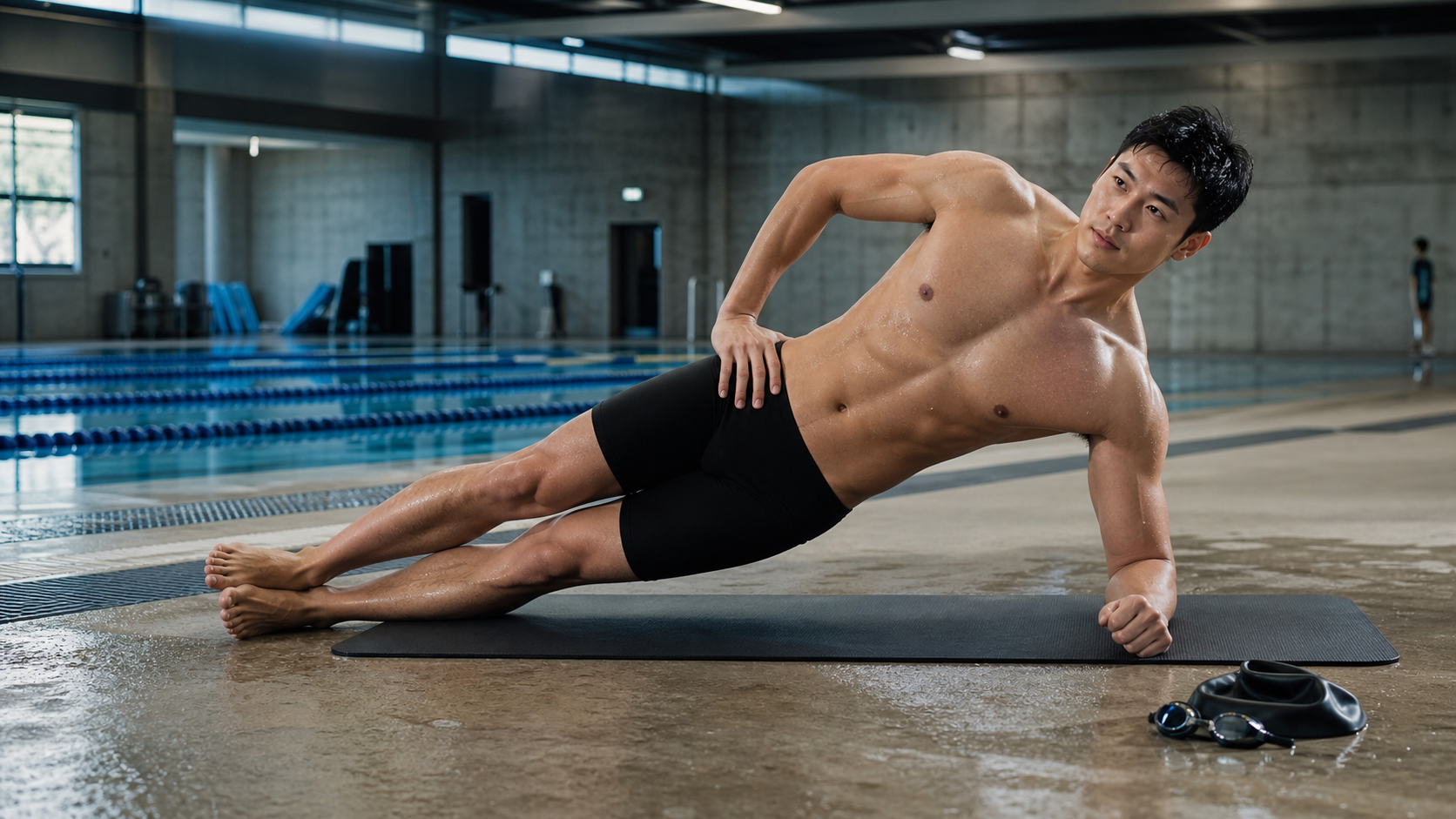
The side plank targets the external obliques and gluteus medius, the two muscle groups that are key to controlling the degree of body roll during the swim stroke. Without lateral core stability, the body over-rotates during breathing, which increases drag.
Correct Execution
- Lie on your side, supporting yourself on the lower forearm, elbow directly under the shoulder
- Lift the hips so the body forms a straight line from head to feet
- The upper arm can rest on the hip or extend straight up
- Keep breathing steady, core braced throughout
Advanced variation (swimmer-specific):
- The upper arm simulates a stroke (reach forward → pull back), completing a full stroke arc while in the side plank position, without letting the torso wobble
Recommended Side Plank Training Volume
| Level | Hold Time | Sets | Weekly Frequency |
|---|---|---|---|
| Beginner | 20–30 sec | 2 sets per side | 3x |
| Intermediate | 40–60 sec | 3 sets per side | 3–4x |
| Advanced | Add variations | 3 sets per side | 4x |
Dead Bug: Dynamic Core Control
Of the three exercises, the dead bug most closely mirrors the swimming movement pattern, training the ability to maintain core stability while opposite limbs move — which is exactly what freestyle stroke mechanics require.
Correct Execution
- Lie on your back, arms extended toward the ceiling, legs raised with hips bent at 90°
- Keep the lower back pressed flat against the floor (this is the most critical cue)
- Extend the right arm backward (close to but not touching the floor) while simultaneously extending the left leg forward (close to but not touching the floor)
- Return to the starting position, then switch to the left arm and right leg
- Keep the lower back flat against the floor throughout, breathing steadily
Why the lower back must stay flat: if the lower back lifts off the floor, it means the lumbar spine has arched excessively and core stability has been lost. The challenge in this exercise isn’t the limb movement itself — it’s maintaining core control while the limbs move.
Advanced Dead Bug Applications
- Resistance band version: hold a resistance band anchored overhead with both hands, working against the band’s pull as you extend your arms, which increases the stroke-simulation effect
- Single-leg support version: hold one leg suspended at 90° while extending the other, increasing the difficulty
Combined Three-Exercise Program
| Exercise | Sets | Rest Between Sets | Weekly Frequency |
|---|---|---|---|
| Plank (with variations) | 3 sets, 30–60 sec each | 30 sec | 3x |
| Side Plank (both sides) | 3 sets, 30–45 sec per side | 30 sec | 3x |
| Dead Bug | 3 sets, 10 reps each | 30 sec | 3x |
The full circuit takes about 15–20 minutes and works well as an activation routine before swim training, or as a standalone session on non-swimming days.
Practical Tips
- Core training follows a “quality over quantity” principle: a perfectly held 60-second plank is far more valuable than a 3-minute plank with breakdown in form
- Add “breathing pattern training”: practice diaphragmatic breathing (the belly naturally rises on the inhale) during planks and dead bugs, which mirrors the breath control needed for breathing during the stroke
- The core is usually already fatigued after swimming, so it’s best to schedule land-based core work before swim training (as activation) or on the day following a swim
- In the water, you can check your core stability with an easy pull-buoy drill: if the lower back is stable, the body should barely sway
Conclusion
The plank, side plank, and dead bug may look simple, but they are the three highest-value exercises in a swimmer’s core training toolkit. Each one directly addresses the demands of rotational stability, streamline maintenance, and contralateral coordination that swimming requires. For swimmers in Taiwan, 15 minutes of core training three times a week is one of the most time-efficient investments you can make in your in-water efficiency.
Related Reading
[教學] Premiere 影片 手震 修正 教學 防抖 單眼 影像 GoPro 穩定 Video Stabilization
8 年前
CT暗黑廚房) 車友必備 宇宙無敵鮮蚵湯 幫助訓練恢復 天然食補 好市多 超肥鮮蚵 破PR
7 年前
實景訓練台) 彰化經典百K 高強度喵團 90分鐘 跟著一起練功 2019 Indoor workout Changhua Classic 100 Taiwan
7 年前
一起升級!海鷗盃LSD團練...JJSC Zone2招待 騎到手抖 / 公路車 / CT Yeh
1 天前
一日北高/長距離團騎 常見問題補充篇 / 組團或跟團的眉角 / 壯車友容易被瘦車友慢性拉爆 / 原來屁股痛可能是這個原因...? / 風場配速法 / 公路車 / CT Yeh
2 年前
如何把 GoPro 影片 翻轉 批次 轉正?
6 年前
教學) 如何做出專業 慢動作 影片 Slow Motion 120fps GoPro 7 ActionCam AX700 A99II
7 年前
CT 喇低賽) 武嶺牽車 才是王道 西進牽車四小時內秘訣 攝手位置 如何判斷 防抽筋小秘訣
7 年前