Round-the-Island Refueling Strategy: Daily Calorie Needs and the Convenience Store Dependency Culture
Introduction
Taiwan has a secret weapon that cyclists around the world find hard to believe: a 7-Eleven or FamilyMart convenience store every few kilometers. This is no exaggeration—it’s a real geographical phenomenon. According to unofficial statistics, Taiwan has one of the highest convenience store densities in the world, and for round-the-island cyclists, this is almost like having a superpower—you never have to worry about finding food, water, or even emergency medicine. But the science of refueling isn’t just about “stopping at a convenience store to buy things”—it’s about when to refuel, how much to consume, and what to eat.
Estimating Daily Calorie Needs for a Round-the-Island Ride
A 65 kg cyclist riding 120 km on flat terrain burns approximately 2,500 to 3,000 kcal. Adding basal metabolic rate (BMR) of about 1,600 kcal, the total daily requirement can reach 4,000 to 4,500 kcal. That’s nearly double the daily expenditure of an average office worker.
| Body Weight | 120 km Flat Terrain Burn | 150 km with Climbing Burn | Estimated Total Daily Need |
|---|---|---|---|
| 55 kg | ~2,100 kcal | ~2,800 kcal | 3,500–4,000 kcal |
| 65 kg | ~2,500 kcal | ~3,300 kcal | 4,000–4,500 kcal |
| 75 kg | ~2,900 kcal | ~3,800 kcal | 4,500–5,200 kcal |
Many cyclists complain that after the round-the-island trip they “didn’t lose weight” or even “gained weight.” The reason is that when refueling at convenience stores, they consume far more calories than they burn. Although the ride burns a lot of energy, stress and fatigue also make overeating more likely.
Best Refueling Strategy at Convenience Stores
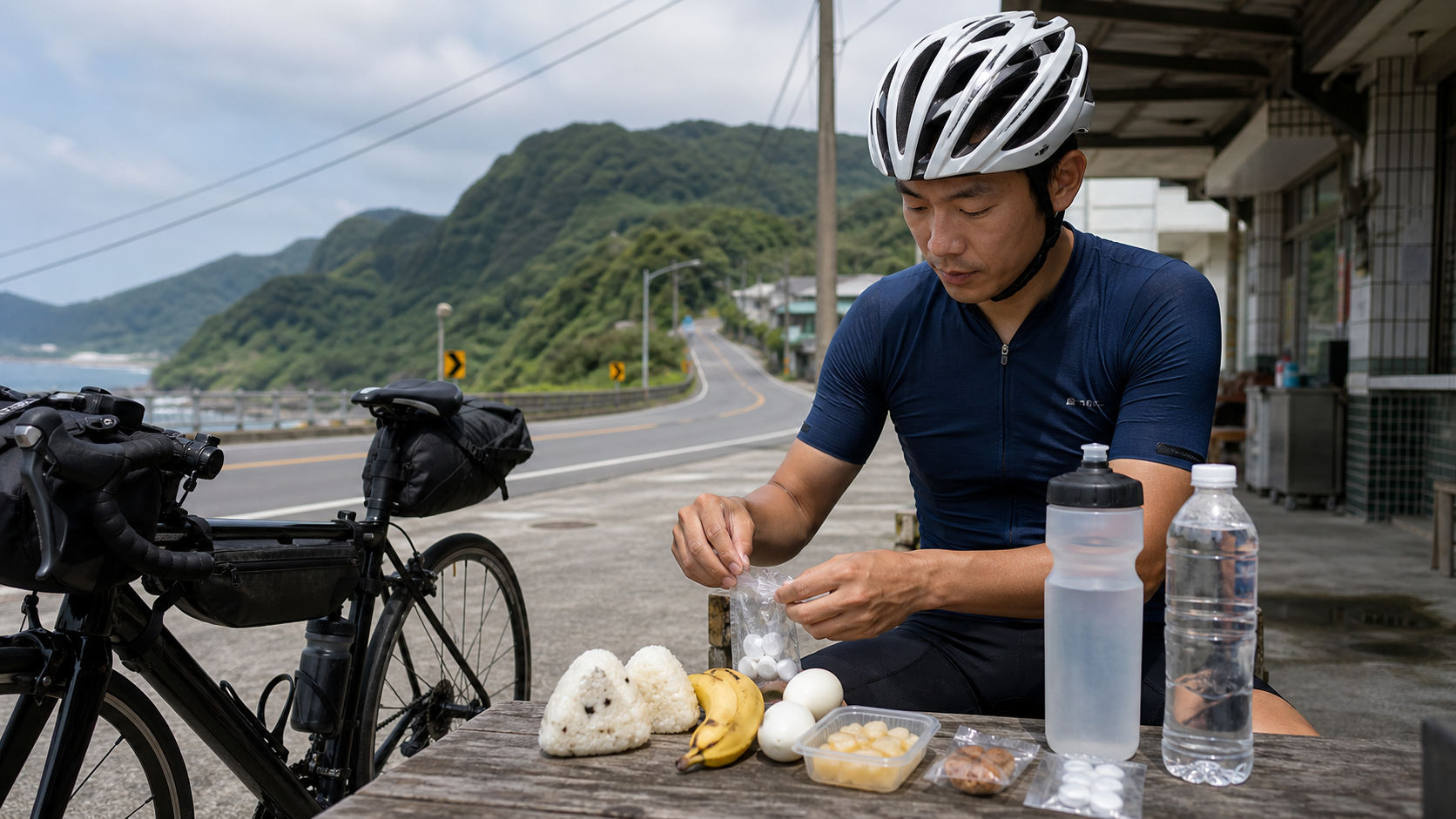
Taiwan’s convenience stores carry almost everything, but for round-the-island cyclists, the following items deserve top priority:
Refueling During the Ride (mid-ride stops on longer riding days):
- Salt candy, glucose tablets (quick electrolyte and blood sugar replenishment)
- Triangle rice balls (180–220 kcal, easy to carry)
- Tea eggs (65–80 kcal, high in protein)
- Sports drinks (舒跑, Pocari Sweat, to replenish electrolytes)
- Bananas (available at both FamilyMart and 7-Eleven, natural carbs + potassium)
Refueling During Rest (longer stops of 15+ minutes):
- Oden: the tofu, eggs, and radish in oden are rich in protein and carbohydrates
- Hot bento boxes: after meal times (after 11 AM), you can buy discounted bento boxes
- Hot coffee or tea: for an energy boost and warmth before setting off in the morning
Evening Refueling and Preparing Next Day’s Provisions:
- Overnight bread, cereal: store in your saddlebag for a quick bite before departure the next morning
- Electrolyte tablets: brands like Nuun are available at Taiwan sports goods stores, but not at convenience stores—prepare these in advance
Refueling Timing: The Core Principle for Avoiding the Bonk
“Bonking” refers to the sudden severe fatigue that hits when glycogen stores are depleted, manifesting as weak limbs, sluggish thinking, and shaking legs. Once you bonk, it takes 20 to 30 minutes of rest and sugar intake to recover, seriously impacting your schedule.
Principles for preventing the bonk:
- Actively consume sugar every 45–60 minutes—don’t wait until you’re hungry to eat
- Remember to refuel after long descents: downhill riding may feel easy, but over time it still burns energy
- Always eat breakfast before departure: even if you have no appetite, at least eat a rice ball or some bread
- Complete most of your daily mileage before 3 PM: blood sugar hits its lowest point in the afternoon, when fatigue is strongest
Electrolyte Replenishment: Sodium and Potassium in Sweat
Riding a full day in Taiwan’s summer can cause you to lose over 2 liters of sweat, which contains large amounts of sodium and potassium. Drinking only plain water without replenishing electrolytes can lead to hyponatremia (headache, nausea, muscle cramps).
Sports drinks sold at convenience stores (舒跑, Pocari Sweat, 百岳) are the most convenient way to replenish electrolytes—drink one bottle every 2 to 3 hours. If they taste too sweet, you can make your own electrolyte drink by mixing 500 ml of plain water with a small packet of salt.
Practical Tips
- Set a refueling alarm: set one to go off every 45 minutes to remind yourself to eat and drink, rather than relying on how you feel
- Carry emergency food: keep 2–3 energy bars or 3–4 packs of salt candy in your saddlebag in case you hit remote stretches without convenience stores
- Watch out on the Taitung Longitudinal Valley section: between Chishang and Fuli in Taitung, and between Yuli and Ruisui in Hualien, 7-Eleven stores can be 15–20 km apart—refuel in advance
- Special note for the Suhua Highway section: there are almost no convenience stores along the entire Suhua Highway—stock up on water and food before departing from Nan’ao
- Avoid alcohol: a drink after checking into your accommodation may be tempting, but alcohol hinders muscle recovery and affects your performance the next day
Conclusion
Taiwan’s convenience store culture is a huge advantage for round-the-island cyclists, but making the most of it requires understanding your body’s refueling needs. Treat refueling as part of the ride—not stopping to eat only when you’re tired, but planning to replenish energy at fixed intervals—and you’ll keep every day of riding at its best. Every 7-Eleven in Taiwan is your relay station—use them well.
Related Reading
- Round-the-Island Refueling Strategy: Daily Calorie Needs Calculation and Convenience Store Refueling Tips
- Round-the-Island Refueling Strategy: Convenience Stores, Bike Shops, and Accommodation Planning
- Daily Refueling Strategy for Round-the-Island Rides: Convenience Store Density Map Across Taiwan’s Counties
- Energy Refueling Plan for Cycling Around Taiwan: Precise Carb Needs Calculation and Real-World Strategy for 150 km Per Day
單車 一日北高 ( 雙城 ) 肥宅雙人瘋狂行 紀錄片 REACTO
10 年前
CT暗黑廚房) 車友必備 宇宙無敵鮮蚵湯 幫助訓練恢復 天然食補 好市多 超肥鮮蚵 破PR
7 年前
台北闊瀨陡坡 騎旅 / 日本單車雜誌編輯車友臨時加入!/ 髮香才是最強的 / feat. 北迴歸線小隊 / 公路車 CT Yeh
6 個月前
2022 環花東挑戰賽 Day2 搭到特快車 高速真空吸引! 台東一路逆風殺回花蓮! 總排 ??| Feiyu Pocket 2s | 公路車 | CT Yeh
4 年前
大武山20%魔王陡坡【JJSC南台灣遊騎Day2】!屁股真的要裂開了...凡士林抹滿也沒用?神秘金教堂還有超便宜夜市
3 個月前
中秋團練!GoPro Hero 9 拍攝絲般順滑,ft. 新竹某校隊 公路車
5 年前
水金九不厭五分 10度寒流冷到不願停!feat. 卡卡 / 公路車 / CT Yeh
6 個月前
嘉義大埔、阿婆灣挑戰賽,美到以為在日本!ft. 環騎5 Cool 西拉雅188 / 公路車 / CT Yeh
7 個月前