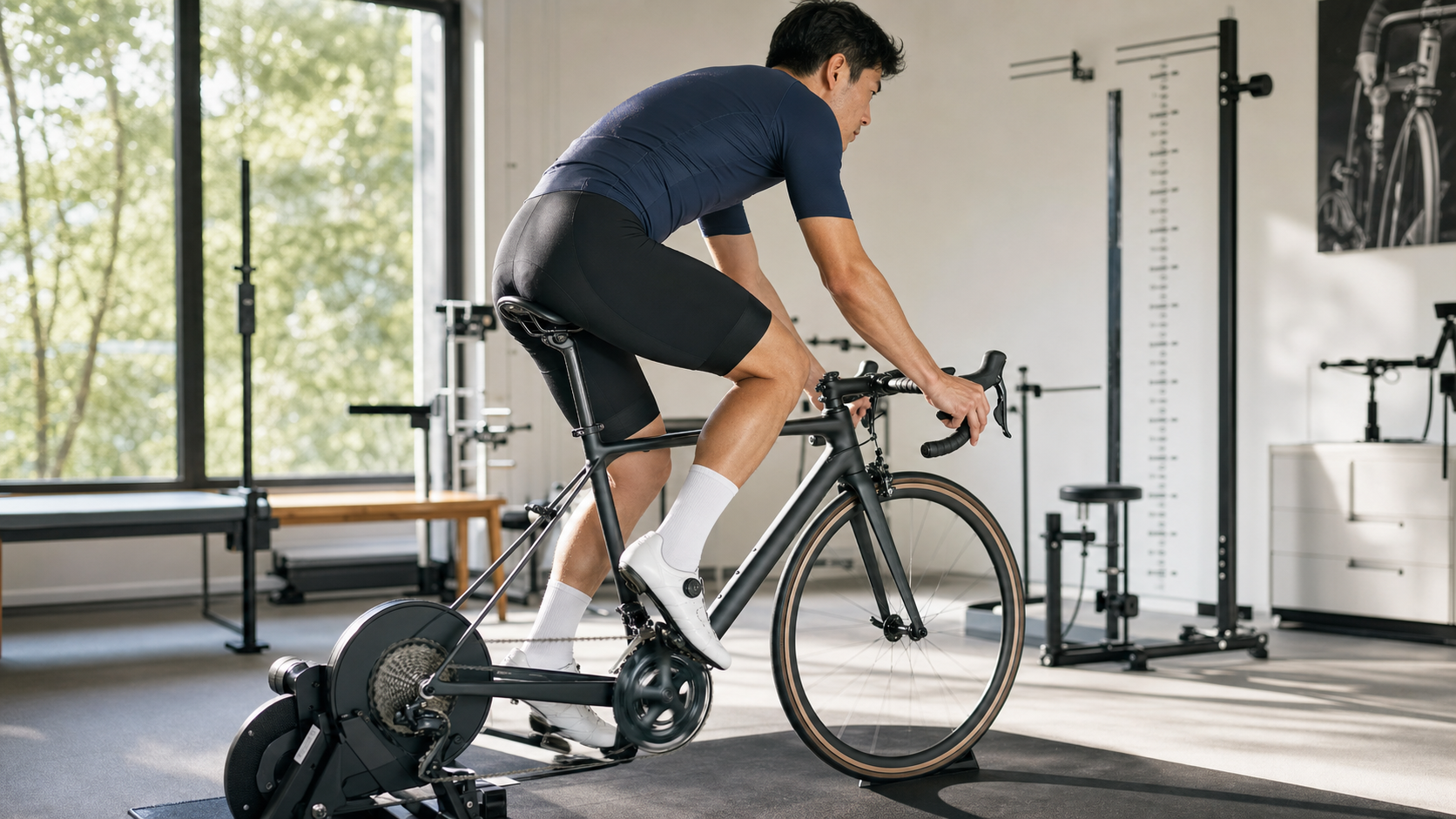
Interaction Between Cadence and Saddle Height: Why High-Cadence Riders Have Lower Saddles
Introduction
In Bike Fit discussions, the relationship between cadence and saddle height has long been overlooked. Most static fit assessments are conducted while the rider maintains a specific cadence, but when riding intensity changes and cadence rises or falls, muscle recruitment patterns and joint angles undergo subtle shifts.
What Changes When Cadence Changes?
1. Ankle Joint Angle (Ankling)
At low cadence, riders tend to use greater plantarflexion to assist with power application, with the heel relatively lower at the bottom of the pedal stroke. At high cadence, the pedaling motion becomes more “neutral,” with reduced ankle flexion range, effectively equivalent to the foot being slightly elevated.
This effect is equivalent to “the effective saddle height increasing by 2–5mm at high cadence.”
2. Pelvic Stability Demands
High cadence requires greater neuromuscular coordination. If the saddle is slightly too high, requiring significant pelvic rocking to complete the pedal circle, this may not be noticeable at low cadence—but once cadence increases, the rocking becomes as obvious as a pendulum, accelerating fatigue in the lower back and hip flexors.
3. Muscle Recruitment Ratios
Low cadence, heavy pedaling: The quadriceps (front of the thigh) dominate, requiring a longer effective moment arm; a slightly higher saddle helps maximize leg extension force.
High cadence, light pedaling: The glutes and hip flexors contribute a greater proportion, requiring that the hip joint not be overly compressed at the top of the stroke; a slightly lower saddle is actually more advantageous.
Observations from Professional Riders
Professional track cyclists (speeds exceeding 50km/h, cadence 120–130rpm) typically set their saddles relatively lower than road cyclists—not because their legs are shorter, but because ultra-high cadence demands a more compact, smoother pedal circle.
Conversely, downhill mountain bikers (low cadence, high torque) prefer a slightly higher saddle to fully leverage the power of every pedal stroke.
Recommended Saddle Height Differences by Cadence Range
| Primary Cadence Range | Recommended Minimum Knee Angle | Notes |
|---|---|---|
| Low cadence (70–80 rpm) | 28–35° | Angle can be slightly larger, utilizing the full pedal circle |
| Standard cadence (85–95 rpm) | 25–32° | Standard setting for most road riders |
| High cadence (100+ rpm) | 22–28° | Saddle can be 2–3mm lower to reduce pelvic rocking |
How to Find Your Cadence–Saddle Height Balance Point?
Step 1: Confirm Your Habitual Cadence
Use a bike computer or power meter to record your average cadence over one month. Most amateur riders naturally fall into 80–90 rpm during long-distance rides.
Step 2: Perform a Dynamic Assessment
Have someone observe whether your pelvis rocks while you pedal at 80rpm and 100rpm for 5 minutes each. If your pelvis visibly sways side to side at 100rpm, it indicates the saddle is slightly too high for high cadence.
Step 3: Test with Small Reductions
If adjustment is needed, lower the saddle by no more than 3mm at a time, then reassess after two weeks of riding. Pay attention to the feeling of “spinning freely”—a saddle that is too low will make each pedal stroke feel like “pushing a wall with a hunched back” rather than “pedaling a circle.”
Common Misconception: Does High Cadence Require Longer Cranks?
This is a common misunderstanding. In fact, from a biomechanical perspective, the combination of high cadence with shorter cranks is more harmonious, because shorter cranks reduce the pedal circle, lowering the joint angular velocity required per revolution, making high cadence easier to sustain without expending extra coordination energy.
Practical Recommendations
- If you are training to increase your cadence (e.g., from 80rpm to 95rpm), it is recommended to undergo a new dynamic fit assessment after your cadence has stably improved
- On climbs, where cadence naturally drops, a saddle that feels “slightly high” is acceptable; if it feels too high on flats and descents at high cadence, your overall setup may be too high
- During the early stages of cadence training, increased pelvic rocking is normal as neuromuscular coordination has not yet adapted—it does not necessarily mean you need to lower the saddle immediately
Conclusion
Cadence and saddle height are not isolated variables but an interconnected system. A saddle height optimized for 80rpm may require fine-tuning when you progress to 95rpm. Understanding this relationship allows you to proactively manage your bike setup as your riding skills improve, ensuring that training at every stage is conducted under optimal biomechanical conditions.
Related Reading
- Small Gear High Cadence vs. Big Gear Low Cadence: The Scientific Choice for Climbing Cadence
- Climbing Cadence Choices: Muscle Group Effects of High Cadence vs. Low Cadence Climbing
- Dynamic Effects of Saddle Height on Pedaling Efficiency: A Study on Knee Flexion Angle
- The Effect of Cadence on Oxygen Consumption: Finding Your Optimal Cadence
#公路車 #Fitting 靠人工智慧APP 幫你調整單車
6 年前
來都來了!改好改滿 / CS大導輪 + BB 可以省幾瓦? / 同場加映 TIME XPRO卡踏 / #公路車 #ceramicspeed / CT Yeh
1 年前
一日北高常見問題大集合 | 攻略 | 路線 | 訓練 | 補給 | 自行車 單車 | 一日雙城 | 雙塔 | TWB北高360 | 屁股痛
6 年前
單車胎壓觀察到的有趣現象,SRAM Quarq TyreWiz 2.0 無內胎胎壓計 / 裝了有哪些幫助? / Tubeless / 公路車 / CT Yeh
1 年前
訓練台體驗) 2019台北自行車展 三大家 訓練台體驗 Tacx Neo Flux 2 Xepdo Apx Wahoo Kickr
7 年前
一日北高/長距離團騎 常見問題補充篇 / 組團或跟團的眉角 / 壯車友容易被瘦車友慢性拉爆 / 原來屁股痛可能是這個原因...? / 風場配速法 / 公路車 / CT Yeh
2 年前
2025 自行車錶排行榜 兩萬車友大數據 / Garmin Bryton 排名會大洗牌嗎? / 全新的碼表前身分析 /公路車 / CT Yeh
1 年前
CT 喇低賽) 單車 比賽總是沒照片? 攝影師的觀點大公開 姿勢就是力量! 請加速1.25倍收看
7 年前