The Science Behind Brick Training — Muscle Adaptation Mechanisms and Workout Design for Bike-to-Run Transitions
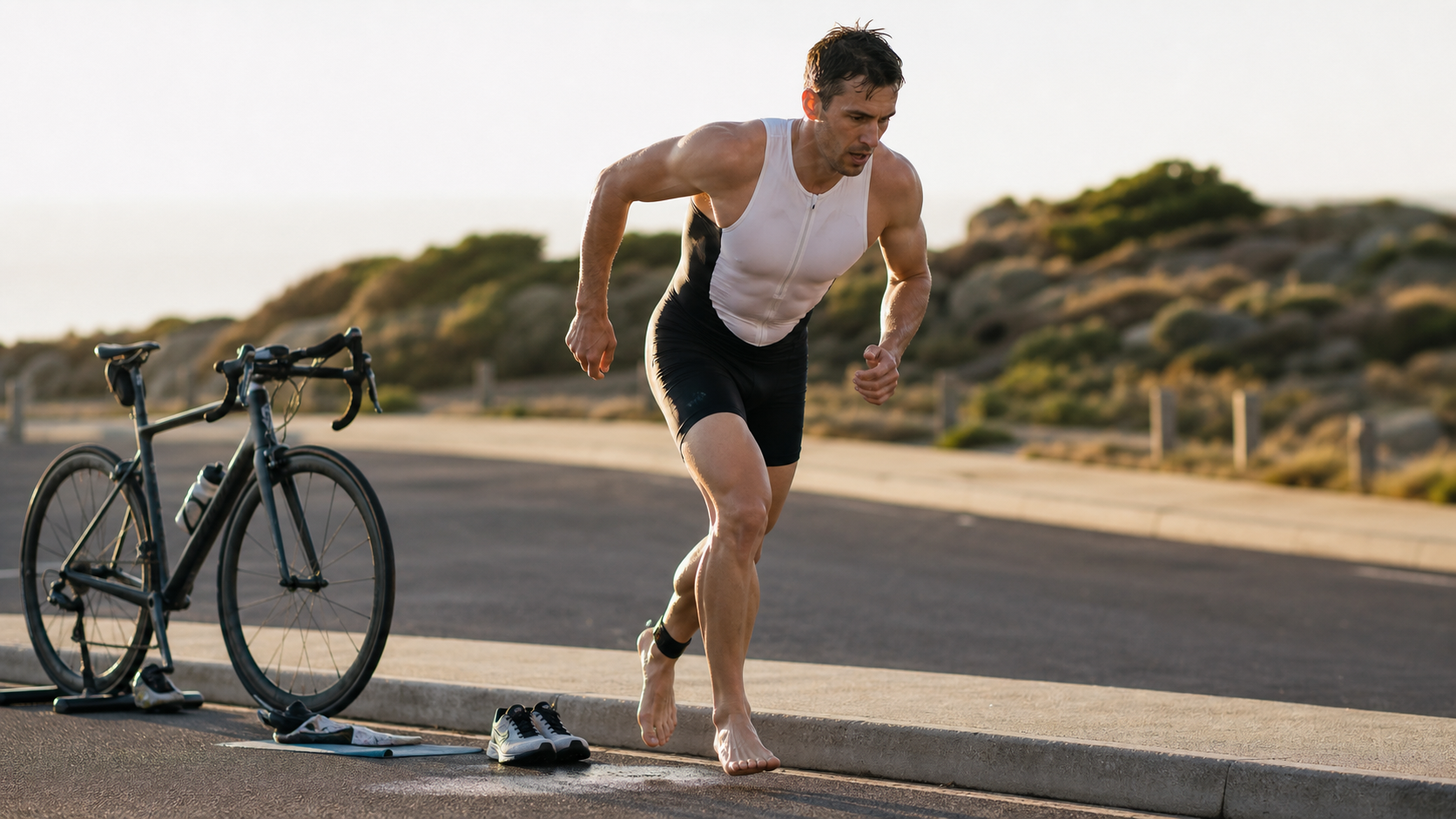
What Is a Brick? Why Must You Train It?
Brick = Bike + Run consecutive training, named after the feeling of legs being “as heavy as bricks” when you start running after getting off the bike. Athletes who haven’t trained bricks will run the first 3 km after T2 30-45 seconds/km slower than their usual pace.
Three Major Physiological Changes from Bike to Run
1. Neuromuscular Pattern Switching
While cycling, the quadriceps dominate (hip and knee extension), but running requires the glutes and posterior chain to take over. This switch requires 5-10 minutes of neural adaptation.
2. Muscle Blood Flow Redistribution
When you get off the bike, blood is still concentrated in the front of the thighs, leaving insufficient blood flow to the calves and soles of the feet that running needs, causing tight calves for the first 1-2 km.
3. Compromised Running Form
Cadence drops to 165-170 (normally 180+) right after dismounting, and stride length shrinks by 10-15%. This compromised phase lasts 3-5 km.
Four Levels of Brick Training
Level 1: Mini Brick (Adaptation Phase)
- Bike 30-45 minutes + Run 10-15 minutes
- Intensity: Z2
- Purpose: Adapt to the feeling of running off the bike
- Frequency: Once per week
Level 2: Race-Pace Brick (Progression Phase)
- Bike 60-90 minutes @ 70.3 race power + Run 5-7K @ 70.3 race pace
- Intensity: IF 0.78 + Threshold
- Purpose: Simulate race-pace transitions
- Frequency: Once per week
Level 3: Long Brick (Peak Phase)
- Bike 3-4 hours + Run 60-90 minutes
- Intensity: Z2 throughout
- Purpose: Simulate race-distance endurance
- Frequency: Once every other week
Level 4: Hard Brick (4 Weeks Before Race)
- Bike 2 hours @ 85% FTP + Run 10K @ 10K pace
- Intensity: Threshold level
- Purpose: Stimulate maximal lactate tolerance
- Frequency: Once each at 4-6 weeks before race
Three Brick Variations
Type 1: Traditional Brick (Transition Practice)
Change shoes and start running within 60 seconds of dismounting, focusing on T2 transition speed and mental adaptation.
Type 2: Mini Brick × N (Neural Adaptation)
- Bike 15 minutes + Run 5 minutes × 4 sets
- Rest 30 seconds between each transition
- Purpose: Strengthen neuromuscular switching ability
Type 3: Run-Bike-Run (Reverse Brick)
Run 20 minutes → Bike 60 minutes → Run 20 minutes again. The purpose is to train running form maintenance under fatigue.
Technical Points for the First 1 km After Dismounting
- Actively raise cadence to 180+ (use a metronome or heart rate monitor alerts)
- Shorten stride length; don’t chase pace for the first 500m
- Lean the upper body forward 3-5 degrees, let gravity drive you
- Control first-kilometer pace at target pace +15 seconds
Advanced Monitoring for Brick Training
| Metric | Target Value | Meaning |
|---|---|---|
| Heart rate in first 1K of run | 5-8bpm above upper Z3 | Heart rate compensation after dismounting |
| Cadence recovery time | Back to 175+ within 1 km | Quality of neural adaptation |
| Pace recovery time | -5 seconds within 2 km | Efficiency of running form recovery |
Common Mistakes
- Brick intensity too high: Many people treat bricks as an all-out run, which instead leads to fatigue accumulation
- Transition time too long: Exceeding 3 minutes defeats the purpose of a brick
- Insufficient frequency: At least once per week for the 12 weeks before race day
- Ignoring Mini Bricks: High-frequency short bricks are more effective for neural adaptation
Conclusion
A brick is not just “running after biking” — it is systematic neuromuscular training. Put bricks into your periodized plan, and you can easily hold a steady 5:00/km on the run leg of an IM 70.3, and maintain 5:30/km for a 226.
Related Reading
- The Science Behind Brick Training: Why Running After Cycling Feels Like Running on Cotton
- The Physiology of Brick Training: Why Your Legs Feel Like Lead After Cycling
- Triathlon Brick Training: Leg Adaptation Workout Design for Running Immediately After Cycling
- Sprint Triathlon Brick Workout Design: Building Muscle Memory for Run-Off-the-Bike
#公路車 #Fitting 靠人工智慧APP 幫你調整單車
6 年前
iPhone內建一秒變長腿🤣 車友必備#cycling
2 年前
一日北高常見問題大集合 | 攻略 | 路線 | 訓練 | 補給 | 自行車 單車 | 一日雙城 | 雙塔 | TWB北高360 | 屁股痛
6 年前
本週北高前練習,連同天比的226們也來⋯鐵車真的太猛了 #cycling #北高
2 年前
Fitting訓練兩用功率車 ! Thinkrider ST900 完整實測!/ 坡度升降 / 鄰居測試/ smart bike/公路車/ CT Yeh
2 年前
公路車 BB培林大升級! / 備戰海鷗繞圈賽 Canyon Aerod & TIME 一起改 / MIT大廠 CEMA對鎖式陶瓷培林BB & 導輪 / 公路車 / CT Yeh
2 年前
下雨天就是要改車 #ceramicspeed #bike
1 年前
靠單車減肥35公斤 心得分享與整理
7 年前