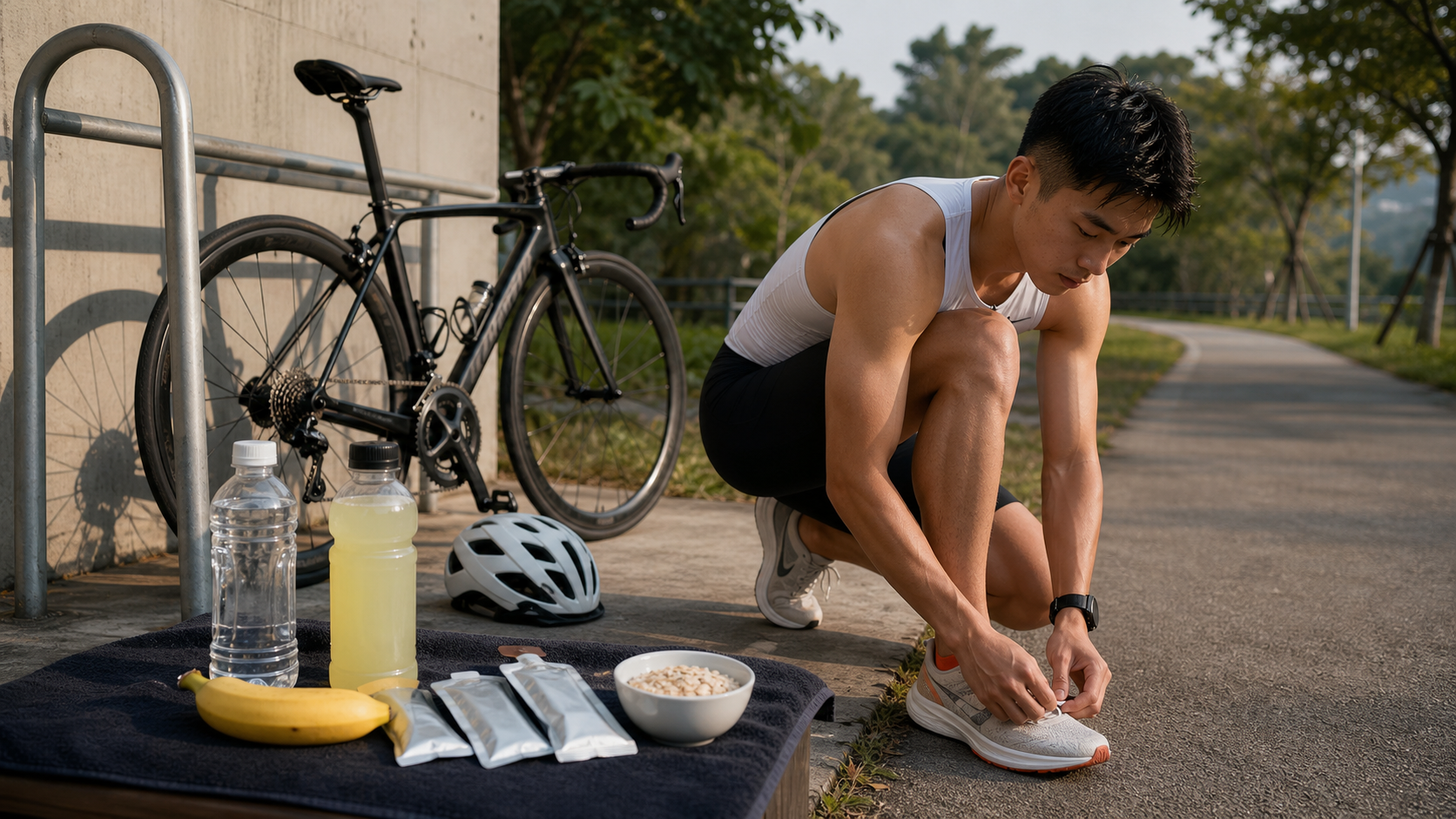
Brick Training Nutrition: After Fueling the Bike Leg, Should You Still Fuel the Run?
“You already ate 3 gels on the bike leg—do you still need to fuel on the run?” This is the most common fueling question in Brick training. The answer isn’t “yes” or “no,” but rather depends on the Brick’s duration, intensity, and training goals.
1. Basic Fueling Principles
Three Key Principles of Sports Fueling
- Carbohydrates: 30–90g per hour (depending on intensity and tolerance)
- Fluids: 500–750ml per hour
- Electrolytes: 300–700mg sodium per hour (depending on sweat rate)
The Unique Nature of Brick Training
Brick training isn’t just about building fitness—it’s also about “testing your fueling strategy.” Discovering fueling problems on race day is too late. Brick is the perfect opportunity for fueling experiments.
2. Fueling Strategies for Bricks of Different Durations
Short Brick (30+10, 40 minutes total)
Fueling principle: Eat a light meal 1 hour before training; only take fluids during the session.
| Time Period | Fueling Content |
|---|---|
| 60 min before training | 1 banana + 240ml water |
| Bike leg | 250ml sports drink |
| Run leg | No fueling (unless extremely hot) |
Purpose: Train the ability to perform under low glycogen without relying on fueling.
Medium Brick (90+30, 2 hours total)
Fueling principle: Similar to racing—fuel on the bike, observe on the run.
| Time Period | Fueling Content | Carbs (g) |
|---|---|---|
| 90 min before training | Oatmeal + eggs + banana | 60 |
| Bike 0:30 | 1 gel + 200ml water | 30 |
| Bike 1:00 | 1 energy bar + 200ml sports drink | 40 |
| Bike 1:30 | 1 gel + 200ml water | 30 |
| Run leg | Observe how you feel; no fueling needed within 30 minutes | 0–25 |
Long Brick (4+1, 5 hours total)
Fueling principle: Fully simulate race day.
See the other article “Long Brick Workout Design” for detailed fueling.
3. Criteria for Deciding Whether to Fuel on the Run Leg
Criterion 1: Duration
| Run Duration | Fuel or Not | Content |
|---|---|---|
| < 30 minutes | No fueling | Water only |
| 30–60 minutes | Depends | Half a gel |
| 60–90 minutes | Fuel | 1–2 gels |
| > 90 minutes | Must fuel | Every 20–25 minutes |
Criterion 2: Intensity
- Below Z2: Can rely on fat oxidation; fueling needs are low
- Z3: Carbohydrate expenditure increases; fueling is recommended
- Z4 and above: Purely carbohydrate-fueled; fueling is mandatory
Criterion 3: Training Purpose
| Training Purpose | Fueling Strategy |
|---|---|
| Race simulation | Fuel exactly as on race day |
| Low-glycogen training | Fuel on bike, no fueling on run |
| Fueling strategy testing | Try new products |
| Pure fitness training | Standard fueling |
4. Fueling Strategy for the Bike Leg
Why the Bike Leg Is the “Golden Fueling Window”
- Faster gastric emptying (riding position is less jarring)
- Stable body temperature (better heat dissipation)
- No worry about vomiting
- Can take fluids and carbs simultaneously
Recommended Fueling Schedule (Per Hour)
| Time Point | Fueling | Carbs |
|---|---|---|
| 0:00 (start) | 200ml sports drink | 15g |
| 0:20 | 1 gel + 100ml water | 30g |
| 0:40 | Half a banana / half an energy bar | 20g |
| 1:00 (repeat every hour) | — | 65g/hr |
5. Fueling Strategy for the Run Leg
Why Fueling on the Run Is Difficult
- Slower gastric emptying: Vertical impact disrupts digestion
- Blood flow redistribution: Muscle blood flow increases, stomach blood flow decreases
- Higher body temperature: Increased stomach discomfort
- Higher breathing rate: Conflicts with chewing and swallowing
Fueling Options for the Run Leg
| Fuel Type | Pros | Cons | Recommended Timing |
|---|---|---|---|
| Gel | Easy to swallow, fast absorption | Too sweet, needs water | Every 20–25 minutes |
| Energy drink | Fuels and hydrates at once | Limited carrying capacity | Every 5 km |
| Gummies | Good taste, easy to portion | Requires chewing | Mid-run fueling |
| Salt tablets | Replaces electrolytes | No carbs | Every 30 minutes |
| Banana | Natural, easy to digest | Hard to carry | Available at aid stations |
6. Applying Train Low
Concept
Deliberately training in a low-glycogen state to enhance fat-burning capacity. Brick training is a great opportunity to execute Train Low.
How to Execute
- Reduce carbohydrate intake 12 hours before training
- Train fasted in the morning (water only)
- Hydrate but don’t consume carbs on the bike leg
- No carbs on the run leg either
- Consume a full recovery meal within 30 minutes after training
Cautions
- Intensity must not be too high: Primarily Z1–Z2
- Duration control: Within 90 minutes
- Frequency: At most once per week
- Not recommended for beginners: Hypoglycemia risk if the base isn’t solid
7. Head-to-Head Comparison of Fueling Products
Here’s how common fueling products perform in Brick training:
Gels
| Brand | Carbs per serving | Texture | Recommendation |
|---|---|---|---|
| GU Energy | 22g | On the sweet side | ★★★★ |
| SiS Beta Fuel | 40g | Milder | ★★★★★ |
| Maurten Gel 100 | 25g | Jelly-like | ★★★★★ |
| Powergel | 27g | Average | ★★★ |
Energy Bars
| Brand | Carbs per bar | Protein | Best For |
|---|---|---|---|
| Clif Bar | 42g | 9g | Early bike leg |
| PowerBar Energize | 27g | 4g | Mid bike leg |
| Maurten Solid | 44g | 3g | Bike leg |
| Honey Stinger Waffle | 21g | 1g | Before the run |
Drinks
| Brand | Carbs per bottle | Sodium | Review |
|---|---|---|---|
| Gatorade Endurance | 36g/591ml | 300mg | Well balanced |
| SiS Go Electrolyte | 36g/500ml | 280mg | On the sweet side |
| Tailwind | 25g/500ml | 310mg | Easy to digest |
| Maurten Drink Mix 320 | 80g/500ml | 100mg | High carb |
8. Common Fueling Timing Mistakes
- Eating too much before training: Starting before the stomach has emptied leads to bloating during exercise
- Not fueling in the first hour: Waiting until you’re already tired means the stomach has already shut down
- Taking too much at once: More than 60g of carbs per 30 minutes can’t be absorbed in time
- Fueling without drinking: Gels need water to be absorbed
- Trying new products on race day: Fueling products never tested in training
9. Gastric Response to Fueling
Gastric Emptying Rates
- Water: 15–20 minutes
- Sports drink: 30–40 minutes
- Gel (with water): 30–45 minutes
- Energy bar: 60–90 minutes
- Solid food: 90–120 minutes
Warning Signs of Stomach Distress
- Nausea, urge to vomit → Immediately switch to water only, stop taking in sugar
- Bloating → Slow down the fueling pace
- Reflux → Chew mint gum, take deep breaths
- Diarrhea → Too much caffeine or artificial sweeteners in fueling products
10. Real-World Example: 113-Distance Brick Simulation
2 Hours Before Training
- 2 slices of whole wheat bread + 2 eggs + 1 banana + black coffee
- Approximately 80g carbs + 25g protein
Bike Leg (3 hours)
- 0:30 SiS Gel
- 0:50 Half a banana
- 1:10 SiS Gel
- 1:30 Half a Clif Bar
- 1:50 SiS Gel
- 2:10 Half a banana
- 2:30 SiS Gel
- 2:50 1 salt tablet + gel
- Water: 200ml every 20 minutes (approximately 1800ml total)
Run Leg (45 minutes)
- 0:15 Half a gel + 100ml sports drink
- 0:35 1 salt tablet + water
- Water: 100ml every 10 minutes
Within 30 Minutes After Training
- 500ml chocolate milk + banana
- Approximately 80g carbs + 30g protein
There is no single right answer for fueling strategy—testing and finding the approach that works for you through Brick training is the core homework for preparing for a triathlon.
Related Reading
- Triathlon Three-Leg Fueling Tactics: Nutrition Strategies Before the Swim, on the Bike, and on the Run
- 70.3 Fueling Engineering: The Feeding Assembly Line for the 90km Bike Leg
- Cycling Race Fueling Strategy: What to Put in Your Pockets and When to Eat
- The Physiology of Brick Training: Why Your Legs Feel Like Lead After Getting Off the Bike
一日北高前的高裝檢 | 北高 360 | 挑戰11小時的裝備 | 一日雙塔 | 補給
6 年前
靠單車減肥35公斤 心得分享與整理
7 年前
一日北高/長距離團騎 常見問題補充篇 / 組團或跟團的眉角 / 壯車友容易被瘦車友慢性拉爆 / 原來屁股痛可能是這個原因...? / 風場配速法 / 公路車 / CT Yeh
2 年前
CT暗黑廚房) 車友必備 宇宙無敵鮮蚵湯 幫助訓練恢復 天然食補 好市多 超肥鮮蚵 破PR
7 年前
一日北高常見問題大集合 | 攻略 | 路線 | 訓練 | 補給 | 自行車 單車 | 一日雙城 | 雙塔 | TWB北高360 | 屁股痛
6 年前
單車 一日北高 ( 雙城 ) 肥宅雙人瘋狂行 紀錄片 REACTO
10 年前
Live) 備戰2019彰化經典百K 賽前攻略 (已完賽請看新影片
7 年前
詳測) 小米 電動打氣筒 公路車胎要充多久? 值得買嗎? 米家充氣寶 小心燙手!
7 年前