What Is the Base Phase?
The annual triathlon periodization typically has four phases:
- Base Phase: 8–12 weeks, aerobic foundation, primarily Z1–Z2
- Build Phase: 6–8 weeks, introduces threshold and VO2max training
- Peak Phase: 3–4 weeks, race-intensity simulation
- Taper: 2–3 weeks, recovery-focused
Base Phase training characteristics: low intensity, long duration, high reliance on fat oxidation. Your nutrition strategy should align with this goal.
Why Doesn’t the Base Phase Require High Carbohydrate Intake?
At Z2 training heart rates of 65–75% HRmax, your body has ample oxygen and can burn fat (9 kcal per gram). If you eat high-carb every day, your body becomes “lazy” about activating fat metabolism.
Conversely, moderately lower carbohydrate intake forces the body to upregulate fat-oxidation enzymes (LCHF adaptation), making it less likely you’ll hit the wall in the latter half of an IM.
Daily 5 g/kg Carbohydrate Plan (70 kg Athlete = 350 g/d)
Training Day (90–180 Minutes of Z2)
Training load: ~1,500 kcal expended
Total calories: 2,800 kcal
| Meal | Contents | Carbs | Protein | Fat |
|---|---|---|---|---|
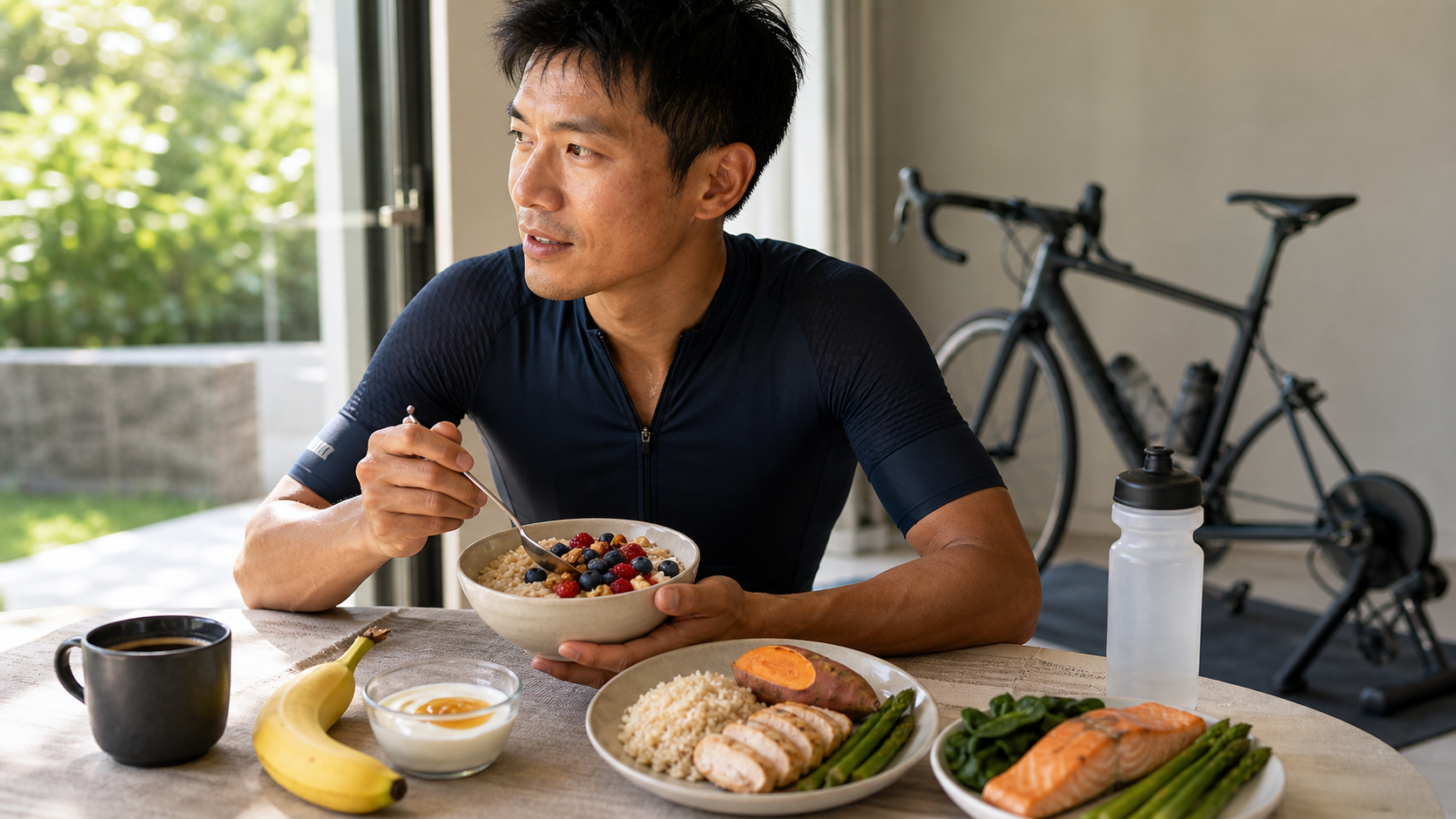
| Breakfast | Oats 60 g + milk + berries + nuts 10 g | 65 g | 20 g | 15 g |
| Snack | Banana + black coffee | 25 g | 1 g | 0 g |
| During training (90 min) | Sports drink 500 ml | 30 g | 0 g | 0 g |
| Lunch | Brown rice 100 g + chicken breast 150 g + vegetables + olive oil | 75 g | 35 g | 12 g |
| Snack | Greek yogurt + honey | 30 g | 15 g | 5 g |
| Dinner | Sweet potato 200 g + salmon 120 g + asparagus + egg | 80 g | 35 g | 20 g |
| Before bed | Cottage cheese 100 g | 5 g | 15 g | 5 g |
| Total | 310 g | 121 g | 57 g |
Ratios: Carbohydrate 45%, protein 17%, fat 38%
Rest Day (No Training)
Reduce carbs to 3–4 g/kg (210–280 g), keep protein at 1.8 g/kg.
Train Low Strategy: Fasted Morning Workouts
During the Base Phase, schedule 1–2 fasted aerobic sessions per week:
- Drink water + black coffee upon waking
- Head straight out for a 60–90-minute Z1–Z2 jog or ride
- Eat a protein-focused breakfast within 30 minutes after training
This approach enhances fat metabolism, but only at Z2 or below—going harder will hurt performance.
Protein: 1.6–2.0 g/kg/d
Even in the Base Phase, protein intake cannot be neglected. Long-duration aerobic work breaks down muscle, and adequate protein is needed for repair.
A 70 kg athlete needs 110–140 g per day, and spreading it across 5 meals at 25–30 g per meal is most effective.
Fat Sources
In the Base Phase, fat intake can rise to 30–40% of calories, but choose the right sources:
- Good fats: olive oil, avocado, nuts, deep-sea fish, flaxseed
- Avoid: fried foods, processed meats, margarine
Key Micronutrients
Base Phase training volume is high, so watch:
- Iron: 8 mg/d for men, 18 mg/d for women (red meat, spinach, liver)
- Magnesium: 300–400 mg/d (nuts, dark leafy greens)
- Vitamin D: 1,000 IU/d (outdoor sun exposure + supplementation)
- Omega-3: 1–2 g EPA+DHA (deep-sea fish 2x/week)
Hydration Strategy
Daily baseline needs are 35 ml/kg plus training volume. A 70 kg athlete needs 2.5–3.5 L per day. Light-yellow urine is a good indicator.
Sample Weekly Menu
| Day | Training | Carbs | Focus |
|---|---|---|---|
| Mon | Swim 60 min | 4 g/kg | Adequate protein |
| Tue | Ride 120 min Z2 | 5 g/kg | Fuel during training |
| Wed | Run 60 min Z2 fasted | 4 g/kg | Train Low |
| Thu | Rest | 3 g/kg | Eat plenty of vegetables |
| Fri | Swim + ride | 5 g/kg | Two-session day |
| Sat | Long ride 180 min | 6 g/kg | Fuel during training |
| Sun | Run 90 min Z2 | 5 g/kg | Recovery meal |
Conclusion
The keyword for Base Phase nutrition is “moderation.” You don’t need to carb-load, but you do need to train fat metabolism; you don’t need to go overboard on protein, but you should spread your intake throughout the day. Get your diet dialed in gradually during this phase, and you’ll be able to ramp up intensity painlessly in the subsequent Build and Peak phases.
Related Reading
西進武嶺 免費訓練分析服務 Intervals | 練不夠還是練過頭?你哪一種類型選手?AI模型告訴你! | 備戰神器 | 公路車 訓練 | CT Yeh
4 年前
CT暗黑廚房) 車友必備 宇宙無敵鮮蚵湯 幫助訓練恢復 天然食補 好市多 超肥鮮蚵 破PR
7 年前
靠單車減肥35公斤 心得分享與整理
7 年前
一日北高前的高裝檢 | 北高 360 | 挑戰11小時的裝備 | 一日雙塔 | 補給
6 年前
2016/4/20 - 中社路 夜騎 半年甩肉14KG 後測
10 年前
#公路車 #西進武嶺 配速配瓦實驗 坡度分析 四小時內攻略 建大盃 NeverStop #西進武嶺攻略
6 年前
一日北高常見問題大集合 | 攻略 | 路線 | 訓練 | 補給 | 自行車 單車 | 一日雙城 | 雙塔 | TWB北高360 | 屁股痛
6 年前
CT 喇低賽) 武嶺牽車 才是王道 西進牽車四小時內秘訣 攝手位置 如何判斷 防抽筋小秘訣
7 年前