Introduction
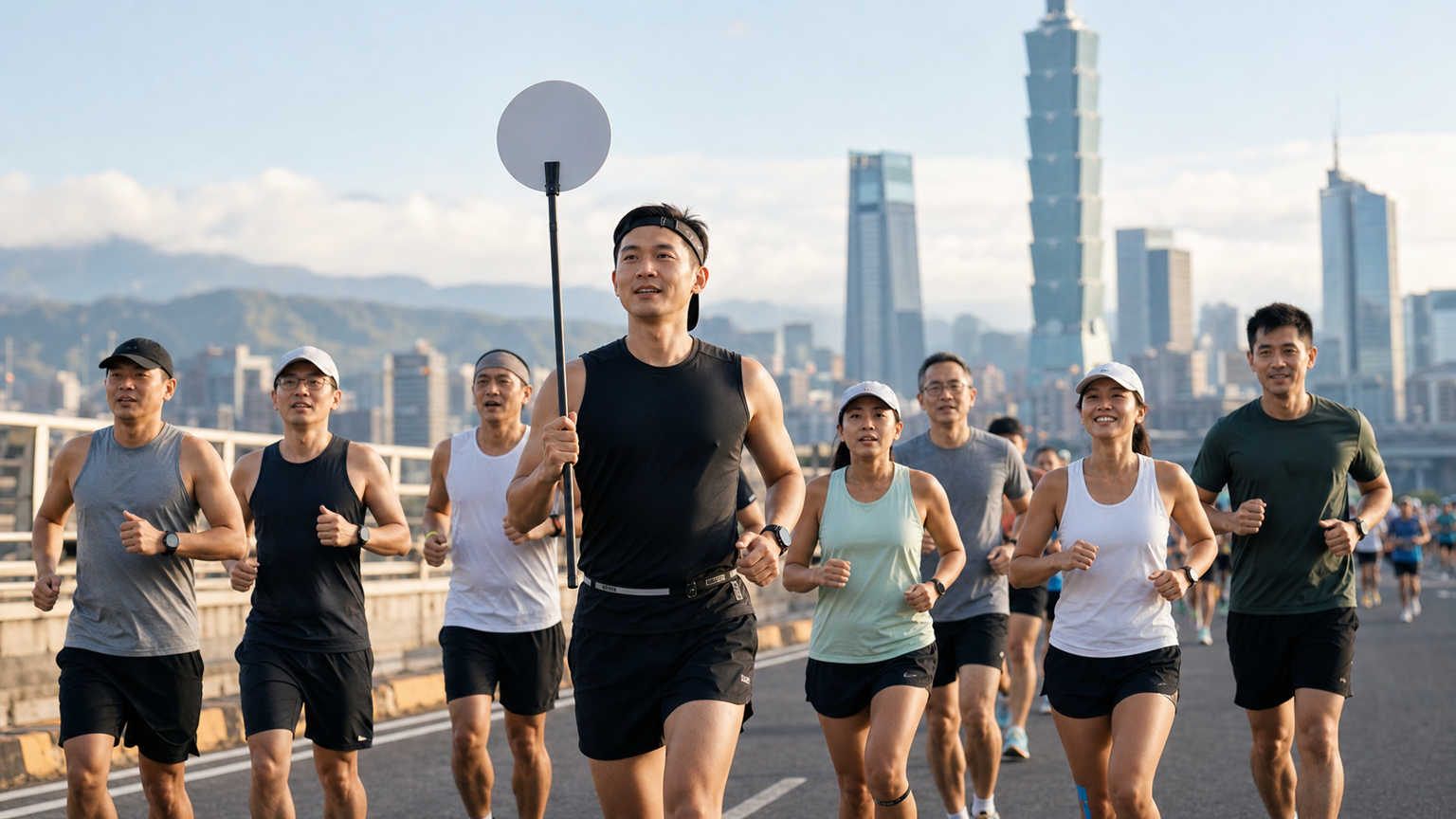
Behind the Sub-4 pacers at the Taipei Marathon, dozens or even hundreds of runners typically follow. The figure holding the time sign represents more than just a pacing rhythm—it is a mobile psychological safety net.
Many runners describe the feeling of running with a pacer: “I don’t know why, but running with a pacer just gives me a sense of security. Even though I could control my pace by checking my watch, following that sign makes me feel completely relaxed.”
This sense of security is not an illusion but a real effect grounded in psychology. Understanding the psychological dynamics between pacers and runners can not only help you use pacers more wisely but also deepen your understanding of how the running community becomes a unique system of psychological support.
The Psychological Functions of a Pacer
| Function | Psychological Mechanism | Practical Effect |
|---|---|---|
| Cognitive Offloading | Outsourcing pace judgment to free up mental resources | Runners can focus on bodily sensations rather than calculations |
| Social Facilitation | The presence of a group enhances individual performance | The implicit competitive boost of running in sync |
| Emotional Contagion | The pacer’s calm confidence transfers to runners | Reduces individual anxiety levels |
| Social Comparison Anchor | Provides a reliable external reference point | Avoids burning out too early or being overly conservative |
| Group Identity | The sense of “we are the Sub-4 collective” | Enhances commitment to the goal |
The Cognitive Offloading Effect
In the latter half of a marathon, runners’ cognitive resources (attention, judgment, working memory) decline significantly due to physical fatigue. If they still need to “calculate whether their pace is on track” at this point, it consumes already limited mental resources and may lead to mistakes in other areas (missed aid stations, deteriorating running form, etc.).
Pacers allow runners to outsource this calculation task, and the freed-up mental resources can be used for: maintaining running posture, executing self-talk strategies, and monitoring bodily signals. This is one reason why running with a pacer is especially advantageous in the latter half.
Social Facilitation and Emotional Contagion
Psychologist Norman Triplett discovered as early as 1898 that people tend to perform better in the presence of others than when working alone—this is called the “social facilitation effect.” In a marathon, the pacer group creates a micro “social facilitation environment.”
A more subtle mechanism is Emotional Contagion: the pacer’s stable emotional state (they are trained to maintain a calm tone and demeanor even in difficult situations) is unconsciously mimicked by surrounding runners, conveying the implicit message that “the current situation is normal and manageable.”
How to Maximize Your Use of a Pacer
Not all strategies for following a pacer are equally effective:
Strategy Recommendations:
- Follow within your comfort zone: The pacer’s pace should feel “just right” for you, not like “chasing to keep up.” If you find it strenuous within the first 15 kilometers, this pace group may not suit you
- Interact proactively: Pacers are usually happy to offer encouragement and aid station information at appropriate moments—don’t be shy about talking to them
- Don’t stick to the very front: When following a pacer, position yourself in the middle-to-back of the group so you won’t be pulled too fast by crowd pressure, and you’ll also have buffer space
- Separate strategy at aid stations: You can temporarily leave the group at aid stations and rejoin after finishing your hydration—don’t sacrifice your fueling just to stay close
- Make your own decision in the late stages: After 35 kilometers, if you feel good, try to surge past the pacer group; if you’re fading, let another pace group catch you
The Psychological Support Mechanisms of Fellow Runner Interactions
Pacers are institutionalized social support, but interactions among fellow runners have equally powerful psychological effects.
The Shared Suffering Effect
Research shows that enduring pain together with others significantly increases pain tolerance. This explains why, in the latter half of a race, casually saying “let’s get through this together” to a runner beside you often brings a genuine sense of strength—not just to them, but to you as well.
There is a beautiful phenomenon on Taiwan’s marathon courses: mutual encouragement between strangers. In the later stretch of Ren’ai Road, “Keep going! Almost there!” is not just a polite phrase—it’s a real flow of energy between runners.
Research on the Effectiveness of Verbal Encouragement
Multiple sports psychology studies (including research by Hasan Boyraz and others) show that:
- Runners who receive verbal encouragement during a race report significantly lower RPE (Rating of Perceived Exertion) in the later stages compared to those who receive none
- Peer encouragement (cheers from fellow runners) has a stronger effect than spectator cheers (from bystanders)
- Timing matters: offering encouragement at the moment a runner’s expression is most strained has a greater effect than when they are relaxed
The Power of Non-Verbal Support
Beyond language, non-verbal signals between fellow runners are equally important:
- Pace synchronization: When your cadence syncs with a fellow runner, your body naturally “falls into rhythm” and your stride becomes more stable
- Visual locking: Fixing your attention on the back of the runner ahead helps maintain pacing rhythm
- Physical touch (e.g., a pat on the back): Relatively rare in Taiwanese culture, but research shows it significantly enhances pain tolerance
The Responsibility and Professional Ethics of Pacers
For Taiwan’s volunteer pacers (many race pacers are volunteer runners):
- The psychological influence of pacers means they have a responsibility to maintain a steady tone, even when they themselves are struggling
- Avoid saying “still a long way to go” in an anxious tone during difficult stretches; instead say “keep maintaining, you’ve got this”
- Aid station strategy should be announced in advance (“When you see the aid station, feel free to drink—I’ll wait for everyone at the exit”)
- Don’t force everyone to follow the same pace—a pacer is an anchor, not a restraint
How to Build Psychological Support in Your Running Community During Training
- Find a regular training partner: Even if your paces aren’t exactly the same, running regularly with the same person builds a deep running relationship
- Join the social aspects of a running club: For many running communities, the most valuable part isn’t the training itself, but the coffee time afterward
- Proactively encourage unfamiliar runners: The act of giving support itself reinforces your own positive state (a psychological effect that benefits both giver and receiver)
Practical Advice
- Research pacer information before race day (they usually introduce themselves at pre-race briefings or on Facebook communities) and find the one whose personality and pace suit you
- Prepare a “shared suffering phrase”—when you’re at your most difficult moment, you can say it to the runner beside you; this act can help both them and yourself
- After the race, thank the pacers or fellow runners who helped you on Strava or social media—this simple act strengthens community bonds
Conclusion
Running is sometimes the loneliest sport, and at other times the warmest community experience. The presence of pacers and fellow runners reminds us that in our most difficult moments, humans have an ancient instinct—to walk side by side and support one another.
At kilometer 38 of a marathon, if someone beside you is struggling, perhaps the best thing you can do is not to give advice, but to say: “I’m with you. Let’s make it to the aid station together.”
On the racecourse, behind every “me who keeps going” stands a “you who once said keep going.”
Related Reading
- The Psychological Support of Running Communities: Why Running Alone and Running with a Group Are Completely Different
- Road Race Pace Group Culture: The Sense of Achievement and Community Connection in Leading Others
- Pacer Following Strategies: The Psychological Dependence and Independence of Running with a Rabbit
- Road Race Pacer Following Techniques: How to Use a Pacer to Achieve Your Goals
西進武嶺配速器 3.0更新 / NEW 免功率FTP估算! / 大數據xAI體能模型 / 如何模擬人止關前集團效應 / 配速儲存功能 / AI全台自行車賽事行事曆 / 公路車 / CT Yeh
1 年前
#公路車 #Fitting 靠人工智慧APP 幫你調整單車
6 年前
西進武嶺 免費訓練分析服務 Intervals | 練不夠還是練過頭?你哪一種類型選手?AI模型告訴你! | 備戰神器 | 公路車 訓練 | CT Yeh
4 年前
單車AI教練!全新 ChatGPT4o 幫你分析訓練成果!排武嶺課表,分析騎車姿勢! 太神了! / 公路車 / CT Yeh / feat. 緯緯
2 年前
西進武嶺 自製新版AI配速表產生器 x 賽前攻略 抱佛腳! 沒有功率計也可以產生配速表嗎?有什麼其他眉角賽前要注意的呢? | 西進武嶺 / 東進武嶺 KOM 攻略 | 公路車 | CT Yeh
4 年前
一日北高/長距離團騎 常見問題補充篇 / 組團或跟團的眉角 / 壯車友容易被瘦車友慢性拉爆 / 原來屁股痛可能是這個原因...? / 風場配速法 / 公路車 / CT Yeh
2 年前
2021 96聯賽 桃園市長盃 4K多視角實況 當天選手瓦數/推力比/均速/時間 即時數據分析 | 公路車 | CT Yeh
5 年前
武嶺配速表最佳使用方式 #bike
1 年前