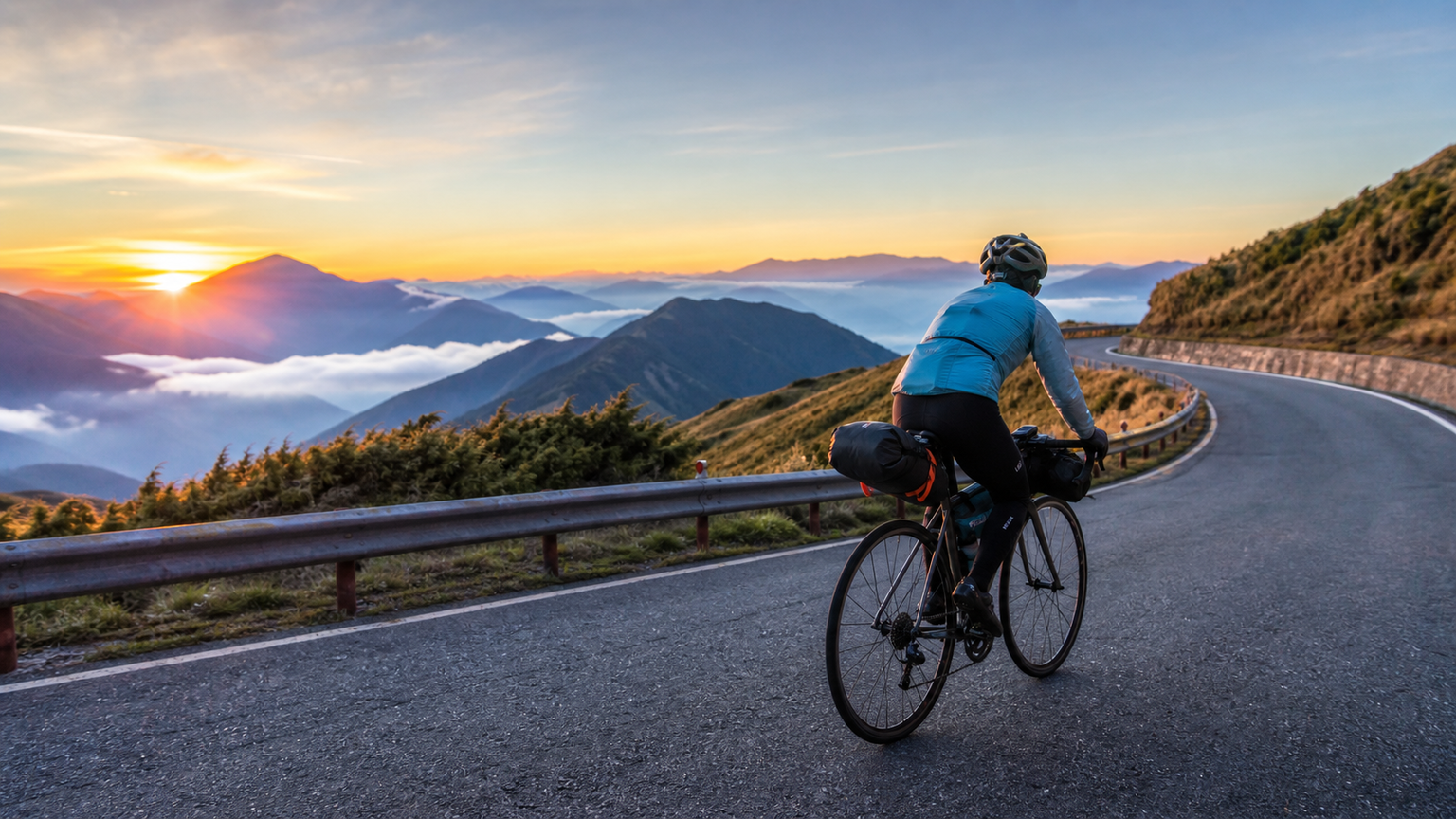
First Time Conquering Wuling: A Transformation Journey from Sea Level to 3,275 Meters
That morning, my alarm went off at 3:30 AM in a bed-and-breakfast in Puli Township. It was pitch black outside, and the temperature was only 12 degrees. I put on my cycling jersey, slipped on arm warmers and a wind vest, and stuffed the supplies I’d prepared the night before into my jersey pockets—four energy gels, two energy bars, and a packet of electrolyte powder. This was my first time attempting Wuling, starting from the Geographic Center Monument in Puli, with the goal of reaching the highest point of Taiwan’s highway system: Wuling on Hehuan Mountain, at an elevation of 3,275 meters.
Where the Idea Came From: A Reckless Decision
To be honest, this decision was planted during coffee time after a group ride. Fellow riders were talking about Wuling—someone said “you have to ride it at least once in your life,” another shared their experience of completing it in four hours, and someone else mentioned their first attempt took nearly seven hours. At the time, my climbing experience was limited to Fengguizui and Yangmingshan in the Taipei suburbs, with my longest single climb being just over ten kilometers. Starting from Puli, Wuling involves over 2,800 meters of elevation gain and nearly 55 kilometers of continuous climbing—this was an entirely different level of challenge.
But once that seed was planted, it couldn’t be uprooted. I started scouring the internet for every record of Wuling rides, training advice, and fueling strategies. The more I read, the more I realized this wasn’t impossible—as long as I prepared thoroughly.
Three Months of Preparation: From Cardio to Willpower
I gave myself three months to prepare. The training plan was simple, but executing it wasn’t easy:
Month One: Base Aerobic Fitness and Climbing Adaptation
I rode four to five days a week—two days of long flat aerobic rides (60-90 km, keeping heart rate in Zone 2) and two days of climbing training. I chose Fengguizui, the closest climb to home, as my primary practice route, deliberately using a lighter gear ratio and higher cadence than usual. At first it felt awkward—like I was spinning my wheels in place—but a coach friend told me: “Long climbs aren’t about power; they’re about efficiency and patience.”
Month Two: Extending Climbing Time
I started tackling longer climbing routes. I extended from Fengguizui to the Yangjin Highway, stretching my single climb time from 40 minutes to 90 minutes. On weekends, I scheduled simulation rides on long-uphill routes like the Beiyi Highway or Balaka Road, practicing eating, drinking, and adjusting my position on the slope. That month I also began core strength training, because long climbs put far more strain on the lower back and abs than flat roads.
Month Three: Intensity and Tapering
The first two weeks maintained high intensity, adding interval climbing training—picking a two-kilometer steep section on Fengguizui and riding it five times, with only three-minute rests between each. The final two weeks were for tapering: reducing volume while maintaining intensity to let my body fully recover.
Challenge Day: From Darkness to Light
Puli to Wushe (0-24K): The Warm-Up
I set off at 4:30 AM, before dawn. The streetlights along Provincial Highway 14 formed a ribbon of light in the darkness, with the occasional early-morning truck roaring past. The gradient on this section was gentle, averaging around 3 to 4 percent. I deliberately kept the intensity low, holding my heart rate below Zone 2. My body hadn’t fully warmed up yet, and my fingers were a bit stiff, but my pedaling rhythm was steady.
By the time I reached Wushe, dawn was breaking. I stopped at a 7-11 to refill water and use the restroom. I glanced at my cycling computer: 24 kilometers, about 600 meters of climbing, in one hour and fifteen minutes. I still felt comfortable, but I knew the real test hadn’t begun.
Wushe to Cingjing (24-33K): Finding a Groove
After leaving Wushe, the gradient steepened noticeably, with long sections at 7 to 8 percent. The mountain air in the early morning was crisp, visibility was excellent, and the distant ridgelines stacked layer upon layer, painted gold by the morning light. I settled into a steady rhythm—watching the road twenty meters ahead, focusing on the smoothness of each pedal stroke, not thinking about how much farther I had to go.
The Cingjing Farm section is where the tourists gather, but at 6 AM the road was nearly empty. Passing through the clusters of European-style resort buildings, mist rose from the valley below—it felt like riding into an ink-wash painting.
Cingjing to Yuanfeng (33-42K): The First Real Test
Past Cingjing, the elevation broke through 2,000 meters, and the air began to thin. For the first time, I truly understood what “high-altitude cycling” meant—with the same pedaling rhythm, my heart rate was running a dozen beats higher than at sea level. My breathing became rapid, and every pedal stroke required a deliberate deep breath.
The stretch from Cuifeng to Yuanfeng featured several soul-crushing long steep climbs, with gradients hitting 9 or even 10 percent. For the first time, I had the urge to get off and rest. My legs were starting to ache—not a sharp pain, but a persistent, dull fatigue, as if my muscles had been filled with lead.
At a switchback, I stopped, stood by the roadside gasping for air, and ate an energy gel with water. I looked down at my cycling computer: I’d been riding for over four hours, with more than 2,000 meters of climbing. Looking up at the winding road ahead, a voice surfaced in my mind: “You can do this. The road left is shorter than the road you’ve already covered.”
Yuanfeng to Kunyang (42-50K): A Conversation with Myself
This was the loneliest yet most profound stretch of the entire ride. Above 2,700 meters, surrounded by alpine arrow bamboo grasslands with no trees for shelter, the wind was fierce. Occasionally a car would pass, and the occupants would roll down their windows to give me a thumbs-up or shout encouragement—each one felt like a shot of adrenaline.
My cadence had dropped to the low 50s, grinding in my easiest gear, but I didn’t get off the bike. My mind kept alternating between “I’m so tired, I want to quit” and “I’ve come this far, I can’t give up now.” I started talking to myself, counting each pedal stroke in my head—every hundred strokes, I allowed myself a sip of water. This simple ritual actually helped me push through the hardest stretch.
Kunyang to Wuling (50-55K): The Final Mile
The moment I saw the Kunyang parking lot, I knew there were less than five kilometers to the finish. But the final climb to Wuling is notoriously torturous—you can already see the stone monument reading “Wuling 3275M” ahead of you, yet the winding road makes it feel like you’ll never get there.
Above 3,000 meters, every breath felt like only half a lungful of air. My legs had almost no strength left; I was pedaling purely on willpower. For the final 500 meters, I stood up and sprinted, using every last ounce of energy, watching the monument draw closer inch by inch.
And then—I made it.
The Moment at the Summit
Leaning my bike against the Wuling monument, I sat on the ground, gasping for air, eyes welling up. Not from pain, not from exhaustion, but from an indescribable emotion. From the person three months ago who thought this was impossible, to standing here now at the highest point of Taiwan’s highway system—every practice session, every moment I wanted to quit in between, all of it suddenly had meaning.
I glanced at my cycling computer: total time 6 hours 23 minutes, moving time 5 hours 48 minutes. Not an impressive time by any standard, but for me, it was a milestone.
The temperature at the summit was only 5 degrees, and the wind was strong enough to make standing difficult. I quickly put on my wind vest and a thermal base layer, then took a photo in front of the monument—face flushed red, lips pale, hair a mess like a bird’s nest, but smiling brighter than ever.
What I Brought Down the Mountain
On the descent, 55 kilometers of downhill took just over an hour. At my fastest, I exceeded 70 km/h, wind roaring past my ears, switchback after switchback. I focused entirely on braking control and line choice, not daring to let my attention waver for a second.
Back in Puli, I had a bowl of braised pork rice with a bowl of meatball soup at a small eatery—it was the most delicious meal I’ve ever had.
What Wuling taught me is simple: Most things you think you can’t do aren’t actually impossible—you just haven’t started preparing yet.
During those three months of training, there were countless mornings I didn’t want to go out and ride, several moments on climbs when I felt like throwing up, and recurring anxiety about whether I’d overestimated my abilities. But all of it combined formed the weight of that final moment at the summit.
If you’re also hesitating about whether to take on Wuling, my advice is this: Don’t wait until you’re ready to set off—decide to go first, then start preparing.
Next goal? Maybe the east route to Wuling, starting from Taroko in Hualien. I’ve heard the scenery there is even more spectacular, and the gradients are even tougher. But that’s another story.
Gear advice: For your first Wuling attempt, make sure your gearing includes at least a 34/32 climbing gear, or even lighter. Bring plenty of supplies and be mindful of the temperature difference at altitude (it might be 30 degrees at the base but only 5 degrees at the summit)—a wind vest and arm warmers are essential.
Related Reading
- First Wuling Challenge Reflections: Conquering the Highest Point of the Highway at 3,275 Meters
- First Time Conquering Wuling: The Complete Mental Journey from Shaking Legs to Standing on Taiwan’s Rooftop
- First Time Conquering Wuling: A Beginner’s Race Preparation Journey and On-Site Report
- Taiwan Cycling Hundred Peaks Challenge: The Complete Preparation Guide for Conquering Wuling
#北橫 + #北進武嶺 最硬的員工旅遊 EP1 | #公路車 #拉拉山 | 明池 | 武嶺 | 武陵農場 | 雲海 | Taiwan Cycling Route Wulin
6 年前
西進武嶺 世界紀錄挑戰!破2:30 ?!一群人推著一個夢上山 直播精華版 / ft. 張翰允 & 台視主播魏于恬 & KPLUS / #cycling 公路車 CT Yeh
2 個月前
#公路車 #西進武嶺 配速配瓦實驗 坡度分析 四小時內攻略 建大盃 NeverStop #西進武嶺攻略
6 年前
FTL 與 SYB 車隊專訪 西進武嶺 實用攻略分享! 2小時 如何練?!你不知道的眉角!新手準備武嶺必看 EP1 | 實力派女車友 | 精華版 | 公路車 | CTYeh
4 年前
大禹嶺 到 武嶺牌樓 全程前後實況錄影 | 北進武嶺 | 東進武嶺 | KOM | 訓練台 | 坡度分析 | Taiwan KOM Last 10 km HARD | 公路車
6 年前
雨戰! 西進武嶺員工旅遊 加料 各路段大數據分析 | 同事端出5公斤的公路車來挑戰!? EP1
4 年前
風櫃嘴時間 預測西進武嶺時間?13000名車友統計數據分析告訴你 !
5 年前
Never Stop 西進武嶺 前後雙機 完整全程錄影 訓練台 實境
8 年前