Standing on the Roof of Kyushu: Riding the Yamabiko Road from Chōgahara to Mino-tō Pass, a Scenic Highland
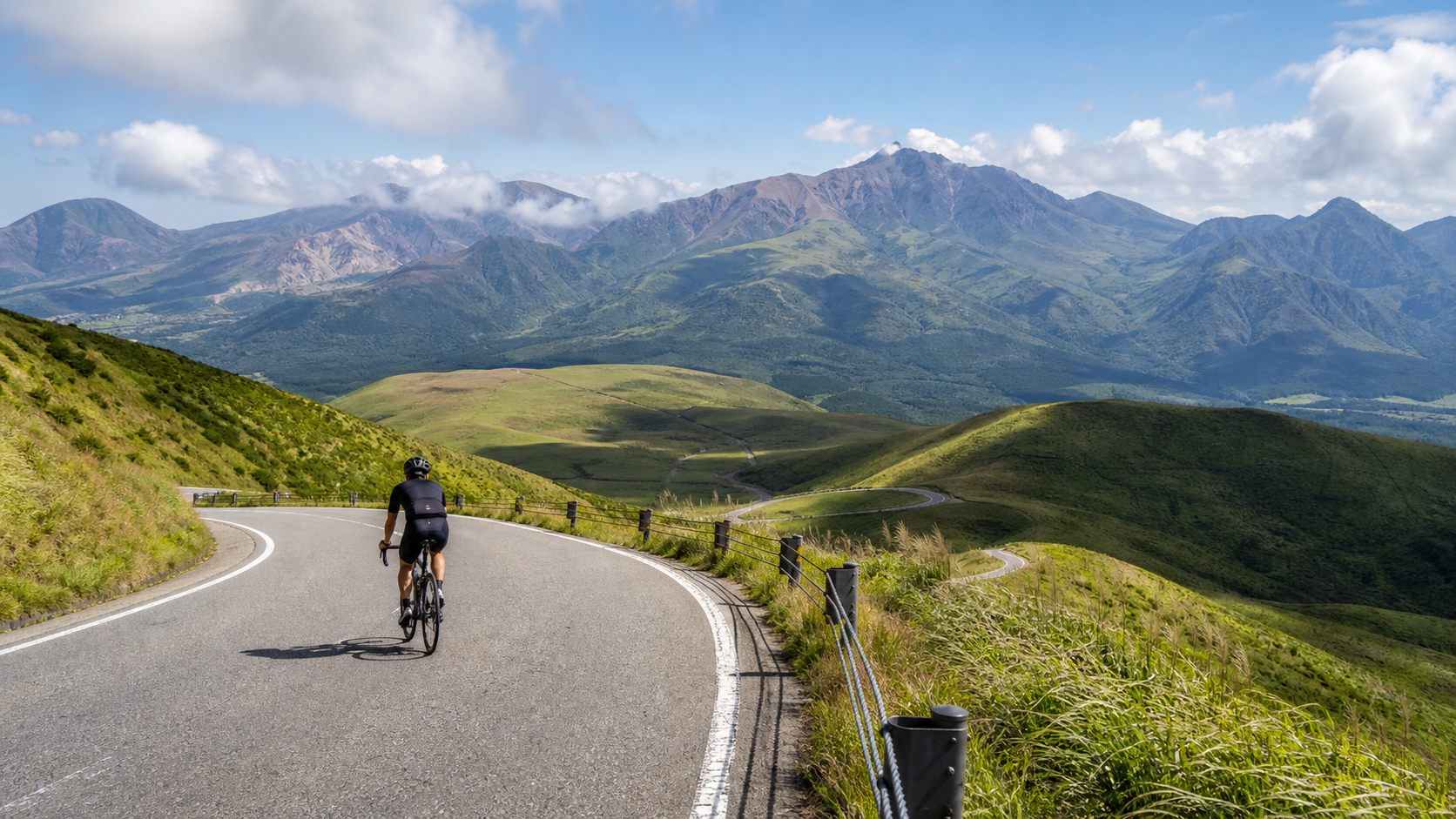
Some say that the Yamana Highway (やまなみハイウェイ) is the “road in Japan you must ride at least once.”
When you truly ride it, climbing from Kujyu no Nagahara all the way up to Mino no Toge—a plateau climb of 5.1 km, 287 m elevation gain, and an average gradient of 5.6%—you will understand why that phrase was spoken. Because every time you look up here, it is a painting: the continuous Kujyu mountain range, the undulating plateau beneath your feet, the grassy slopes combed by the wind, and the road that winds elegantly among the mountains, seemingly endless.
This piece is not about pace. I want to show you why this road, which crosses the “Backbone of Kyushu,” makes so many riders dream of it.
A Legendary Road Connecting Two Famous Mountains
The Yamana Highway is a scenic road connecting Mount Aso and Mount Kujyu (Kujyu Ranzan), spanning approximately 50 km across the core of Aso-Kujyu National Park. It has a beautiful nickname: “The Road on the Backbone of Kyushu.”
This road is legendary because it almost gathers everything a rider dreams of: vast plateaus, continuous volcanic groups, surging seas of grass, occasionally appearing marshes and lakes, and that kind of spaciousness, almost luxurious, that can never be found in Taiwan or in the city.
The section from Kujyu no Nagahara to Mino no Toge is the essence and climax of the Yamana Highway—because Mino no Toge, at an elevation of approximately 1,330 meters, is the highest point of the entire road. Climbing it means you are standing at the very top of the Kyushu backbone.
Departing from Kujyu no Nagahara: A Plateau Surrounded by Mountains
The starting point of the story, Kujyu no Nagahara, is a place itself that you are reluctant to leave.
It sits at the foot of the Kujyu mountain range, is a vast plateau, and is the most famous scenic and resting spot on the Yamana Highway. Here lies the vast Tadabara Marsh (蓼原濕原)—a precious wetland listed under the Ramsar Convention—where boardwalks extend through the grasslands and distant mountains stand like screens. Countless travelers, hikers, and riders stop here just to take another look at this scenery.
I still remember that morning when I started the climb from Kujyu no Nagahara. The air on the plateau was cold and fresh, carrying the scent of plants and soil. Mount Kujyu stood quietly in the morning light, with occasional wisps of clouds drifting over the peaks. Taking a deep breath, the air was so cool it invigorated the soul—this is the taste found only on a plateau above 1,000 meters in elevation.
Then I mounted my bike and began pedaling towards the road that wound upwards among the mountains.
Climbing, Yet Reluctant to Look Down
The gradient to Mino no Toge is not fierce; the 5.6% average gradient gives me enough room to look up at the scenery—which is precisely the most “dangerous” part of this road: you will be reluctant to look down.
As the altitude rises bit by bit, the view becomes increasingly open. The Kujyu mountain range unfolds layer by layer before your eyes, the grassy slopes rise and fall in the wind like a green sea, and the road draws elegant arcs in the valley, extending all the way to an unseen distance. The sky seems low enough to reach out and touch, and the shadows of clouds move slowly across the grassland.
Wind is a frequent visitor here. The plateau is unobstructed, and the wind blows through the valleys, carrying the scent of grass and making the bike cover rustle loudly. Sometimes it is a comfortable tailwind pushing you along, sometimes it is a stubborn headwind challenging you—but regardless of which, it makes you feel more truly that you are situated in a vast world of nature that belongs entirely to you.
While pedaling, I cannot help but look back and gaze into the distance again and again. That feeling is wonderful—the body is tired from the climb, but the heart is filled with the grandeur before your eyes. Tired, yet happy.
Mino no Toge: Standing on the Backbone of Kyushu
When I finally reached Mino no Toge, parked my bike, and walked to the observation deck—
The scenery at that moment was worth all the effort of these 5.1 km.
At the highest point of approximately 1,330 meters, the view is 360 degrees with no obstruction. Looking back, the plateau of Kujyu no Nagahara is visible in full; looking up, Mount Kujyu is close at hand, its ridgelines clear as if within reach. This is the trailhead for hikers climbing Mount Kujyu, and also the victorious finish line for riders conquering the highest point of the Yamana Highway—two different kinds of people gathered here by the same magnificent scenery.
The wind howls in my ears, sunlight spills over the grassy slopes. Standing there, I watch the winding road I just climbed spiral beneath my feet, and a indescribable sense of fulfillment rises from the bottom of my heart. This is not the boastful conquest of a steep mountain, but rather the fulfillment of “I have finally arrived at this plateau of my dreams.”
The Four Seasons of the Kujyu Plateau
- Spring: New green sprouts on the plateau, with snow-capped peaks and tender green slopes, marking the season of awakening.
- Summer: While the lower areas are baked by the heat, this plateau at 1,000 meters enjoys a cool breeze—riding the Yamana Highway in summer is a luxurious way to escape the heat.
- Autumn: Mount Kujyu changes into red leaves, and the miscanthus on the plateau turns golden, making it the most magnificent season of the year.
- Winter: The plateau is covered in snow, and the Yamana Highway becomes a silver-white world. It is beautiful, but dangerous and difficult to traverse, so it can only be admired from afar.
The same plateau has its own grandeur in each season. But the emotion of “vast heavens and earth, humans like dust” remains unchanged.
Side Trip: Hot Springs, Suspension Bridges, and Kyushu’s Healing
After riding past Mino no Toge, this journey is far from over.
The Kujyu area is a treasure trove of hot springs. Soaking in a pool after climbing to wash away fatigue is the classic finale of a Kyushu cycling trip. Nearby is the famous “Kujyu Yume Ohashi Suspension Bridge”—one of the highest pedestrian suspension bridges in Japan. Standing on it and overlooking the river valley and waterfalls offers another kind of shock. Further away, the Yamana Highway extends towards Mount Aso, another world of volcanic scenery in Kyushu.
You can treat Mino no Toge as the climax of a day, or as one stop on a multi-day expedition across Kyushu. No matter how you arrange it, this plateau, this road, and this pass will become the most vivid page in your memory.
Epilogue: Why This is the “Road You Must Ride Once”
5.1 km, 287 m of elevation gain. In terms of climbing, it is not difficult.
But the charm of the Yamana Highway has never been about difficulty. It lies in that boundless Kyushu plateau, in the magnificent panorama of Mount Kujyu, in the surging sea of grass, flowing cloud shadows, and the vast world where the wind never ceases, and in that perfect moment at Mino no Toge where you stand on the backbone and look down on the road you came up.
Someone asked me, is it worth flying all the way from so far to ride a five-kilometer climb?
I would say: When you stand at Mino no Toge, watching that winding road extend towards the horizon among the mountains, you will no longer ask that question.
Because some roads are truly worth riding once in a lifetime. And the Yamana Highway is one of them.
Route Data: Kujyu no Nagahara to Mino no Toge, distance 5.1 km, total elevation gain 287 m, average gradient 5.6%, Kujyu Town, Oita Prefecture, highest point of the Yamana Highway, finish line Mino no Toge at an elevation of approximately 1,330 meters, a scenic plateau climb crossing the Backbone of Kyushu.
Aso-Kujyu National Park: A Land Sculpted by Volcanoes
To understand the grandeur of Mino no Toge, you must first know the land it is located in—Aso-Kujyu National Park.
This is a land shaped by volcanoes for millions of years. Mount Aso possesses one of the world’s largest calderas, which is still active; and Mount Kujyu (Kujyu Ranzan) is a mountain range composed of a group of volcanoes, representing the highest peaks on Kyushu Island. The plateau where Kujyu no Nagahara and Mino no Toge are located is a masterpiece left by this volcanic activity—vast grasslands, rolling hills, hidden marshes and hot springs, all landforms gifted by volcanoes.
Because it is a volcanic area, the scenery here has a primitive and magnificent quality that cannot be replicated elsewhere. There are not many trees to block the view; instead, there are endless grassy slopes rising and falling in unison in the wind. The outlines of the distant volcanic groups are distinct, their ridgelines clear as if within reach; and the abundant geothermal energy beneath the earth nurtures hot spring towns at the foot of the mountains. Volcanoes are both the source of power for this land and its magnificent sculptor.
Riding on the road to Mino no Toge, you are actually riding on a living volcanic land. Every inch of asphalt beneath your feet and every grassy slope before your eyes are the result of the scorching power inside the earth, slowly sculpted over millions of years. This direct feeling of “the power of the earth” is the deepest background color behind the magnificent scenery of Mino no Toge.
The Chokojo and Tadeno Plateau: A Sanctuary on the High Plateau
The starting point of the Kabe no Toge Pass, Chokojo, is a place itself that makes you reluctant to leave.
Situated at the foot of the Kyujou Mountains, it is the most famous scenic and resting spot on the Kabe no Toge Road. What is most precious about Chokojo is the “Tadeno Wetland” beside it—a rare wetland listed under the Ramsar Convention (the international treaty for the protection of internationally important wetlands).
The wooden boardwalk winds through the grass of the wetland, with distant mountains standing like a screen. This wetland is the home of countless animals and plants, displaying completely different faces with the changing seasons—lush green with wildflowers in spring and summer, and a golden aesthetic of withered grass in autumn. Walking on the wooden boardwalk of the wetland, you can feel up close the richness and fragility of this highland ecosystem.
I particularly like to stop at Chokojo for a while before starting the ascent to Kabe no Toge Pass, walking a short distance on the wetland boardwalk. That sense of tranquility and vastness is a wonderful “opening”—it allows you to settle your heart before the official climb, first being moved by the beauty of this highland. Then, carrying that emotion, you mount your bike and head towards Kabe no Toge Pass; the climb is no longer just a climb, but becomes a deep dialogue with this magnificent highland.
Standing on the Roof: That Moment of Vastness and Smallness
When you finally reach Kabe no Toge Pass and walk to the observation deck—the scenery at that moment makes all the hardship worthwhile.
At an altitude of approximately 1,330 meters, the view is unobstructed for 360 degrees. Looking back, the entire Chokojo plateau is visible; that wetland, that winding road, all are within view; looking up, the Kyujou Mountains are close at hand, their ridgelines clear as if within reach. This is the trailhead for mountaineers climbing the Kyujou Mountains, and also the victorious finish line for riders conquering the highest point of the Kabe no Toge Road—two different kinds of people are gathered here by the same magnificent landscape.
The wind howls in your ears, sunlight falls on the grassy slopes. Standing there, looking at that winding road you just climbed, coiling beneath your feet, an indescribable emotion rises in your heart. It is not the boastfulness of conquering a steep mountain, but a sense of fulfillment: “I have finally arrived at the peak of this dream highland.”
At the same time, you will also feel a strange smallness. In the face of such a vast heaven and earth, humans are so insignificant. But that smallness is not loss; it is relief—realizing that the world is so vast, and my worries are so small. The highland, with its vastness, briefly releases you from the cage of self, allowing you to feel again how happy it is to stand between such heaven and earth, breathing freely.
Hot Springs, Suspension Bridges, and Kyushu’s Healing
After riding Kabe no Toge Pass, this journey is far from over. The Kyujou area is a treasure trove of healing in Kyushu.
Hot Springs: Kyujou is rich in hot spring resources. Soaking in a pool of hot springs after climbing to wash away fatigue is the most classic conclusion to a Kyushu cycling trip. The geothermal energy of this volcanic land produces famous hot springs of various qualities, providing the gentlest comfort after your adventure in the vast highland.
Kyujou Yume Suspension Bridge: Nearby is also the famous “Kyujou Yume Suspension Bridge”—one of the highest pedestrian suspension bridges in Japan, approximately 390 meters long and 173 meters high. Standing on the bridge and looking down at the valleys and waterfalls below is another kind of shocking awe that makes your legs weak. This suspension bridge has become a representative attraction of Kyujou and is very worth visiting on the way.
Extended Scenery: Looking further, the Kabe no Toge Road extends towards Aso, which is another world of volcanic scenery in Kyushu—a huge caldera, vast grasslands stretching for thousands of meters, and active volcanic vents still emitting smoke. If time permits, treat Kabe no Toge Pass as the starting point of a longer Kyushu scenic expedition, and you will gain a journey unforgettable for a lifetime.
The Four Seasons of the Kyujou Plateau
- Spring: The highland’s new greenery is just born, with snow-capped peaks and tender green grassy slopes reflecting each other; it is the season of awakening. At this time, Kyujou carries a fresh and hopeful beauty.
- Summer: When the cities of Kyushu are baked by the heat, this thousand-meter highland is cool and breezy—riding Kabe no Toge Pass in summer is a luxurious way to escape the heat. The emerald green sea of grass, blue sky and white clouds, are the most vibrant season of the highland.
- Autumn: The Kyujou Mountains change into red leaves, and the miscanthus on the highland turns golden; the sea of grass surges into gold in the autumn wind. This is the most gorgeous and popular season of the year.
- Winter: The highland is covered in snow, and the Kabe no Toge Road becomes a silver-white world; beautiful though it is, it is dangerous and difficult to travel—high altitude severe cold, roads may be closed by snow and ice; at this time, Kabe no Toge Pass can only be viewed from afar and should not be visited rashly.
After the Finale: Why Some Roads Are Worth Flying Across the Ocean to Ride
5.1 kilometers, 287 meters of elevation gain. For a climb, it is not difficult at all. So, is it worth flying from Taiwan specifically to ride such a short slope?
My answer is: Absolutely worth it.
Because the Kabe no Toge Road and Kabe no Toge Pass give you, from the beginning, not “difficulty,” but a “must-see” vastness. Some scenery, no matter how beautiful in photos, cannot convey; some vastness, you must stand there personally, be blown by the wind, be surrounded by that boundless highland, to truly feel. And Kabe no Toge Pass is exactly such a place.
When you stand on the roof of Kyushu, looking at that winding road extending towards the sky between the mountains, watching the sea of grass surge, cloud shadows flow, and the Kyujou Mountains stand majestically—that moment of shock and emotion will become one of the most vivid memories of “vastness” in your life. Such a memory is worth flying across an entire ocean to collect personally.
Some people spend their whole lives chasing the most difficult, steepest, and most punishing climbs. And Kabe no Toge Pass reminds us—the value of a climb is not only in the difficulty of conquest, but more in the scenery it takes you to, that vastness, that moment of standing between heaven and earth, feeling both small and free, an incredibly precious moment.
So, if you have also longed for “the road most worth riding in Japan”—stop just longing. Pack your bike, your windbreaker, and a heart ready to be shocked; go ride the Kabe no Toge Road, go stand on Kabe no Toge Pass. The roof of Kyushu is waiting to hand over its most magnificent scenery to every traveler willing to step onto this slope.
We will meet on the roof of Kyushu.
Solitude on the High Plateau: Wind, Clouds, and a More Sober Self
What Kabe no Toge Pass gives me, besides vastness, is something almost extinct in the city—true solitude.
Climbing on that open highland, you will feel a kind of wonderful loneliness. There is no city noise around, no pressure of buildings, only endless grassy slopes, flowing clouds, and omnipresent wind. In such an environment, people will unconsciously quiet down, and begin to hear the voice of their own heart.
That is a very precious experience. Our daily lives are filled with too many sounds—phone notifications, work deadlines, others’ expectations, the clamor of social media. We rarely have the opportunity to truly be alone with ourselves, truly hear what we are thinking, what we want. And that vast highland of Kabe no Toge Pass blocks all these external noises, leaving only you and heaven and earth.
In such solitude, I often think a lot. I think about those unresolved problems in life, about those emotions I haven’t had time to feel properly. Miraculously, in the wind of the highland, these problems seem to become clearer and lighter. Perhaps it is because, when placed between such a vast heaven and earth, those worries that once made you gasp for breath suddenly seem less heavy.
The wind blows clouds over the grassy slopes, and also blows away some of the darkness in my heart. This is another gift the highland gives me—it not only lets me see magnificent scenery, but also lets me meet a more sober, more peaceful self in solitude.
For You Who Are Still Hesitating: The Road of a Lifetime
Japanese riders call the Yamabiko Highway “a road you must ride at least once in your lifetime.” These words deserve to be taken seriously by every cycling enthusiast.
Life is long, but the experiences that truly allow you to say “no regrets” are few. Standing atop the Mino-Do Pass, overlooking the entire Kyushu ridge, I can confidently say—that is one of them.
We often hang “someday” on our lips. We’ll do those long-awaited things when we have money, when we have time, when we’re ready. But “someday” is a dangerous word; it often gets postponed again and again until it becomes “never.” The places we’ve always wanted to visit and the roads we’ve always wanted to ride often remain forever stuck in the “longing” stage.
Mino-Do Pass is not difficult. It is only 5.1 km long with a rider-friendly gradient, so physical fitness is not an issue. What truly blocks you is often that repeatedly postponed “someday.” So, to you who are still hesitating, I say: stop waiting. Some roads are truly worth overcoming all obstacles and crossing oceans to ride once.
Because when you stand atop the ridge of Kyushu and are deeply moved by that vast plateau, you will be grateful—you will be grateful that you didn’t leave it for “someday,” that you truly came. The emotion of seeing it with your own eyes will become a warm and shining coordinate in your future life, reminding you: the world is so vast and beautiful, and you once stood personally at its most magnificent height.
May you not leave your longings for “someday.” May you, in every moment when you can still pedal, courageously chase the scenery that moves your heart. The ridge of Kyushu will always be there, waiting for everyone willing to set out for it.
The Plateau of My Hometown: Thinking of Wuling from Mino-Do Pass
As a Taiwanese rider, standing on the plateau of Mino-Do Pass, what comes to my mind is the higher, more vast plateau of my hometown—Wuling.
Taiwan actually possesses high-altitude climbs that cycling enthusiasts across Asia long for. Wuling, at an elevation of 3,275 meters, is the highest point of any road in East Asia and is regarded by countless riders as a holy site they must pilgrimage to in their lifetime. The alpine meadows, sea of clouds, and the vast ridgeline of the Central Mountain Range in the Hualien Mountain range surpass Mino-Do Pass in both scale and height.
Standing on the plateau of Mino-Do Pass at approximately 1,330 meters, I suddenly came to understand the preciousness of Wuling in my hometown even more. Riders in Taiwan actually possess a highland cycling paradise that is uniquely blessed—such altitude, such sea of clouds, such challenges, which many riders in other countries cannot reach even after a lifetime of effort. Yet, because it is “so close,” we often forget to cherish it properly.
The plateau of Mino-Do Pass makes me miss the sea of clouds atop Wuling, miss the magnificent alpine meadows when crossing Hualien Mountain, and miss the emotion of pedaling hard in thin air and finally reaching the peak of East Asia. It turns out that whether it is the ridge of Kyushu or the ridge of Taiwan, the shock of “standing high and being surrounded by vast heaven and earth” is universal. Bringing this emotion from Mino-Do Pass home, I want to ride Wuling again—with a new, more appreciative perspective.
If you are also a Taiwanese rider, after experiencing the vastness of the plateau at Mino-Do Pass, do not forget that your hometown has a higher, more beautiful Wuling waiting for you to pilgrimage to. Sometimes, traveling far away is to fall in love again with the plateau closest to home.
Mountains know no borders; each ridge has its own vastness. May we be moved again and again by this vast world, between the plateaus of our hometown and those far away.
Related Reading
- Kokonoe Longers Plain → Mino-Do Pass Guide: Pace, Wind Protection, and Summit Guide for the 5.1 km 5.6% Highland Climb
- Riding Toward the Clouds Bread Shop: A Journey of Volcanoes and Snow Walls at Shibetsu Pass, Yokoteyama, and Shiga Katsunomi Road
- Riding Up Along the Route of the Hakone Ekiden: National Route 1, Hot Spring Towns, and Fuji at Ashino Lake
- Coming of Age for Kanto Riders: Yagura Pass, a Holy Site That Measures Your Combat Power
2025 乘鞍 KOM 登山賽挑戰實錄 / 日本公路最高 ! 賽前探路篇 / 比富士山厲害,無敵絕景!/ 40週年 / 中文YT首發 / 公路車 / CT Yeh #乘鞍ヒルクライム
10 個月前
台北闊瀨陡坡 騎旅 / 日本單車雜誌編輯車友臨時加入!/ 髮香才是最強的 / feat. 北迴歸線小隊 / 公路車 CT Yeh
6 個月前
2025 乘鞍岳登山賽 比賽全紀錄篇 / 完整路線攻略介紹 / 日本版武嶺 公路最高點 / 高山空拍絕景 / 明年會開團! / 公路車 / CT Yeh
10 個月前
觀霧 變好騎了! | 北高車友爆笑大會師 | 公路車 | 單車旅遊 Taiwan Cycling Route GuanWu
6 年前
新竹羅平 x 天湖部落 大禹嶺級變態陡坡! 4K超高畫質 空拍 | 公路車
5 年前
日本公路最高登山賽,台灣首位YT挑戰實錄,乘鞍登山賽40週年,賽前篇完整版,請到我的YT收看 #公路車 #cycling
10 個月前
帶「咩」一起騎玩日本熊本 上天草市 / 單車旅行、賞海豚、釣魚、高空滑索通通有!/ 公路車 / CT Yeh /
1 年前
日本島波海道 EP1 / 五大絕景路線之一! / 私房溫泉 x 豪華單車客棧 / 今治 to 大三島 / 公路車 / CT Yeh
2 年前