The Gate of Southern Fuji: A Legend of the Turning Point at Iwate-san's Magaeshi, the Mountain of Takuboku and Kenji's Homeland, and a Short-Climb Pilgrimage Toward Faith
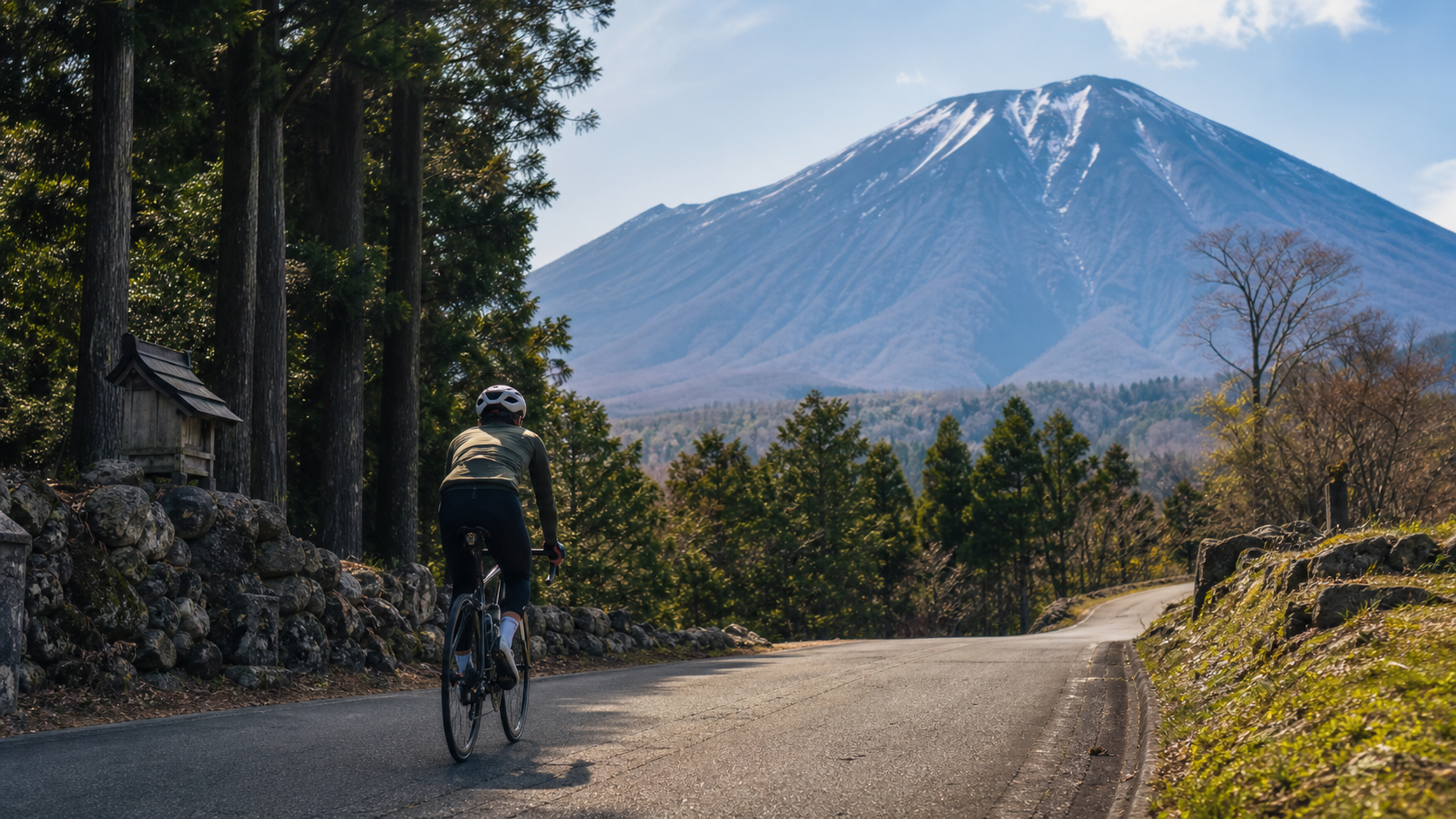
Some place names are stories in themselves. The first time you hear “Magaeshi (うまがえし),” it might strike you as odd—why would a trailhead be called “the place where horses turn back”?
The answer lies in an ancient legend, and in what this mountain means to the people of Iwate. In this piece, I want to set aside power meters and training plans for a moment, and take you to understand the great mountain behind this short climb—Mount Iwate, the mountain of home affectionately called “Southern Fuji” by the people of Tohoku. Because once you understand its story, you’ll find that riding up Magaeshi is, in truth, a pilgrimage toward faith and nostalgia.
1. The Secret of the Place Name: Where Horses Turn Back
Let’s first unravel the mystery of the name “Magaeshi.”
The generally accepted origin is that, in ancient times, the road up the mountain was so steep and rugged that even the horses carrying goods and travelers could go no further. People had no choice but to turn the horses back at this point and continue on foot. Thus, this “end of the horse’s journey, beginning of the hiker’s feet” came to be called “Magaeshi.”
Such place names are not uncommon among Japan’s mountains; they often mark the boundary where an old road transitions from “rideable” to “walkable only.” It’s a naming born of practical wisdom and the passage of time—not some elegant title deliberately chosen, but a name “walked into existence” step by step, by countless travelers, horsemen, and pilgrims over the long years, with their feet and their horses’ hooves.
Legend has it that this is where horses stopped. Hundreds of years later, we arrive riding another kind of “iron horse,” yet it is precisely at the point where horses turned back that we must push onward with all our might. History plays a gentle joke here: back then, horses ended their journey here; today, iron horses take over from this very spot.
Standing in the parking lot at Magaeshi, imagine a weary horse stopping here a thousand years ago, snorting white breath, being led back by its master, while a devout climber adjusted their pack, looked up at the sacred mountain towering into the clouds, and took their first step on foot—this image infuses this seemingly ordinary short climb with a profound sense of time. You’re not just riding a stretch of asphalt; you’re riding an ancient road walked and re-walked by time and legend.
(Regarding this legend, accounts vary from place to place; we treat it with the cautious stance of “it is said” and “generally believed”—but whatever the details, the imagery this place name carries—“horses stop here, humans continue upward”—is moving enough on its own.)
2. Southern Fuji: One Mountain, the Symbol of a Prefecture
To understand Magaeshi, you must first understand the mountain it guards—Mount Iwate.
Mount Iwate, standing 2,038 meters tall, is one of Japan’s 100 Famous Mountains and the highest peak and definitive landmark of Iwate Prefecture. It bears another name, more widely known and deeply felt: “Southern Fuji,” or “Iwate Fuji.”
Why “Southern Fuji”? Because of its nearly perfect solitary silhouette—a lone, symmetrically shaped volcano standing aloof upon the land of Iwate. Viewed from afar, its majesty and beauty echo the bearing of Mount Fuji itself. Across Japan, many local mountains are crowned with the title “〇〇 Fuji”—it is the highest honor the people of a region can bestow upon their homeland’s most beautiful, tallest, most symbolic peak: to compare it to Fuji, the king of sacred mountains in the Japanese heart.
Mount Iwate is to the people of Iwate what Jade Mountain is to the people of Taiwan—an identity rooted deep in the land and in the blood. It is not merely a geographical mountain; it is a spiritual one. Wherever you are in Iwate, if you look up and see that familiar silhouette, you know “home” lies in that direction. It appears in countless childhood memories, in the scenery outside the train window when travelers return home, and in the gazing eyes of generation after generation of Iwate’s people.
And Magaeshi is the most iconic gateway to this sacred mountain. From the Magaeshi trailhead, following the Yanagisawa Course upward, the summit lies about 5.7 kilometers away, with the route splitting into the “New Trail” through the forest and the “Old Trail” across volcanic scree slopes. Countless climbers yearning to draw close to this sacred mountain begin their intimate dialogue with Southern Fuji from this trailhead, at an elevation of about 630 meters.
3. Takuboku and Kenji: The Mountain of Home in the Words of Literary Masters
A mountain’s greatness lies not only in its height, but in how deeply it enters people’s hearts, how much it becomes words and emotion. Mount Iwate is moving, in large part, because it is the “mountain of home” that haunted the dreams of two literary giants of Tohoku.
Iwate Prefecture nurtured two brilliant stars of modern Japanese literature: the poet Takuboku Ishikawa and the fairy-tale writer and poet Kenji Miyazawa. Both men, who loved their homeland deeply, infused their works with the landscapes, customs, and nostalgia of Iwate—and that towering Mount Iwate was an indispensable part of their inner scenery.
For Takuboku, the mountains and rivers of home were the eternal repository of nostalgia in his wandering life—that profound longing for his native land, for the mountains and streams of his childhood, flowed through his tanka poetry to later generations, moving countless readers who carried their own homesickness. And Kenji Miyazawa, a writer who devoted his life to loving the land of Iwate and transformed his home into the ideal realm of “Ihatov,” built his animistic, poetic natural world upon the very northeastern highlands he gazed upon day after day.
Mount Iwate is not just a geographical coordinate; it is a mountain steeped in literature, a mountain gazed upon by poets, a mountain called upon again and again by nostalgia. When you ride up Magaeshi, you are pedaling across land that once nourished great souls.
This literary weight lends an extra layer of poetry to riding up Magaeshi. You’re not just doing a climbing workout; you’re personally stepping into the landscape that Takuboku and Kenji once gazed upon with deep affection and wrote about again and again. Every inch of this ground beneath your wheels could have been the source of a line of their poetry, a spark for one of their fairy tales. This sense of connection—to literature, to history, to the land—is something no cold data can ever provide.
4. Riding to the Gate of a Sacred Mountain: The Narrative of a Short-Climb Pilgrimage
Let me take you, in the first person, through the inner journey of this short climb.
Setting out from the direction of Takizawa, passing through the streets and fields of the suburbs of Morioka with their everyday rhythms, you gradually leave the city’s clamor behind. The air grows fresher, and the mountain in your view—Southern Fuji—becomes clearer and more immense with each turn of the wheel, like a silent, benevolent giant patiently waiting for you to draw near.
Turning onto the road toward Magaeshi, the grade begins to rise. A 6.8% slope leaves no room for distraction; you must put in real effort, breathing growing heavier, heartbeat drumming louder. But strangely, this brief exertion carries a near-ritual solemnity—because you know you are pedaling along the road to the gate of a sacred mountain, climbing in the footsteps of countless pilgrims and climbers who came before you over the centuries.
Sweat drips, your legs burn, but your gaze remains fixed on Mount Iwate, growing ever closer ahead. It is there—symmetrical, majestic, standing alone—like a silent summons. You are no longer riding to break records or chase power numbers; you are riding to draw near to it, to reach its gate, to leave one breath and one heartbeat at its feet.
When you finally ride into the trailhead parking lot at Magaeshi, steady your bike, and look up, gasping—Southern Fuji stands before you, so close it feels within reach. In that moment, the toil of a mere 3 kilometers is repaid with the awe of standing face to face with a great sacred mountain. You suddenly understand why, for a thousand years, people were willing to turn their horses back here, switch to their own two feet, and keep climbing toward this mountain. Because some mountains are worth approaching with the most devout of postures.
Resting a while in the parking lot, you might encounter hikers preparing to ascend, adjusting their gear and gazing toward the summit. They are about to follow the Yanagisawa Course, through the forests of the New Trail or the scree of the Old Trail, embarking on a deeper dialogue with Southern Fuji. And you, on your iron horse, have just reenacted the ancients’ “final stretch by mount,” completing a small pilgrimage of your own—a rider’s pilgrimage—at the gate of this sacred mountain.
5. Flavors at the Foot of the Mountain and Nearby Detours
After climbing Magaeshi, don’t rush to leave. This expanse of Iwate land, centered on Morioka, holds far too many things worth savoring.
The Local Character of Takizawa and the Morioka Suburbs: The Takizawa area, where Magaeshi is located, sits adjacent to Morioka City, home of the Iwate Prefectural Government. This is an excellent gateway for exploring Iwate’s local culture. After finishing the climb and returning to Morioka, you can reward yourself with a fine local meal—the springy Morioka Reimen (cold noodles), the entertaining Wanko Soba refill culture, and a variety of local dishes made with Tohoku ingredients. A body that has just exercised craves these savory, chewy, warming flavors for healing.
Iwate-san Shrine and Traces of Faith: As a sacred mountain, Iwate-san has been surrounded by related faith traditions at its foothills since ancient times. Travelers interested in the beliefs and history of this land might consider visiting the related shrines and cultural heritage sites along the way, to feel how this mountain has, over the long passage of time, become the spiritual anchor of the people of Iwate.
Morioka’s Historic Streets: Morioka itself is a city full of charm, preserving many historic districts, long-established shops, and cultural attractions. Using Morioka as your base, you can stroll through the streets of this old castle town between rides, experiencing the understated yet profound cultural depth of a Tohoku city.
6. Route Suggestions: Weaving a Short Climb into a Deep Journey
If you’ve come from afar, Magaeshi certainly won’t be the entirety of your itinerary. I suggest using Morioka as your base and setting this short climb into a more complete deep-dive journey through Iwate:
- Base yourself in Morioka: With convenient transport, abundant accommodation, and great food, it’s the ideal gateway for exploring the area around Iwate-san. Use it as the center point, radiating your cycling and sightseeing plans outward.
- Combine a short climb with a long climb: Also within Iwate Prefecture, there’s the Hachimantai Aspite Line, a long volcanic climb of an entirely different magnitude. You could dedicate one day to the pilgrimage of the short Magaeshi climb, and another day to an expedition up the sky corridor of Hachimantai, experiencing the dual charm of Iwate riding—“one short, one long; one pilgrimage, one flight.”
- A combined cycling and hiking itinerary: For multi-discipline outdoor enthusiasts, Magaeshi is both the end of the ride and the start of the hike. You could even plan a multi-sport challenge of “riding to Magaeshi, changing gear, and hiking to the summit of Southern Fuji,” getting to know this Hyakumeizan (one of Japan’s 100 Famous Mountains) in the most complete way possible.
- A literary pilgrimage: If you have a particular fondness for the works of Ishikawa Takuboku and Miyazawa Kenji, this journey can become a literary pilgrimage—riding at the foot of the mountain they loved as their homeland, letting words and landscapes overlap in your memory.
7. The Yanagisawa Course: Two Paths Beyond the Gate
The cyclist’s journey ends at the Magaeshi parking lot; but the hiker’s journey is just beginning there. Understanding the route to the summit beyond Magaeshi will give you a deeper appreciation of this sacred mountain as you gaze up from the parking lot.
From Magaeshi, the classic route to the summit of Iwate-san is the so-called “Yanagisawa Course.” This trail climbs from the Magaeshi trailhead at approximately 630 meters above sea level, ascending about 5.7 kilometers to the 2,038-meter summit. Interestingly, this route splits partway into two paths of distinctly different character—the “New Trail” and the “Old Trail.”
The “New Trail” winds through the forest, with a relatively gentler gradient and shade from the trees, making for a milder hike; the “Old Trail” requires crossing the volcanic scree slopes (zareba) characteristic of the mountain, offering open views but far more demanding terrain—a path where you can feel the wildness of the volcanic landscape more intensely. Many hikers choose to go “up the Old Trail, down the New Trail,” or vice versa, experiencing two completely different faces of this volcano in a single outing.
This structure of “one mountain, two paths” is itself a metaphor about choice. The safe forested New Trail, or the wild scree-strewn Old Trail? Gentler but with fewer views, or harder but rewarded with grandeur? Isn’t this the very choice every one of us who loves the outdoors makes in our hearts, again and again? When you park your bike at Magaeshi and look up at that branching trail, you might suddenly understand: what makes this mountain so appealing is precisely that it never offers you just one answer.
And for us as cyclists, even if we don’t continue on foot to the summit, simply standing before this gate, imagining the New Trail’s forest and the Old Trail’s scree converging above the clouds at the peak of Southern Fuji, is already a kind of romance. The end of this climb connects to infinite possibilities leading to the summit of a Hyakumeizan.
8. The Character of a Volcano: Between Gentleness and Ferocity
We call Iwate-san “Southern Fuji,” we call it “graceful” and “majestic,” but don’t forget—its essence is that of a volcano. And a volcano always possesses two faces: gentleness and ferocity.
Its gentle face is the symmetrical, beautiful mountain profile; the bountiful forests and fields at its foothills; the land that has nourished countless lives and works of literature. It gives the people of Iwate a sense of homeland identity, gives travelers magnificent scenery, gives hikers the joy of conquest. For centuries, it has stood like a silent guardian on the plains of Iwate, watching over this land and its people.
But deep within the volcano, the power of the earth always lies dormant. It is this energy from beneath the ground that shaped its form, piled up its scree slopes, and may, over vast geological time, reveal its ferocious side. When you stand at Magaeshi and look up at this sacred mountain, what you face is not just a landscape, but a force of the earth that is still breathing, still alive.
I’ve always felt that understanding a mountain’s “volcanic character” makes the experience of getting close to it far more profound. It makes you hold a sense of awe for nature’s power even as you admire its beauty; it makes you realize how small and how fortunate we humans are in the presence of such an existence. This awe doesn’t diminish the joy of riding and climbing—it makes that joy heavier, more substantial, more real.
Gentleness and ferocity, beauty and power—a volcano unites these contradictory qualities within a single, symmetrical mountain form. This, perhaps, is the deepest allure of Southern Fuji—it lets you feel at once the comfort of beauty and the shock of power.
9. Southern Fuji Through the Four Seasons: A Mountain’s Transformations
The beauty of Iwate-san changes with the turning seasons, and Magaeshi is the perfect front-row seat for watching this mountain’s seasonal transformations.
In spring, the summit may still be draped in lingering snow, while new greenery sprouts at the foothills. The interweaving of remnant snow and fresh green is the most vibrant scene of the year on Southern Fuji. Snowmelt streams babble, all things awaken, and the mountain seems to slowly open its eyes from winter slumber.
In summer, it’s peak season for hiking and cycling. The mountain is lush green, the sky a clear blue, and the Magaeshi parking lot is packed with hikers preparing to summit. This is Southern Fuji’s most energetic, liveliest season, with the air full of the passion of outdoor sports.
In autumn, the forests at the foothills are dyed into a brocade of reds and yellows, forming a striking contrast with the first snow that may appear on the summit. This is the season photographers love most—when you ride up to Magaeshi, before you lies layer upon layer of autumn color, set against that majestic sacred mountain, breathtakingly beautiful.
In winter, Southern Fuji is draped in thick white snow, transformed into a silver sacred mountain, standing in solitary grandeur beneath the cold skies of Tohoku. Though this is no longer the season for cycling or ordinary hiking, that pure, solemn beauty of a snow-covered mountain is Southern Fuji at its closest to the “divine.”
The same mountain, the same Magaeshi, yet performing entirely different souls across the four seasons. This is why this mountain deserves to be visited again and again—each season, it shows you a brand-new face.
10. Writing Cycling into Life: What Magaeshi Taught Me
Writing this far, I’d like to step away from the route itself and share something more personal.
The Magaeshi climb is short—so short that I can ride it in a little over ten minutes. But what it has taught me runs far deeper than its length.
It taught me that value is not determined by length. A short climb, because it is connected to a legend of turning back, the faith of a sacred mountain, and the nostalgia of two literary figures, becomes immeasurably weighty. Life is the same—some brief encounters, brief journeys, brief efforts may leave the deepest marks on our lives.
It taught me that continuing upward is a choice. At the “place where horses turn back,” the ancients chose to turn their horses around and continue the ascent on foot. This image of “not turning back, continuing upward” gives me a strange strength every time I ride this climb. On the road of life, we too often arrive at our own “Magaeshi”—a place where our original methods, our original supports, can no longer carry us forward. At that moment, do we choose to turn back, or do we choose to find another way and continue upward?
It taught me that cycling can be a pilgrimage. When pedaling is no longer just for data, no longer just for results, but for drawing close to a great mountain, for stepping into a land steeped in literature, for settling one’s heart between heaven and earth—then cycling ceases to be merely a sport and becomes something close to an act of faith.
This, perhaps, is the deepest meaning of riding abroad, and of cycling itself: it allows us, even as we push hard on the pedals and sweat freely, to quietly build a deeper connection with the world, with this land, and with ourselves.
Epilogue: At the Place Where Horses Turn Back, Continue Upward
We must return, in the end, to that original image: Magaeshi—the place where horses turn back.
In ancient times, this was the end of the road for horses. Travelers turned their weary horses around here, then lifted their eyes in reverence toward the sacred mountain, and continued upward on foot.
And today, we arrive here on our steel horses. We do not turn back; we choose to continue upward—with our pedals, with our sweat, with our heartbeats, inching closer to that mountain called the “Southern Fuji,” the mountain of home, the mountain of the heart once gazed upon with deep affection by Takuboku and Kenji.
This, perhaps, is the deepest meaning of cycling: it gives us the opportunity, through our own strength, to draw close to those great, solemn places that carry countless stories and emotions. The Magaeshi climb is short—too short to constitute an epic; but its meaning is long—long enough to connect a legend of turning back, the faith of a sacred mountain, the nostalgia of two literary figures, and, within your own heart, that devout and courageous soul willing to continue climbing upward at the “place where horses turn back.”
When you ride up Magaeshi and behold the Southern Fuji—remember that what you have completed is not merely a climb, but a pilgrimage—short, yet profoundly solemn—belonging to a rider.
11. The Call of the Mountain of Home: Why We Need “Our Own Mountain”
Before concluding this journey, I want to explore a deeper thought: why is the “mountain of home” so important to people?
Mount Iwate to the people of Iwate, Yushan to the people of Taiwan, Mount Fuji to the people of Japan—the people of every land seem to need “their own mountain” in their hearts. That mountain need not be the tallest, the most treacherous, or the most famous, but it must be the most familiar, the one that best represents home, the one that most readily evokes nostalgia in the hearts of those far away.
When a child of Iwate wanders in a foreign land and longs for home, what surfaces in the mind is often the familiar silhouette of the Southern Fuji. When Takuboku Ishikawa looked back at his hometown through a life of hardship, when Kenji Miyazawa transformed his home into a utopia, that mountain was the gentlest coordinate in their hearts. A mountain of home carries not merely geography, but memory, identity, and an entire answer to the question “where do I come from.”
And as a rider who has come from afar, from Taiwan, when I ride up Magaeshi and look up at the Southern Fuji, I am, in truth, using this mountain to understand a universal emotion—that deep and enduring bond between people and land. Though I am not from Iwate, standing before this mountain, I can recall the “mountain that is mine” in my own heart, recall my own hometown, my own origins.
This, perhaps, is one of the most wonderful rewards of riding abroad: you think you are merely riding someone else’s road, climbing someone else’s mountain, but in that process, you often unexpectedly come to understand yourself, your hometown, and those emotions of belonging and nostalgia that everyday life so often obscures—far more deeply.
12. A Short Climb, a Long Lingering Afterglow
The Magaeshi climb—a mere 3.17 kilometers—might take just over ten minutes to ride. But the afterglow it leaves in your heart may linger for a very, very long time.
You will remember the ancient legend behind the place name, “turning the horse back”; you will remember that solemn sacred mountain called the “Southern Fuji”; you will remember the tender gaze Takuboku and Kenji cast upon this land; you will remember the awe of coming face to face with the sacred mountain at the trailhead; you will remember the new and old roads branching upward at the Yanagisawa Course, leading to the infinite possibilities of a Hyakumeizan; you will remember the icy, tangy cold noodles of Morioka at the foot of the mountain, soothing your weary body.
These memories will surface suddenly on some ordinary day. Perhaps when you are struggling on some climb in Taiwan, the image of “continuing upward at the place where horses turn back” will come to mind, and you will push one more stroke; perhaps on some homesick night, the silhouette of the Southern Fuji will appear, and you will come to cherish your own mountain of home all the more.
A good route never exists only on the day you rode it. It transforms into a long afterglow, blending into every journey, every pedal stroke, every gaze upon mountain and land that follows. Magaeshi is precisely such a route—“a short climb with a long resonance.”
May you, one day, ride this climb yourself, and at the place where horses turn back, continue upward, and behold that mountain belonging to the persistent and the devout—the Southern Fuji.
Related Reading
- Mount Iwate Magaeshi Short-Climb Training Bible: 3.17km, 6.8% Power Workout, Power Testing, and Full Guide to Surrounding Extension Routes
- Riding Around the Back of the Mountain: Cycling Ura-Rokko, 7.7km of Hydrangeas, Deep Forests, and a Thousand-Year-Old Hot Spring
- Coffee, Hot Springs, and the Memory of an Earthquake: A Deep, Slow Ride Through Guoxing Demon King Slope
- Riding Toward Silence: Koyasan, a 17.4km Pilgrimage from the Human World to the Buddhist Realm
台北闊瀨陡坡 騎旅 / 日本單車雜誌編輯車友臨時加入!/ 髮香才是最強的 / feat. 北迴歸線小隊 / 公路車 CT Yeh
6 個月前
虎豹潭!日本老師來台一日約騎 台灣車友熱情招待私房路線 / CT Yeh
20 天前
小野田真的存在!日本赤城山爬坡公路賽 台灣首發團完全實錄 | 頭文字D真實賽道! | 看完東奧自行車賽後好想再去騎一次啊! | 公路車 | CT Yeh
4 年前
大武山20%魔王陡坡【JJSC南台灣遊騎Day2】!屁股真的要裂開了...凡士林抹滿也沒用?神秘金教堂還有超便宜夜市
3 個月前
2025 乘鞍 KOM 登山賽挑戰實錄 / 日本公路最高 ! 賽前探路篇 / 比富士山厲害,無敵絕景!/ 40週年 / 中文YT首發 / 公路車 / CT Yeh #乘鞍ヒルクライム
10 個月前
爬坡ITT實境)台中 魔王 松鼠坡 首航 6:12 大肚山 大三元 科福路
8 年前
司馬庫斯 | 單車員工旅遊 | 比武嶺還接近上帝的路 | 2021 全面實況 路況解析 | 空拍 櫻花炸開超濃密 | 財伯觀光果園 | CT Yeh
5 年前
東眼山 x 角坂山 / 冰沙季又來了 一次買兩杯 + 私房豆花 / 廢物伙伴小約騎 / 公路車 / CT Yeh
2 年前