The Untraveled Face of Mount Akagi: Riding from Kiryu's Weaving Town to Rihei Chaya, a Soliloquy of the Eastern Slope Hidden in the Forest
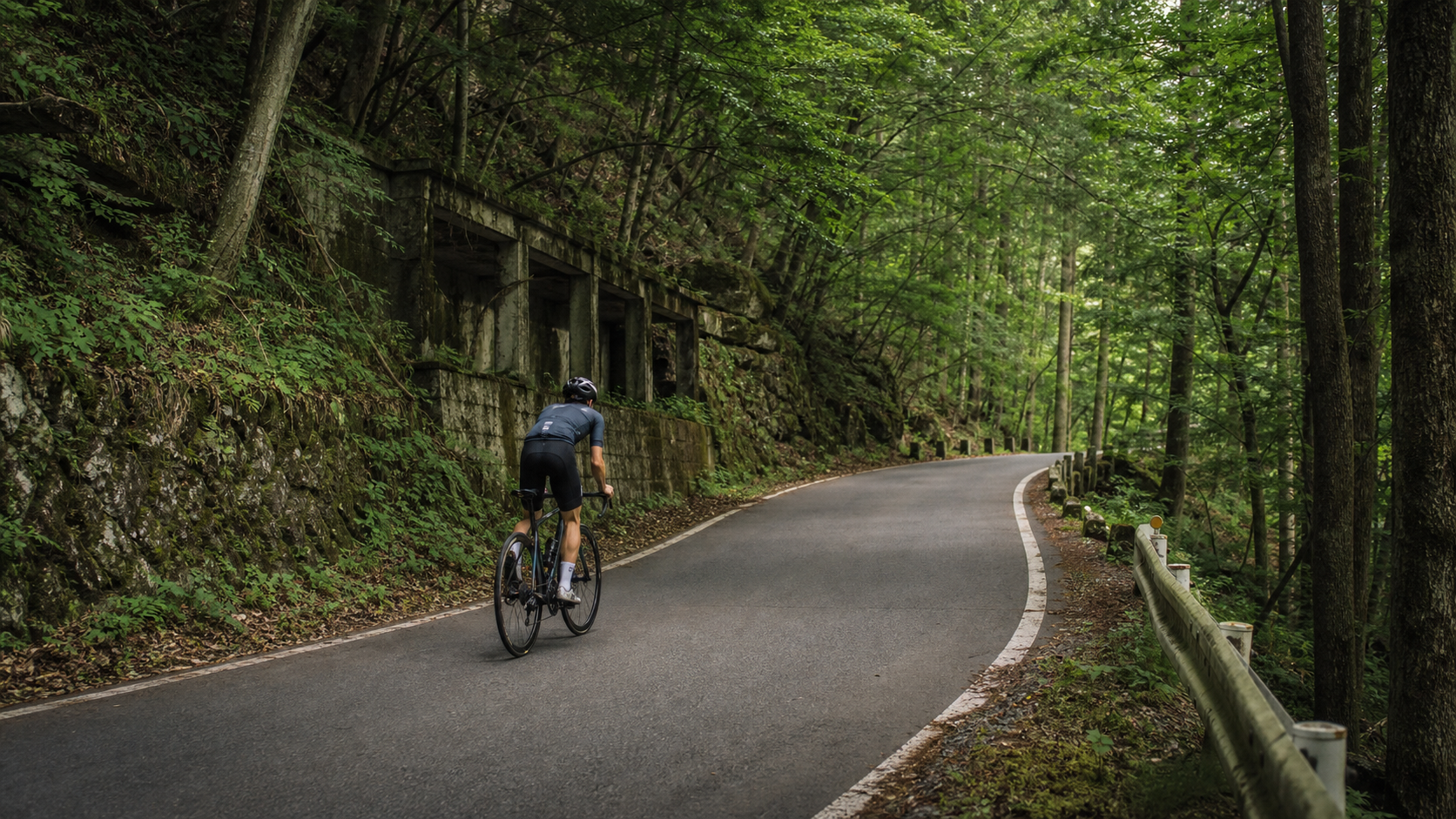
Some mountains have two faces. One is reserved for tourists, the other for those willing to ride around to the back.
That morning, I didn’t follow the majority of riders heading toward Maebashi. I turned my handlebars toward Kurohone-machi, Kiryu City, determined to climb the quieter face of Mount Akagi—Rihei Chaya on the eastern side. 9.1 km in distance, 714 meters of elevation gain, 7.7% average gradient—on paper it’s not the longest climb, but it’s the most “quiet” slope I’ve ridden recently. So quiet that I could almost hear my own heartbeat and the rustling of leaves.
Setting Out from Orimachi: Kiryu’s Textile Legacy
The starting point, Kiryu, is a city with a story. It has been famous for “Kiryu-ori” (Kiryu weaving) since ancient times and is one of Japan’s important textile cities—the kind of city whose heritage is built on cloth. Walking through the old streets, you can still feel it. The weathered old houses and workshops that once hummed with the sound of looms bear witness to an era of prosperity woven together, one bolt of fabric at a time.
Before climbing, I like to take a slow ride through such a city first. Because when you know how this city beneath your wheels once wove its prosperity with its own hands, and then look up at that silent Mount Akagi, an invisible thread seems to connect the mountain and the city. Generations of people in this weaving town have looked up at this very mountain; and today, I’m going to measure the eastern face of this mountain with my own wheels.
A Volcano Embraced by Twelve Peaks
Mount Akagi is not a simple solitary peak. It is one of the “Jomo Sanzan” (Three Mountains of Jomo), and is also listed among Japan’s 100 Famous Mountains and Japan’s 100 Landscapes, renowned for its gracefully sweeping foothills. Its center is a caldera, embraced by twelve peaks including Mount Kurobi and Mount Komagatake—in other words, Mount Akagi is an entire mountain range forged by volcanic activity, not a lone summit.
Viewed from the east, the mountain’s character is completely different from the main tourist side. The Maebashi side is the bright, open, bustling tourist Akagi; the eastern Rihei Chaya side is the hermit Akagi—deep forests, few visitors, and steep slopes. The one I’m about to climb is this hermit.
Riding into the Forest: A Monologue Between a Rider and the Slope
The moment I turned into Kurohone-machi and began the climb, the world suddenly went quiet.
The early section was still gentle, and I let myself settle into a rhythm, listening to the steady clicking of the chain. About two or three kilometers up, the gradient started to bite—the 7.7% average on this road isn’t just talk. Just when you think you’ve found your rhythm, it throws a steeper pitch at you out of nowhere, forcing you to shift down again and recalibrate your breathing.
Climbing a quiet slope alone is the most honest thing there is. There’s no one to follow, no one watching—you can only face how much strength you have left, and how much resolve.
No tourist clamor, no competitive overtaking—just me, my breathing, and the forest receding behind me. This kind of quiet feels like a luxury. In the city, we’re surrounded by too much noise, but on the eastern face of Mount Akagi, I could finally hear myself clearly. Sweat dripped onto the top tube, tree shadows swayed across the pavement, and occasionally a mountain breeze slipped through the gaps in the trees, cool in just the right way.
Relics of the Cable Car: A Vanished Memory of Climbing
Along this route, you’re reminded of a piece of history nearly buried by time—Mount Akagi once had a cable railway (ropeway) leading to the summit, and now only its remnants remain quietly in the mountains.
Imagine it: there was once an era when people didn’t need their own legs to be pulled up this mountain along steel cables—to escape the heat, see the lake, or pay respects at the shrine. Later, the cable car ceased operation, the cables and tracks fell into silence, and the forest gradually reclaimed them, bit by bit.
And today, the power to carry myself up the mountain has returned to my own legs. This thought gave me a strange sense of reverence with every pedal stroke: technology once spared people this climb, yet now I’m choosing to reclaim it inch by inch in the most primitive way. The meaning of climbing isn’t always about conquest—sometimes it’s about personally measuring a road that others once glided over with ease, a road now forgotten.
Rihei Chaya Forest Park: A Quiet Base in the Mountains
The route’s destination, Rihei Chaya Forest Park, is located in the Shimotazawa area of Kurohone-machi, Kiryu City. It’s one of the trailheads for Mount Akagi and has a campsite, making it a quiet mountain base. There’s none of the bustle of the main tourist route here—most visitors are hikers, campers, and riders like me who’ve come around to the east side to climb.
Worth noting is that this area is also one of the pilgrimage sites for the anime “Encouragement of Climb (Yama no Susume)”. That work tells the story of a few girls gradually stepping into the world of mountaineering—gentle, slow, about the growth that comes from “climbing a mountain on your own two feet.” When I stopped at the forest park, gasping for air, I suddenly felt that sense of groundedness from the anime—“my own feet brought me up this mountain”—happening to me right here, right now.
The Forest of “Encouragement of Climb”: On “Using Your Own Feet”
The area around Rihei Chaya Forest Park is one of the pilgrimage sites for the anime “Encouragement of Climb (Yama no Susume)”. This fact suddenly took on real meaning for me after I finished the climb and sat catching my breath at the forest park.
That work tells the story of a few girls who, starting from knowing nothing about mountaineering, gradually step into the world of the mountains, one step at a time, on their own two feet. There’s no heated competition, no earth-shattering feats—only a gentle and solid kind of growth—“so I really can climb a mountain that once seemed impossibly far away, on my own two feet.”
Sitting in the air of the forest park, I looked down at the legs that had just carried me up the mountain, and a sense of groundedness welled up in me, exactly like in the anime. No engine, no cable car, no external force—just these legs, pedal stroke after pedal stroke, carrying me from the outskirts of Kiryu to this quiet forest. The sense of accomplishment that comes from “arriving on your own two feet” is simple, yet profoundly real.
Perhaps this is why this forest became a pilgrimage site—it’s quiet, it demands something of you, and what it gives back is a feeling that belongs only to those who have “walked it themselves.”
The Descent: Walking the Quiet All Over Again
After reaching the top and resting enough, it’s time to descend. And the descent on the eastern side is a completely different kind of quiet experience.
On the way up, you’re focused on your breathing and cadence, with no attention to spare. On the way down, speed picks up, and you finally have the leisure to “see” the forest again. The same road, traveled in reverse—the tree shadows, the light, the angles of the corners all look different, as if filling in the scenes you missed on the way up, one by one.
But I kept reminding myself: the eastern side is quiet, the road is narrow, the corners are many, and traffic is sparse—the more relaxed you feel, the more alert you must stay. I feathered the brakes, slowed down, giving myself enough margin to enjoy the view and enough margin to handle anything unexpected. Cool wind poured into my collar, the forest rushed past on both sides—that feeling of “safely, calmly gliding down a mountain I’d just climbed with sweat” is the most satisfying way to end a climb.
When the houses on the outskirts reappeared in view, I knew this quiet eastern monologue was drawing to a close. And Kiryu’s old streets were waiting to gently welcome me back from the world of the mountains with a well-earned, late lunch.
Scenery and Seasons Along the Way: The Eastern Face’s Four Expressions
The eastern face of Mount Akagi changes its attire with the seasons, each one moving in its own way.
| Season | Impression of the Eastern Scenery | Riding Notes |
|---|---|---|
| Spring | Fresh greenery sprouts, the forest turns from barren to emerald | Still cool in the mornings and evenings; temperatures are low at the summit |
| Summer | Dense shade blocks the sun, cool and refreshing in the forest | Humid and hot at the base; be sure to guard against dehydration |
| Autumn | Layers of autumn leaves, most flavorful around the forest park | Large temperature swings; be sure to add layers on the descent |
| Winter | Bleak and silent, possible lingering snow and ice | Road conditions are risky; ride within your limits |
If I had to choose, I love the eastern face most in autumn. The autumn leaves around the forest park, paired with air so quiet it feels almost transparent, seem to absorb all the hardship of the climb into their colors. You’re gasping for breath on a steep pitch, and you look up to find your eyes full of red and gold—in that moment, you think: it’s all worth it.
Suggested Itinerary: Linking the Weaving City and the Mountain
If you also want to ride the eastern slope to Rihei Chaya, here’s how I would arrange a day:
- Morning: Start with a slow ride through Kiryu’s old town, soaking in the weaving city’s textile heritage and old-street atmosphere, tuning your mindset to a “slow down” frequency.
- Before noon: Head to Kurohone Town and officially begin the eastern slope climb. Attack the ascent while temperatures haven’t peaked and your energy is at its best.
- On the mountain: Arrive at the Rihei Chaya Forest Park area, rest, refill water, and let your mind wander—giving both body and mind time to settle.
- After descending: Gunma is a major hot spring prefecture, so on the way back, find a renowned hot spring town to soak in, dissolving the fatigue of the climb in warm water.
The moment you sink into the hot spring, every gasp, every downshift, every gritted-teeth moment on the eastern slope’s steep grades becomes a medal worth savoring.
What This Route Means to Me
After years of cycling, you gradually learn to distinguish two kinds of routes: one is lively, social, meant for chasing PRs and group photos; the other is quiet, personal, meant for inner dialogue. The eastern slope of Mt. Akagi to Rihei Chaya is the latter.
It’s not long, but it’s steep enough that you can’t afford to be distracted; it’s quiet, quiet enough that you must face yourself. Climbing this slope feels like filtering out the accumulated noise of daily life, segment by segment, with your cadence—until, in the air of the forest park, only the purest version of yourself remains.
When I turn around to descend, looking back at that empty eastern slope I just climbed, I suddenly understand that saying—some mountains have two faces, and those willing to go around to the back often see the more authentic one. The memory of the weaving city, the remnants of the ropeway, the forest from “Encouragement of Climb,” and the version of me that kept talking to myself over those 9.1 kilometers—all remain on the quiet eastern side of Mt. Akagi.
Next time you tire of the crowds, why not turn your handlebars toward Kurohone Town in Kiryu City and climb that face without an audience. You’ll discover that the quietest slopes often give you the greatest echoes.
Kiryu at Dawn: A Ritual Before Departure
I like to start cultivating the mountain experience from early morning.
That day, before the sky was fully light, I was walking my bike through Kiryu’s streets. The morning mist hadn’t lifted, the old town was perfectly still, with only a few breakfast shops puffing out white steam. Kiryu has an old-fashioned sense of solidity—it doesn’t flaunt itself, yet traces of the textile era are everywhere: wooden lattice windows on old houses, narrow yet straight alleys, and the occasional building preserving its former workshop appearance. Walking through it, you can’t help but slow your pace, as if even the air is reminding you, “Don’t rush.”
I bought a rice ball and hot tea at a small shop and sat by the entrance, eating slowly. This breakfast before a long climb is almost a ritual for me. It’s not just about refueling—it’s the transition that shifts my mindset from “daily life” to “the mountain.” Eating my rice ball, I gazed at Mt. Akagi still shrouded in thin mist in the distance and silently said to it: Today, I’m coming to climb your eastern face.
Weaving Cloth, Weaving a City’s Memory
Walk a few more steps through Kiryu’s old streets, and you’ll gradually read the soul of this city.
Kiryu has been renowned since ancient times for Kiryu-ori (Kiryu weaving) and was one of Japan’s most important textile cities. “Weaving” means thread by thread, shuttle by shuttle, turning scattered silk into fabric with pattern, thickness, and warmth. The city’s prosperity was woven, shuttle by shuttle, by countless hands at countless looms. It’s a labor that demands immense patience—no shortcuts, only inch-by-inch progress.
Standing before an old building that preserves its former workshop appearance, I suddenly felt this bore a striking resemblance to climbing. Isn’t climbing a 9.1-kilometer slope also a matter of pedal by pedal, inch by inch, getting yourself up the mountain with no shortcuts? The weavers of this city used shuttles to weave cloth; I use my pedals to “weave” an ascent. Both are patient labor, both are the gradual accumulation of scattered effort into a complete achievement.
Thinking of this, I felt a new respect for both the city and the slope I was about to climb. The first lesson Kiryu taught me was “patience”—and that is precisely the core of climbing any long slope well.
The Sound of the Forest: A Sensory Cleansing
After turning into Kurohone Town and starting the climb, the first thing that struck me wasn’t the gradient—it was the “sound.”
In the city, we’re surrounded layer upon layer by engine noise, broadcasts, and human voices, until we almost forget what “silence” feels like. But the road to Rihei Chaya on the eastern slope is quiet to the point of luxury—you can clearly hear your chain engaging, the rustle of tires on pavement, the howl of wind through gaps in the forest, and your own increasingly heavy breathing.
As altitude rises, the forest’s scent changes too. Lower down, it’s warm with a hint of dust; higher up, the air grows crisper, mingled with the smell of soil and leaves—one deep breath and your lungs feel rinsed clean. An occasional bird darting past or a cool breeze brushing by becomes a precious little reward during the long ascent.
We spend fortunes on gym memberships, exercising with headphones on, yet we forget that the world’s best gym is a quiet mountain with forests, birdsong, and wind.
This sensory cleansing was the most unexpected gift the eastern slope to Rihei Chaya gave me. It didn’t just train my legs—it emptied my ears and my mind, both so stuffed full by the city.
Jōmō Sanzan: The Three Sacred Mountains in Gunma’s Heart
To understand what Mt. Akagi means to this land, you first need to know the “Jōmō Sanzan.”
Gunma (historically called Kōzuke or Jōmō) has three representative peaks, collectively known as the Jōmō Sanzan—Mt. Akagi, Mt. Haruna, and Mt. Myōgi. They are symbols of Gunma’s landscape and deeply embedded in local identity. For the people of Gunma, these three mountains aren’t just climbing or cycling destinations; they’re more like presences that have been there since childhood, looking down on you, accompanying you through life.
Among them, Mt. Akagi is known for its gracefully spreading susono (foothill slopes). The susono refers to the gentle slopes that spread outward from the mountain’s base in all directions—from a distance, it looks like the flowing hem of an unfurled kimono, with soft, grand lines. It’s precisely because of this broad susono that Mt. Akagi’s character differs dramatically depending on which direction you climb—the Maebashi side has long foothills, many curves, and thriving tourism; the Kiryu eastern side is steep and secluded. One mountain, two completely different ways to climb it—that’s what makes Mt. Akagi so fascinating.
Caldera and Twelve Peaks: A Mountain’s Life Story
In the gaps between gasps on the steep slope, I often think about this mountain’s history.
Mt. Akagi is an ancient composite volcano. Its center isn’t a single sharp peak but a vast caldera—a depression formed by the collapse of the volcano after its activity—surrounded by twelve peaks including Mt. Kurobi and Mt. Komagatake. In other words, what I’m climbing right now is one outer wall of this massive volcanic body.
This imagining gives the climb a different weight. I’m not just climbing a slope; I’m clinging to the flank of a sleeping volcano. The forest beneath my feet and this steep grade are all results of millions of years of geological activity. A person is almost inconceivably small within it, yet by physically measuring it with my own body, I forge a genuine connection with it. This feeling of “small yet connected” is something you can never experience staying in the city.
Things Figured Out on the Slope
Climbing a quiet slope has one great byproduct: “figuring things out.”
In the early, easier section, your mind wanders—work, life, those nagging little matters tucked away in your heart. But when the gradient bites and your breathing turns heavy, those distractions get squeezed out one by one—you don’t have spare brainpower for anxiety; physical suffering forces you to live in the present. At the steepest sections, the world shrinks to “the next breath” and “the next pedal stroke,” simple to the point of purity.
I’ve always felt that climbing is a cheap form of meditation. You don’t need to sit cross-legged; just find a slope steep enough, and the suffering will clear your head for you.
By the time I reached the forest park, panting hard and drenched in sweat, most of the things I’d been agonizing over before the climb had somehow found their answers. Not thought out—climbed out. This, I suppose, is why I keep returning to quiet slopes like this one—what they give me is never just a physical achievement, but a rare clarity of mind.
Side Trip: Kiryu Old Town and Gunma Hot Springs
If you’ve made a special trip for this eastern slope, don’t rush off as soon as you’ve finished riding.
Kiryu Old Town itself is well worth a leisurely stroll. As a city famed for textiles, it retains many old workshops and merchant buildings—perfect for wandering on foot or with your bike after the climb, once you’ve shifted into a relaxed frame of mind, soaking in that understated historical depth. Find a local shop, sit down, grab something to eat and a cup of tea, and let both your tense legs and your mind unwind together.
And Gunma itself is a renowned hot-spring prefecture. After climbing the eastern face of Mount Akagi, the ideal finish is to find a famous hot-spring town and soak. Hand over the energy you drained on those steep slopes to the warm spring water and let it slowly restore you—that “relaxation after suffering” is the most honest pleasure, earned through hard work.
- Suggested one-day itinerary: Morning breakfast in Kiryu Old Town → Morning assault on the eastern Rippei Chaya → Rest at the forest park → Descend and explore Kiryu Old Town → Evening hot-spring finale.
- Accommodation advice: If you’d prefer a more relaxed pace, stay in the Kiryu or Maebashi area the night before, then set off early the next morning—it’s the easiest and coolest option.
- Dietary reminder: Climbing is high-intensity work. After descending, don’t rush into cold or greasy food—rehydrate first and have something warm and easy to digest to let your body recover gradually.
Cycling and travel, when it comes down to it, are both ways of “getting to know a place with your body.” Seeing Mount Akagi from a tour bus, and climbing its eastern face pedal stroke by pedal stroke, does not give you the same mountain. Only by sweating, gasping, and wrestling with yourself on that slope can you truly “know” the eastern face of this mountain. And Kiryu Old Town and the Gunma hot springs serve as the prelude and the coda to that firsthand encounter, stretching a simple climb into a complete memory of town, mountain, and hot water.
A Final Note: On “Going Around to the Back”
After years of cycling, I’ve gradually developed a habit—whenever I come across a famous mountain, I can’t help but want to ride around to the side fewer people visit.
Because the popular front face has been photographed a thousand times and written about a thousand times; when you go, you’re mostly just repeating someone else’s experience. But the back is different. The back is quiet, with little information and few traces of people—you have to ride it yourself and see it yourself to get a feeling that belongs only to you. The Rippei Chaya on the eastern face of Mount Akagi is exactly such a “road on the back.”
I’ve often wondered since why the eastern face of the same Mount Akagi felt so different to me. Perhaps the answer is: when a road has no audience, you can no longer perform for anyone—you can only be honest with yourself. The Maebashi side is lively, with races and applause; it’s easy to turn the climb into a “show for others” amid the crowd. But the eastern Rippei Chaya has none of that—it forces you to bring all your attention back to yourself: your breathing, your rhythm, your weakness, your persistence. This situation of “having no one to perform for” actually returns climbing to its most essential form: one person, one mountain, and oneself.
It repaid me with 9.1 kilometers, 714 meters of elevation gain, and that almost luxurious quiet, for an entire morning of focus and sweat. The memory of the weaving town, the remnants of the ropeway, the forest from “Encouragement of Climb,” the story of the caldera, and the version of myself who worked through things one by one on that slope—these are things that bustling tourist road on the front can never give me.
So I’ll come again. Next time, perhaps in autumn when the fall colors are at their deepest, I’ll once again point my handlebars toward Kurohone-machi in Kiryu City, to listen to that face without an audience give me its greatest echo.
Related Reading
- Eastern Face of Mount Akagi · Rippei Chaya Hill Climb Guide: 9.1 km at 7.7% Average Grade, the Quiet Steep Slope of Kiryu Kurohone-machi
- From the Poet’s City to the Crater Lake: The Orthodox Pilgrimage of Maebashi–Mount Akagi, 18.6 km and 60 Curves
- The Gentlest Climb: Mount Yufu, a Day from Beppu to Yufuin, Ending in Hot Springs
- Riding Around to the Back of the Mountain: Cycling Ura-Rokko, 7.7 km of Hydrangeas, Deep Forest, and a Thousand-Year-Old Hot Spring
小野田真的存在!日本赤城山爬坡公路賽 台灣首發團完全實錄 | 頭文字D真實賽道! | 看完東奧自行車賽後好想再去騎一次啊! | 公路車 | CT Yeh
4 年前
台北闊瀨陡坡 騎旅 / 日本單車雜誌編輯車友臨時加入!/ 髮香才是最強的 / feat. 北迴歸線小隊 / 公路車 CT Yeh
6 個月前
一定要騎一次!阿里山最深處:里佳部落!單車旅行 | 2800m爬升 | 深度部落體驗:嗨翻晚會、螢火蟲、銀河 | feat. JJSC & 廢物伙伴 | 公路車 CT Yeh
9 個月前
5 ℃ 櫻花之旅 / 75萬單車直接雨中洗車.../ 平菁街 / 北迴歸小隊 / 公路車 / CT Yeh
5 個月前
京都!99%人不知道的秘境玩法!租 E-Bike 騎進探訪宇治抹茶原鄉 刺激好玩絕美的山林古道 鬼滅之刃的場景探訪 / CT Yeh
12 天前
日本自助單車旅,茨城絕景路線/ 新手也可以體驗 / 4K空拍絕景 / 機票省錢大法 / 單車友善旅館 / 國家級霞之浦180K自行車道 / feat. 緯緯 / CT Yeh
1 年前
新竹白蘭部落! 爬陡坡還能講笑話...? 廢物伙伴の約騎 | 公路車 | CT Yeh
4 年前
里佳部落 阿里山單車深度旅遊! | 竹山/草嶺/來吉/奮起湖 | 無敵銀河絕景 全新路線探索! 驚險狀況百出! | 4K沉浸式畫質 | 公路車 | CT Yeh
3 年前