From the Poet's City to the Crater Lake: A Classic Pilgrimage of 18.6 km and 60 Curves up Mount Akagi in Maebashi
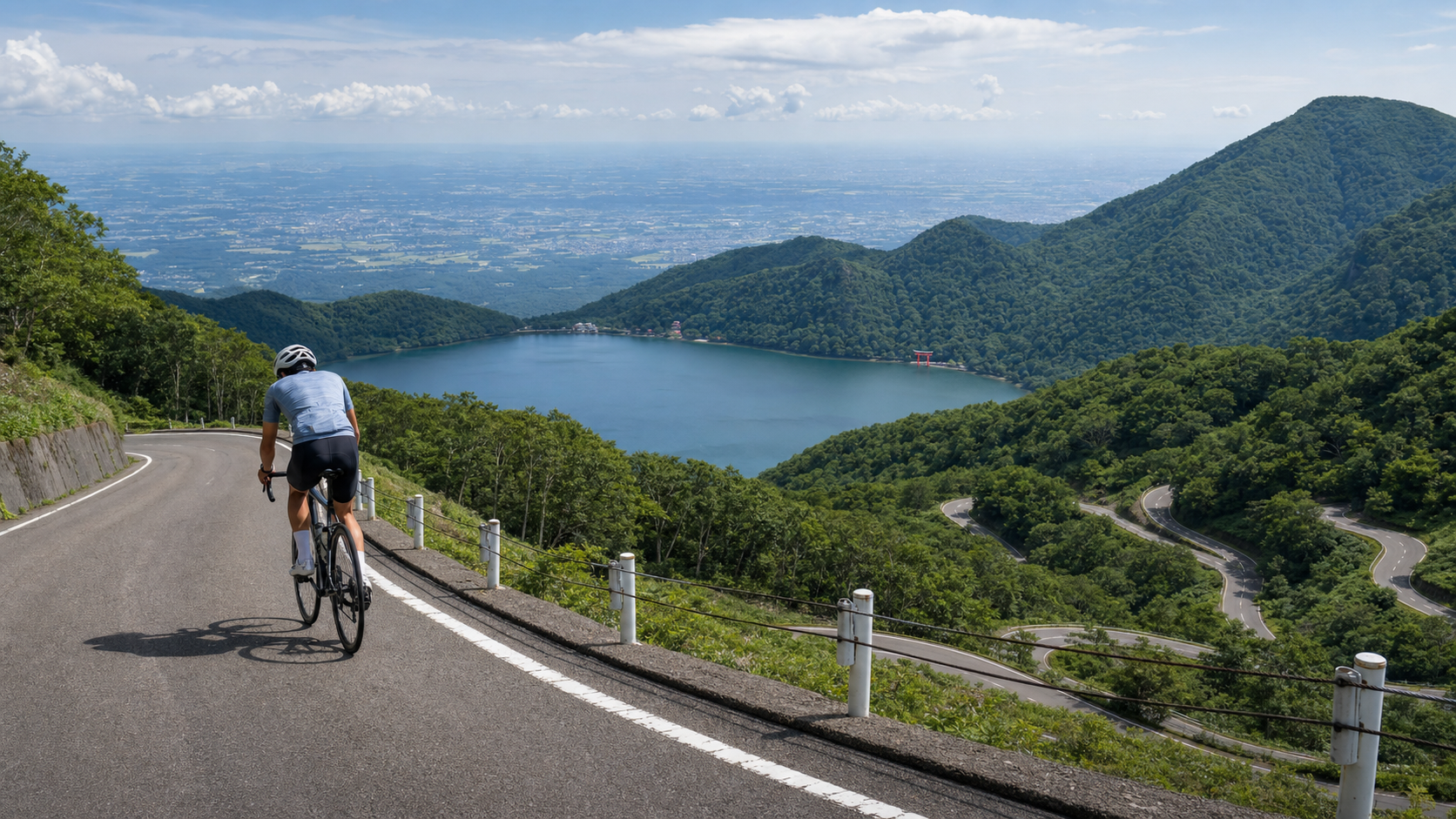
Some pilgrimages are made on foot; this one, I made on two wheels, with 60 curves.
There are many ways to climb Mount Akagi, but if you want to choose the “orthodox” route, it has to be the one from the Maebashi side along Gunma Prefectural Route 4—18.6 km long, 1,238 meters of elevation gain, an average gradient of 6.6%, and over 60 consecutive curves. It starts at the roadside station “Maebashi Akagi” and ends at the summit beside the Akagi Comprehensive Tourist Information Center, on that highland hiding crater lakes and a red shrine. This is the course for the official hill climb race every autumn, and it is also a pilgrimage road leading from the city of poets to a shrine by a volcanic crater lake.
The Starting Point, Maebashi: The Prefectural Capital and the City of Poets
Maebashi is the seat of Gunma Prefecture’s government, the political and daily center of this region. But what truly made my heart stir for this city is another identity—it is the hometown of modern Japanese poet Hagiwara Sakutaro.
Sakutaro is hailed as an important pioneer of modern Japanese colloquial free verse. His poetry carries a quality of loneliness, subtlety, and a modern urban sensibility. Standing in his hometown, about to climb a long 18.6 km slope, a strange resonance arose in my mind: the poet measured the darkness within with words, while I was about to measure the mountain’s height with my cadence. Both are a solitary ascent, only the tools differ.
Setting out from the poet’s city on the plain, the sprawling Mount Akagi rises before you. Maebashi and Akagi—one writes poetry on the flatland, the other keeps silent in the clouds, and Prefectural Route 4 is the line connecting these two existences.
From the Foothills to the Clouds: The Rhythm of 60 Curves
Not long after leaving the city, the road begins to climb along Akagi’s gentle foothills. The initial slope is so mild it feels like an invitation. I held my pace, unhurried, because I knew—the mountain is still ahead.
Past the foothills, Prefectural Route 4 cuts straight into the mountain, and those 60-plus consecutive curves come at you one after another.
One curve, then another. The world keeps folding, unfolding, and folding again before your eyes. You stop thinking about the finish; you only think about the exit of the next curve.
Climbing a long slope and a short slope are two entirely different states of mind. A short climb is a sprint; a long climb is a discipline. An 18.6 km road forces you to let go of the anxiety to “get it over with” and learn to coexist with time. And those 60-plus curves became my metronome—each one passed is like turning a page, breaking the endless ascent into manageable segments.
Gradually, the streets of Maebashi and the Kanto Plain sank lower and lower behind me. The air turned cooler, the trees denser, the birdsong clearer. Inch by inch, I was climbing from the human world toward the clouds.
The Reward at the Summit: Onuma, Konuma, and the Crater Lake
When you reach the top, Mount Akagi welcomes you with its gentlest face—the crater lakes.
Mount Akagi is an ancient volcano, and in the caldera at its summit lie two crater lakes, Onuma and Konuma, resting quietly. When you’ve been gasping on a steep slope for over an hour, your legs flooded with lactic acid, and you finally round a curve to suddenly see a highland lake open up before you—the shock of that contrast is something no flat cruise can ever deliver.
The lake mirrors the sky, embraced by the peaks of the Akagi mountain range. Wind sweeps across the water, blowing away the heat from your body. In that moment, you understand that all the hardship of those 18.6 km was simply to earn this quiet expanse of lake light.
The Red by the Lake: Onuma and Akagi Shrine
By the shore of Onuma lies the true destination image of this pilgrimage—Akagi Shrine.
It is a shrine standing by the lake, defined by its vivid red impression. When your weary body finally reaches the summit and you see that touch of red reflected on the blue crater lake water, a nearly religious calm wells up inside you. Mount Akagi has been an object of faith for this land since ancient times, and having climbed the mountain on my own legs to arrive before the shrine, in a sense, this entire ascent is itself an act of worship.
I leaned my bike against a post, walked to the lakeshore, and quietly watched that red and that blue. No words, only the wind. The end of a climb should not merely be an elevation on a data sheet, but a place where you can grow still and converse with the landscape. The Akagi Shrine by Onuma’s shore is exactly such a place.
Scenery Along the Way and Seasons: Akagi’s Four-Season Pilgrimage
This orthodox route on the Maebashi side has its own face in every season.
| Season | Scenery at the Summit and Along the Way | Riding Impression |
|---|---|---|
| Spring | Fresh green on the foothills, lingering cold at the summit | Warm below, cool at the top, large temperature gap |
| Summer | Lush greenery at its peak, crater lakes offer cool refuge | Humid and hot below, pleasant at the summit |
| Autumn | Autumn leaves dye the mountain, race-season atmosphere | Large day-night温差, both stunning views and challenge |
| Winter | Desolate lakeshore, possible ice and snow | High-altitude risks, ride within your limits |
If you ask me when it’s most beautiful, I’d say autumn. During race season, the entire Mount Akagi is dyed in autumn colors; every one of the 60 curves turns into a painting, and the crater lake and red shrine at the summit appear even more solemn in the fall hues. It’s the season that blends “challenge” with “breathtaking views.”
I especially remember that feeling of “climbing through a tunnel of autumn leaves.” You’re gasping for air, your legs burning, sweat stinging your eyes, and when you look up, the mountain is full of red and gold, sunlight filtering through the gaps in the leaves and dappling the road. In that instant, the pain of the body and the beauty before you exist simultaneously—pain makes beauty deeper, and beauty gives pain meaning. This contradictory, full-bodied experience is something those who view the scenery from a car will never understand. It’s also the reason I’m willing, time and again, to give this mountain over an hour of suffering.
Suggested Itinerary: Linking the Poet’s City, the Volcano, and the Hot Springs
If you too want to embark on this Maebashi Akagi pilgrimage, here’s how I’d plan it:
- The night before: Stay in Maebashi, soak in the atmosphere of this poet’s city and prefectural capital, and let your mind settle first.
- Early morning: Set out from the roadside station “Maebashi Akagi,” start climbing while the air is cool and your energy is at its best, giving your finest self to these 18.6 km.
- At the summit: Arrive at Onuma’s shore, pay respects at Akagi Shrine, take a walk around the lake, and let both body and mind settle into the stillness of the crater lake.
- After descending: Gunma is a major hot-spring prefecture; on the way back, find a famous hot-spring town and soak the fatigue of the entire pilgrimage into warm waters.
As the steam of the hot spring wraps around your body, those 60 curves, that 1,238 meters of climbing, that lake, and that touch of red replay in your mind, scene by scene. This is the most complete ending to a climb.
The Meaning of This Route: A Discipline in Patience
After riding this official Maebashi Akagi race course, my deepest takeaway is not “I conquered it,” but rather—it taught me patience.
An 18.6 km long slope doesn’t allow you to be impatient; 60-plus curves don’t allow you to be distracted; 1,238 meters of elevation gain doesn’t allow you to be arrogant. It forces you to slow down, to hold your rhythm, to make peace with long stretches of time. And when you finally reach the summit, standing by Onuma’s shore and gazing at that red of Akagi Shrine, you realize—what has truly been climbed is not just this mountain, but also that slope inside you that wanted to “hurry up and finish.”
Setting out from the hometown of poet Hagiwara Sakutaro, following Prefectural Route 4 through 60 curves to the red shrine by the crater lake. This is a pilgrimage from a plain-city of poetry to a sacred lake in the clouds, and what completes it is your legs, your patience, and your willingness to climb one curve at a time, slowly.
Next time you’re looking for a long climb with “meaning at the finish,” come to Maebashi. Let Prefectural Route 4 take you from a city that writes poetry all the way up to that quiet crater lake and the red by its shore. What you’ll bring back is not just a Strava trace, but an entire memory of patience and pilgrimage.
The Roadside Station at Dawn: Air Before the Start
I like to treat this kind of formal route with a “race-day” mindset, even when it’s just a solo training ride.
The starting point, Michi-no-Eki “Maebashi Akagi,” is the gateway to the climb on Prefectural Route 4. Arriving here in the early morning, there’s a particular tension and anticipation in the air—you know that the next hour-plus will be a long struggle with yourself. I usually do a final equipment check here: tire pressure, gears, water bottles, energy supplies. Then I spend a few minutes warming up, slowly spinning my legs, waking the body from its slumber.
Standing at the start and looking up, Akagi-san’s gently sweeping foothills unfold slowly in the morning light, the summit still hidden behind the clouds. That feeling of “not being able to see the finish” is the first lesson of a long-climb pilgrimage: you can’t take it all in at a glance; you have to ride it into view, corner by corner.
The Three Mountains of Jōmō and Akagi’s Standing
To understand the weight of this pilgrimage, you first need to understand Akagi-san’s place in Gunma.
Gunma (Jōmō) is home to the three famous mountains collectively known as the Jōmō Sanzan: Akagi-san, Haruna-san, and Myōgi-san. They are symbols of Gunma’s landscape and local identity. Akagi-san is listed among Japan’s 100 Famous Mountains and 100 Landscapes of Japan, renowned for its gracefully sweeping foothills, making it one of the most imposing mountains in the region.
For the people of Maebashi, Akagi-san is almost a backdrop they see every time they look up. The poet Hagiwara Sakutarō was born and raised here; surely he too gazed at this mountain countless times. When I set out from his hometown and climb toward the summit, I feel like every pedal stroke lands on something deeply local, something enduring. This isn’t just a climbing route—it’s a thread connecting people to the land.
Poetry and the Climb: Sakutarō’s Solitude, and the Solitude of Climbing
I’ve always felt that choosing to climb this mountain from a poet’s city is a meaningful coincidence.
Hagiwara Sakutarō is regarded as a key pioneer of modern colloquial free verse in Japan. His poetry has a particular texture—solitary, subtle, carrying the alienation and introspection of modern humanity. Reading his poems, you sense the weight of a person facing the darkness within, alone.
And climbing a long hill—isn’t that also a lesson in solitude? On an 18.6 km climb, no one can pedal for you, no one can hurt for you. You must face your limits, your weakness, and that voice saying “I want to quit” all by yourself. The poet measures the abyss within with words; the rider measures the mountain’s height with cadence—both are a solitary ascent, an upward effort against gravity (whether physical or spiritual).
So every time I set out from Maebashi, I feel like I’m not just climbing a mountain, but continuing some inner quality of this city—a quality of being willing to face things alone, to climb alone, to see the long road through alone. This adds a layer of literary weight to the route, beyond the physical challenge.
The Moment at the Summit: From Fire to Lake Light
The end of a long climb often holds the most dramatic scene.
After an hour-plus of battling 60 corners and 18.6 km of elevation gain, my legs flooded with lactate, breathing heavy, my mind reduced to the single obsession of “just one more corner”—in that state of extremity, I round the final few bends and the view suddenly opens up with a whoosh: before me lies the crater lake cradled by the summit peaks—Ōnuma’s still waters, reflecting the sky.
The contrast in that moment almost brings tears. You were just fighting pain on the steep slopes, and the next second you’re in the midst of a lake-and-mountain scene so quiet it feels unreal. This volcano took millions of years to settle its flames into a lake, and you traded an hour-plus of suffering for the right to witness this stillness firsthand.
I stop the bike, grip the handlebars, and gasp for air, sweat dripping onto the top tube, but my eyes can’t leave the lake. This is the core experience of a long-climb pilgrimage—not conquering something, but using your own legs to deliver yourself to a place of beauty that “can’t be reached without effort.” That beauty is all the more profound for being hard-won.
The Volcano’s Story: Ōnuma, Konuma, and the Caldera
The reason Akagi-san hides a lake at its summit is that it is itself an ancient volcano.
Its center is a vast caldera—a depression formed after volcanic activity caused the ground to collapse, surrounded by peaks like Kurobi-yama and Komaga-take. And within this caldera lie two crater lakes, Ōnuma and Konuma. This is Akagi-san’s most moving geological romance: a volcano that once erupted in flames now cradles two quiet lakes at its summit, as if all its violence had finally settled into gentleness.
When I’ve been battling 60 corners on the steep slopes for over an hour and finally round a bend to see Ōnuma’s waters suddenly open up before me, that contrast of “flames turned to gentleness” hits you hard. You suddenly understand why people keep climbing this mountain again and again—because that lake at the summit is a quiet letter, written over millions of years by this volcano, to every climber who makes the journey.
Red by the Lake: Akagi Shrine and Faith
The Akagi Shrine, with its striking red presence on the shores of Ōnuma, is the true spiritual endpoint of this pilgrimage.
Akagi-san has been an object of faith in this land since ancient times. Mountain worship has deep roots in Japan—people believe gods dwell in the mountains, and that climbing is an act of worship. When I reach the summit, legs full of lactate and drenched in sweat, and see that red reflected in the blue crater lake, what wells up inside me isn’t just the joy of finishing, but a sense of near-reverent calm.
Climbing a mountain of faith with your own legs and standing before the shrine by the lake—this entire 18.6 km climb is itself a modern-day act of pilgrimage.
I lean my bike against something, walk to the lakeshore, and quietly watch that red and that blue, doing nothing but breathing. The meaning of reaching the summit was never the elevation on the bike computer; it’s that you can finally stand quietly before this landscape and have a conversation with yourself and with the mountain.
60 Corners, 60 States of Mind
The 60-plus corners from the foothills to the summit—I later came to understand—are like a long inner journey divided into 60 small movements.
The first few corners: I’m still excited, still have the energy to enjoy the scenery. The middle corners: I grow silent, locked in a tug-of-war with fatigue. At the steepest corners: my mind goes blank, leaving only the obsession of “one more corner, one more corner.” Each corner corresponds to a state of mind in that moment—from excitement, to focus, to struggle, to near-emptiness, and finally, near the summit, a strange calm emerges.
This is something a short climb can never offer. Short climbs are too quick to experience so many layers of emotional transition. But an 18.6 km climb with 60 corners forces you to walk through every stage of your inner self, completely. You think you’re climbing a mountain, but really you’re climbing the long slope of your own mind, corner by corner.
Seasonal Specials: Akagi in Autumn Leaves and Fresh Green
Akagi-san’s four seasons each have their own call.
- Spring: Fresh green sprouts on the foothills; warm below, still chilly at the summit—a season of things awakening.
- Summer: The greenest season; the crater lake at the summit is cool and pleasant—a rare escape from the summer heat on a climb.
- Autumn: Autumn leaves paint the mountain, and it’s race season; every one of the 60 corners reveals a painting as you turn, and the lake and shrine at the summit feel especially solemn in the fall colors—this is the Akagi I love most.
- Winter: The lakeshore is bleak, snow and ice possible; high-altitude risks are real, so know your limits.
If I had to pick just one season for the pilgrimage, I’d choose autumn without hesitation. It’s the season that blends “the hardship of the challenge” with “the reward of the scenery.” You climb gasping through tunnels of autumn leaves, look up to see the mountain covered in red and gold, and reach the summit to find a serene crater lake—a day like that stays in your memory for a very long time.
The Descent: A Second Encounter with the 60 Corners
After summiting, paying respects, and circling the lake, comes the descent—and the descent is a second encounter with those 60 corners, this time at speed.
On the way up, these corners were slow, manageable rhythm tests. On the way down, they become high-speed consecutive turns demanding focus and skill. I put on my windbreaker at the summit because I know the airflow on a long descent will rapidly strip away body heat, and stiff, cold fingers are the biggest enemy in the corners. I feather the brakes, using an “outside-inside-outside” line to make every corner as smooth and stable as possible—no greed for speed, no hard braking.
Curiously, on the descent I see the scenery I missed on the way up because I was too focused on climbing. The same forest, the same mountain contours, viewed in reverse, feel like an entirely new road. The Maebashi plain and the Kanto skyline gradually unfold in my descending view. Going up is giving yourself to the mountain; coming down is the mountain returning you to the world—and those 60 corners are the ritual of that round trip.
A Soak in the Hot Springs: Ending the Pilgrimage in Warm Water
Gunma is renowned as a major hot-spring prefecture, and the moment you finish climbing Mount Akagi and sink into an onsen is the most perfect full stop to the entire pilgrimage.
As the warm spring water envelops every inch of tired muscle, the whole day replays in your mind like a highlight reel: the nervousness at the roadside station in the early morning, the restraint on the Susono stretch, the tug-of-war with your inner demons mid-climb, the awe when the caldera lake suddenly appears at the summit, the solemnity of the red shrine by the lakeshore, the focus required for the 60 switchbacks on the descent… All the hardship dissolves into sweet aftertaste in the hot water.
Soaking in the bath, gazing out the window, it suddenly hits me—the Japanese really know what they’re doing, placing “mountain worship” and “hot spring culture” on the same land. First, a mountain purges your body and mind; then, a pool of hot water soothes your fatigue. One hard, one soft; one climb, one soak—together they form the most complete journey. On a day like this, you have your labor, you have your stunning views, and you have your comfort. What more could you ask for?
Side Trips and Accommodation: Extending the Pilgrimage into a Full Journey
If you’re making a special trip to climb Maebashi Akagi, it’s worth staying a little longer and turning it into a complete journey.
| Time | Suggested Plan |
|---|---|
| The night before | Stay in Maebashi and soak up the atmosphere of the prefectural capital’s “city of poetry” |
| Early morning | Depart from the roadside station “Maebashi Akagi” for the summit |
| Morning | Climb along Prefectural Route 4, through the 60 switchbacks to the top |
| Summit | Stroll along Lake Onuma, pay respects at Akagi Shrine, rest and refuel |
| Afternoon | Descend and head to one of Gunma’s famous hot spring towns for a soak |
| Evening | End with the hot spring, savoring the entire pilgrimage |
As the seat of Gunma Prefecture, Maebashi is a comfortable base—staying there the night before and setting off early the next morning is the most relaxed approach. And since Gunma is a major hot spring prefecture, soaking after the descent is almost an unmissable finale—handing the fatigue of the entire pilgrimage over to the warm spring water to slowly melt away is the most honest reward after hard work.
In Closing: A Discipline in Patience
If someone asked me what is most precious about the official course up Maebashi Akagi, my answer wouldn’t be its elevation or its distance—it would be that it taught me patience.
18.6 kilometers won’t allow you to rush; 60 switchbacks won’t allow you to be distracted; 1,238 meters of climbing won’t allow you to be arrogant. It forces you, at every turn, to slow down, to hold on, to make peace with the long passage of time. And when you finally stand by Lake Onuma, gazing at that touch of red at Akagi Shrine, you realize: what you’ve truly climbed isn’t just this volcano—it’s that slope inside you that kept saying “I want this to be over.”
Starting from the hometown of the poet Hagiwara Sakutarō, following Prefectural Route 4 through 60 switchbacks, you arrive at the red shrine beside the caldera lake. This is a pilgrimage from a plain-city of poetry to a sacred lake above the clouds, and what completes it is your legs, your patience, and your willingness to climb, one switchback at a time, slowly but surely.
Next time you’re looking for a long climb with “meaning at the finish,” come to Maebashi. Let Prefectural Route 4 take you from a city that writes poetry all the way up to that quiet caldera lake and the red shrine on its shore. What you’ll bring back isn’t just a Strava segment—it’s an entire memory of patience and pilgrimage.
Related Reading
- Maebashi Akagi Hill Climb Official Course Guide: 18.6 km, 60+ Consecutive Switchbacks, 1,238 m of Climbing—The Definitive Uphill Challenge
- The Untouched Side of Akagi: From Kiryu’s Weaving City to Rihei Chaya, an Eastern Soliloquy Hidden in the Forest
- A Volcanic Road with 1,300 Years of Hot Springs: Nasu-Tōge no Chaya’s Onsen, Legends, and Wild Riding
- Seas of Clouds, Cattle, and Sculptures on the Grasslands: A Day of Poetry Riding the Utsukushigahara Highlands
小野田真的存在!日本赤城山爬坡公路賽 台灣首發團完全實錄 | 頭文字D真實賽道! | 看完東奧自行車賽後好想再去騎一次啊! | 公路車 | CT Yeh
4 年前
台北闊瀨陡坡 騎旅 / 日本單車雜誌編輯車友臨時加入!/ 髮香才是最強的 / feat. 北迴歸線小隊 / 公路車 CT Yeh
6 個月前
日本自助單車旅,茨城絕景路線/ 新手也可以體驗 / 4K空拍絕景 / 機票省錢大法 / 單車友善旅館 / 國家級霞之浦180K自行車道 / feat. 緯緯 / CT Yeh
1 年前
半日 小台灣 極限單車路線挑戰實錄
7 年前
京都!99%人不知道的秘境玩法!租 E-Bike 騎進探訪宇治抹茶原鄉 刺激好玩絕美的山林古道 鬼滅之刃的場景探訪 / CT Yeh
13 天前
抖肩舞 台灣x日本交流版 (台灣 vs 前橋) 赤城山登山賽 coincidance
8 年前
新竹羅平 x 天湖部落 大禹嶺級變態陡坡! 4K超高畫質 空拍 | 公路車
5 年前
嘉義大埔、阿婆灣挑戰賽,美到以為在日本!ft. 環騎5 Cool 西拉雅188 / 公路車 / CT Yeh
7 個月前