Highway 9 along the East Rift Valley: Between stillness and speed, finding the purest meaning of cycling
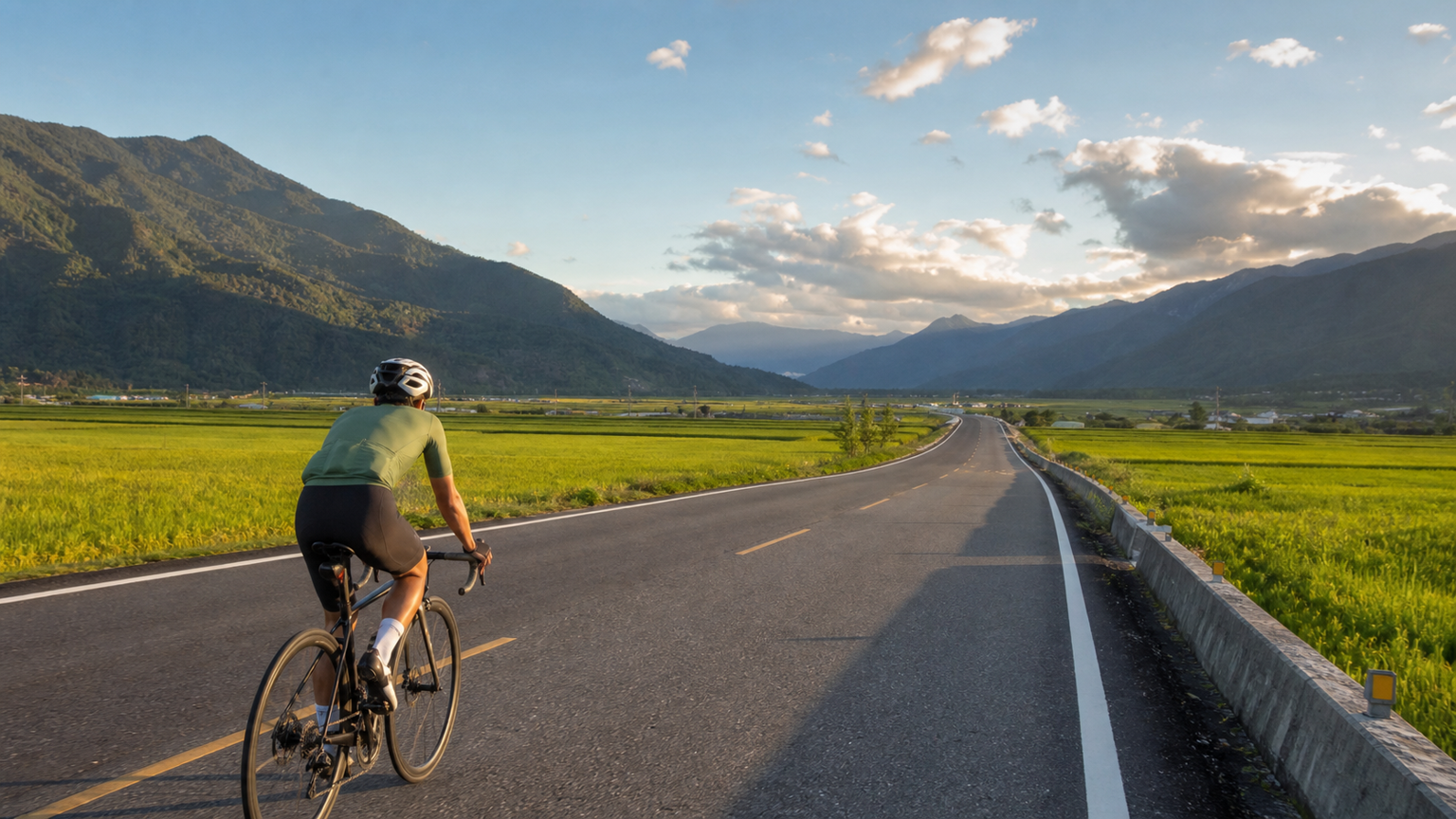
Introduction
On the fifth day of my round-island cycling trip, I set out from Hualien City, heading for Taitung City, taking Provincial Highway 9 through the Huadong Valley.
The distance on paper was about 170 kilometers, the longest single day of the entire trip. But after finishing that day, the first sentence I wrote in my diary was not “I’m exhausted,” but rather: “Today was the happiest day of cycling in my life.”
The Huadong Valley gave me that joy.
The Geographic Magic of the Valley
The Huadong Valley is a narrow, elongated plain between the Central Mountain Range and the Coastal Mountain Range, stretching roughly 150 kilometers from north to south, no more than 10-plus kilometers at its widest, yet it possesses a sense of openness rarely found elsewhere in Taiwan.
Starting from Hualien City, about 20 kilometers after leaving the urban area, the view suddenly opens up—on the left are the low, rolling ridgelines of the Coastal Mountain Range, on the right the towering, imposing wall of the Central Mountain Range, and in between, endless rice paddies, with the occasional wisp of white smoke rising slowly from a farmhouse chimney.
This scene is something unique in Taiwan’s landscape.
The Meaning of Speed: Why the Valley Makes You Want to Ride Fast
The roads of the valley are a paradise for road cyclists, for very concrete reasons:
| Condition | Valley Status | Impact on Riding |
|---|---|---|
| Gradient | Almost entirely flat (elevation change < 3%) | Allows maintaining a steady high speed |
| Road surface | Provincial Highway 9 has good asphalt | Low tire rolling resistance |
| Crosswinds | Mostly north-south tailwinds (autumn/winter) | Can use the wind to accelerate |
| Traffic | Relatively sparse (weekdays) | Peace of mind while riding |
| Supplies | Convenience stores in towns like Yuli and Guanshan | No worries about resupply |
That day my average speed reached 31.5 km/h, the fastest day of the entire round-island trip, yet also the least effortful. The flatness of the valley allowed my body to stay in an efficient aerobic zone; pedaling felt less like effort and more like flow.
Yuli’s Rice and Guanshan’s Three O’Clock
Yuli, a small town in the middle of the valley, is famous for its rice. At noon I stopped at a small eatery near Yuli Station and had a bowl of braised pork rice, paired with a bowl of pig’s blood soup. Simple, yet one of the most satisfying meals I had on the entire trip.
After eating, I sat on the arcade sidewalk waiting for my food to settle, watching the sparse pedestrians pass by, hearing Taiwanese oldies playing over the radio. An elderly woman sat nearby fanning herself, asking me in Taiwanese where I had come from.
“Taipei.”
“You rode a bicycle all the way here?” She widened her eyes, then burst out laughing, saying: “Suai-siah ah, that’s so far.”
I smiled and nodded, feeling that this “suai-siah ah” was the warmest encouragement in the world.
At three o’clock in the afternoon in Guanshan, sunlight slanted down from the ridgeline of the Coastal Mountain Range, dyeing the rice paddies a golden hue. I pulled over by the roadside, leaned against my bike, and watched for about ten minutes. In that moment, I suddenly understood very clearly the answer to the question “why do I ride.”
Not for speed, not for competition, but for this way of moving that lets you stop anywhere, and be struck by beauty in any corner.
Chishang to Taitung: The Calm of the Final Stretch
Chishang’s Brown Boulevard is a popular check-in spot online, but riding through it in person feels much quieter than the photos suggest. Two rows of slender trees, a view free of billboards, and the occasional sound of Taitung folk songs drifting from some farmhouse.
On the final 20 kilometers before entering Taitung City, I had slipped into an almost meditative state. Legs turning the pedals, eyes on the road, mind empty of everything except the movement of the present moment.
Practical Advice
- Choose a weekday: On holidays, tourist traffic in the valley increases dramatically; riding on a weekday is recommended for the purest valley experience.
- Know your resupply points: Yuli (about 70 km from Hualien), Guanshan (about 115 km), and Chishang (about 140 km) are the main resupply stops; it’s recommended to stop at each one to replenish.
- Watch for crosswinds: The valley’s unique topography can sometimes create a strong Venturi effect; when crosswind speeds exceed 20 km/h, lateral stability at high speed decreases, so you need to slow down to respond.
- Don’t rush the itinerary: The valley is best suited for “combining slow and fast”—cruise at high speed to enjoy the road feel, but stop immediately when you see something beautiful. Don’t let your riding goals kill the space for appreciation.
Conclusion
On that evening when I arrived in Taitung City, I sat by the Taiping River and reviewed the entire day’s riding track on my Garmin.
A 170-kilometer line, from Hualien to Taitung, like a smile pulled straight.
Some roads don’t need to be judged by speed. They only need to be felt for what they give you. What the valley gave me was that sense of “just right” happiness—fast enough to be exhilarating, slow enough to have warmth.
Related Reading
- Huadong Valley Cycling Tour: Taiwan’s Most Magnificent Long-Distance Riding Route
- Cycling the Taitung Section of the East Rift Valley: Slow-Paced Experience and Attractions Along the Way
- Around Huadong Cycling Challenge: A Two-Day, One-Night Huadong Valley Riding Record
- Huadong Valley Cycling Route: A Provincial Highway 9 Journey Through Rice Waves and Mountains
2022 環花東挑戰賽 Day2 搭到特快車 高速真空吸引! 台東一路逆風殺回花蓮! 總排 ??| Feiyu Pocket 2s | 公路車 | CT Yeh
4 年前
花東縱谷單車遊 feat. Doris 景點五分鐘快速掃瞄 / 公路車 / CT Yeh
2 年前
嘉義大埔、阿婆灣挑戰賽,美到以為在日本!ft. 環騎5 Cool 西拉雅188 / 公路車 / CT Yeh
7 個月前
台北闊瀨陡坡 騎旅 / 日本單車雜誌編輯車友臨時加入!/ 髮香才是最強的 / feat. 北迴歸線小隊 / 公路車 CT Yeh
6 個月前
微東進 太魯閣 蘇花 單車兩日遊 ! 颱風過後路況超刺激 行程大亂 | 最狂的鹹酥雞訂單 | CT Yeh | 4K 高畫質空拍絕景!
4 年前
2022 環花東挑戰賽 Day1 全記錄! 4K穿越機美景 x 髮香團 | 廢物伙伴軍團騎聚|花蓮-台東 |公路車 | CT Yeh
4 年前
摔! 2023環花東365 Day2 / 絕美縱谷風光 / 集團摔車 / 公路車 / CT Yeh
3 年前
一日北高 知名版主影帝歡笑騎聚 | 公路車 | CT Yeh
5 年前