文章導覽
- Introduction
- Overview of Taiwan's Major KOM Time Trial Routes
- Physiological Demands of KOM Climb Time Trials
- Power Duration Requirements
- Setting Target Power
- Six Key Training Focus Areas for Race Preparation
- 1. Building the Aerobic Base (16–24 weeks before the race)
- 2. FTP Improvement Training (8–16 weeks before the race)
Introduction
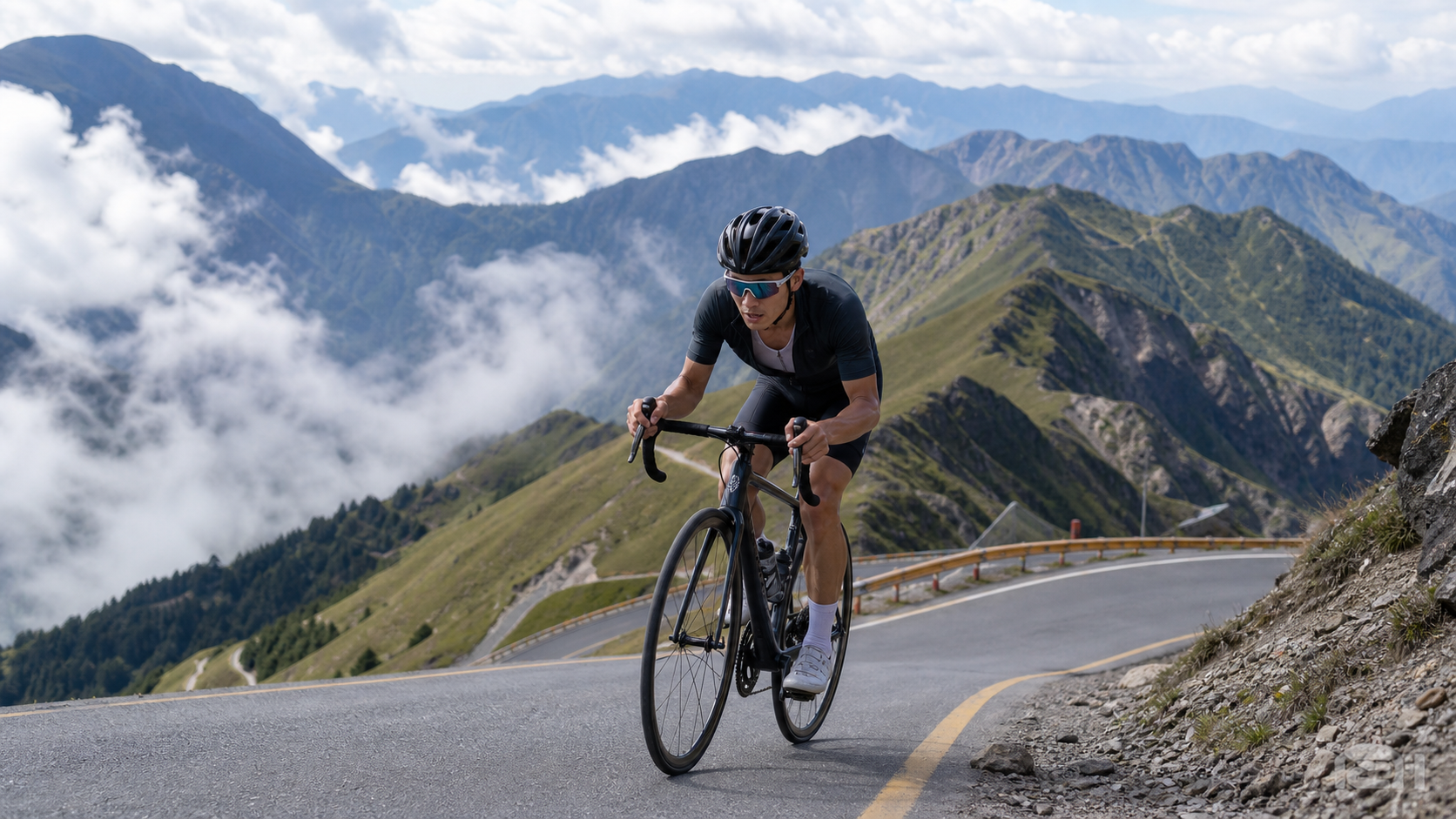
Taiwan is a paradise for cycling enthusiasts, home to one of the highest densities of extreme climbing routes in the world. The Wuling KOM (Taiwan KOM Challenge), with a finish line at an average elevation exceeding 3,000 meters, ranks among the world’s top KOM events, attracting both professional and amateur riders year after year. Beyond Wuling, routes such as Beidawu Mountain, Taipingshan, and Hehuanshan also host time trial events. Preparing for Taiwan’s KOM time trials requires a training plan specifically designed for this unique long-distance climbing time trial format.
Overview of Taiwan’s Major KOM Time Trial Routes
| Route Name | Start Point | Finish Elevation | Distance | Average Gradient | Difficulty |
|---|---|---|---|---|---|
| Wuling KOM (Taiwan KOM) | Dayuling | Approx. 3,275m | Approx. 105km (full course) | Mixed | ★★★★★ |
| Hehuanshan KOM Segment | Wushe | 3,275m | Approx. 55km | Approx. 5% | ★★★★ |
| Beidawu Mountain | Pingtung Taiwu | Approx. 2,000m | Approx. 30km | Approx. 7% | ★★★★ |
| Taipingshan | Luodong | Approx. 1,950m | Approx. 50km | Approx. 4% | ★★★ |
| Lixing Industrial Road | Guoxing | Approx. 1,730m | Approx. 25km | Approx. 7% | ★★★★ |
Physiological Demands of KOM Climb Time Trials
Power Duration Requirements
The biggest difference between a climbing time trial and a flat time trial is that the finishing time is far longer than a typical competitive sprint. Professional riders complete the full Wuling KOM course in 4–5 hours, while amateur riders take 5–8 hours or even longer.
This means the training focus must shift from short-duration, high-intensity efforts toward:
- Long-duration aerobic endurance (sustained output capacity for 3–6 hours)
- Maximizing aerobic threshold power (FTP)
- High-altitude adaptation (heart rate adjustment, managing power decline)
- Improving climbing efficiency (W/kg)
Setting Target Power
| Challenge Level | Recommended Climbing W/kg | Corresponding FTP (70kg Rider) |
|---|---|---|
| Finish (no time pressure) | 2.5–3.5 W/kg | 175–245W |
| Amateur Challenge (within 6 hours) | 3.5–4.0 W/kg | 245–280W |
| Amateur Competitive (within 5 hours) | 4.0–4.5 W/kg | 280–315W |
| Elite Amateur (within 4.5 hours) | 4.5–5.0 W/kg | 315–350W |
| Professional Level (within 4 hours) | 5.0+ W/kg | 350W+ |
Six Key Training Focus Areas for Race Preparation
1. Building the Aerobic Base (16–24 weeks before the race)
The foundation of KOM time trial performance is long-duration aerobic endurance, requiring substantial Zone 1 and Zone 2 (Z1/Z2) training:
- Weekly riding volume: At least 10–15 hours (15–20 hours for advanced riders)
- Long ride habit: At least one 4–6 hour long ride per week
- Climbing accumulation: At least 1,500–2,500m of elevation gain per week
2. FTP Improvement Training (8–16 weeks before the race)
- Sweet Spot Training: 88–93% FTP, 2–3 times per week, 2×20 minutes or 3×15 minutes per session
- Threshold Zone: 95–100% FTP, 2×20 minutes, 1–2 times per week
- VO₂max Intervals: 110–120% FTP, 5×5 minutes, to help raise the FTP ceiling
3. Course Simulation Training (6–8 weeks before the race)
A major advantage for Taiwanese riders is the ability to simulate directly on the race course or similar terrain:
- Riding the same climbs: Complete 2–3 time trial practice rides on the actual course or similar gradients
- Pacing verification: Record power and speed on each climb segment to validate the feasibility of your pacing strategy
- Feed station rehearsal: If feed stations exist, practice grabbing supplies without stopping
4. High-Altitude Adaptation (2–4 weeks before the race)
The finish lines of Taiwan’s KOM time trials are mostly above 2,000m, where high altitude has a significant physiological impact:
- Reduced oxygen-carrying capacity: For every 300m of elevation gain, aerobic capacity decreases by approximately 1%
- Adaptation strategy: Complete 1–2 practice rides at mid-altitude (1,000–1,500m) before the race
- Adjust power expectations downward: Target power for the time trial at altitude can be revised down by 3–7%
5. Nutrition and Hydration Strategy Planning
The nutrition strategy for a long-distance climbing time trial is critical:
| Time Period | Recommended Feeding Frequency | Feeding Format |
|---|---|---|
| 0–90 minutes | Every 20–30 minutes | Water + energy gel/bar |
| 90–180 minutes | Every 15–20 minutes | Electrolytes + carbohydrates |
| 180+ minutes | Every 15 minutes | High-carb + electrolytes + sodium-containing foods |
- Target carbohydrate intake: 60–90g per hour (trained guts can handle 90–120g)
- Fluid replacement: 500–750ml per hour, adjusted according to temperature
- Gut training: Practice eating while riding during long training sessions to avoid gastrointestinal discomfort on race day
6. Pre-Race Taper Week (1–2 weeks before the race)
- Week 2: Maintain 70–80% of training volume, keeping intensity unchanged
- Final week: Reduce training volume to 50%, retaining 2–3 short high-intensity sessions to maintain neuromuscular activation
- 2 days before the race: Easy riding, rest and recovery, ensuring adequate sleep
Practical Advice
- Track W/kg long-term: This is the most direct predictor of KOM performance. Test FTP once a month and record body weight.
- Join an organized training group: Every city and county in Taiwan has active road cycling training teams. Group training boosts motivation and provides access to course information.
- Study course data: Strava or Garmin Connect has extensive course records that can be analyzed for historical pacing and power data as a reference.
- Don’t neglect climbing technique: Technical details such as standing pedaling, seated rhythm transitions, and cornering all have a significant impact on long climbs.
Conclusion
Taiwan’s KOM time trials are a unique challenge combining fitness, strategy, geography, and culture, attracting thousands of domestic and international riders each year. The preparation process itself is a journey of deeply understanding your physical limits and Taiwan’s mountain terrain. Whether your goal is to finish, break a personal record, or stand on the podium, a systematic preparation plan and a solid training foundation will leave you with the most precious cycling memories as you cross the finish line.
Related Reading
- Taiwan KOM Challenge Historical Results Analysis: Decoding Top Rider Data
- The Complete Guide to Taiwan KOM Challenge: The Climber’s Martial Arts Manual
- Taiwan KOM Challenge Guide: Segment Pacing and Heart Rate Control for Wuling KOM
- The Complete Taiwan KOM Challenge Guide: The Ultimate Road from Taroko to Wuling