Introduction
Ultramarathons in Taiwan are mostly held on mountain trails, with cumulative elevation gains often ranging from 1,500 to 4,000 meters—a huge challenge for runners accustomed to flat roads. Climbing doesn’t just test your cardiovascular system; it also heavily depletes the “climbing-specific muscle groups,” including the glutes, hamstrings, and calves (soleus). Without prior training, these muscles burn out within the first 30% of the race, turning the remaining distance into a nightmare. This article systematically outlines the core methods and concepts of climbing training.
Understand Your Race’s Climbing Demands
Before preparing, analyze the elevation gain and terrain characteristics of your target race:
| Race Type | Total Elevation Gain | Key Preparation Focus |
|---|---|---|
| Flat Ultramarathon (50K, < 500m gain) | Low | Speed endurance, aid station management |
| Moderate Trail Ultramarathon (50K, 500–2000m) | Medium | Climbing pace, run/walk transitions |
| High-Intensity Trail Ultramarathon (50K, > 2000m) | High | Specific strength, technical downhill skills |
| 100K+ Mountain Trail Race | Very High | All of the above + long-duration recovery ability |
The Three Levels of Climbing Training
Level 1: Building Base Climbing Volume
Climbing training cannot be rushed; it must be accumulated gradually over a 12–20 week preparation period.
- Schedule 1–2 runs with elevation gain per week, starting with a target of 300–500 meters of climbing
- Increase climbing volume by approximately 10–15% every 2–3 weeks to avoid overtraining
- Good news for runners in Taiwan: hills are usually available near urban areas, such as Elephant Mountain, the Datun Mountain group, and the Erge Mountain system in Taipei
Level 2: Run/Walk Transition Technique
Climbing in an ultramarathon doesn’t mean “keep running” the whole time—learning “strategic walking” saves more energy:
- When the grade exceeds 8–10%, fast hiking is often more energy-efficient than slow running
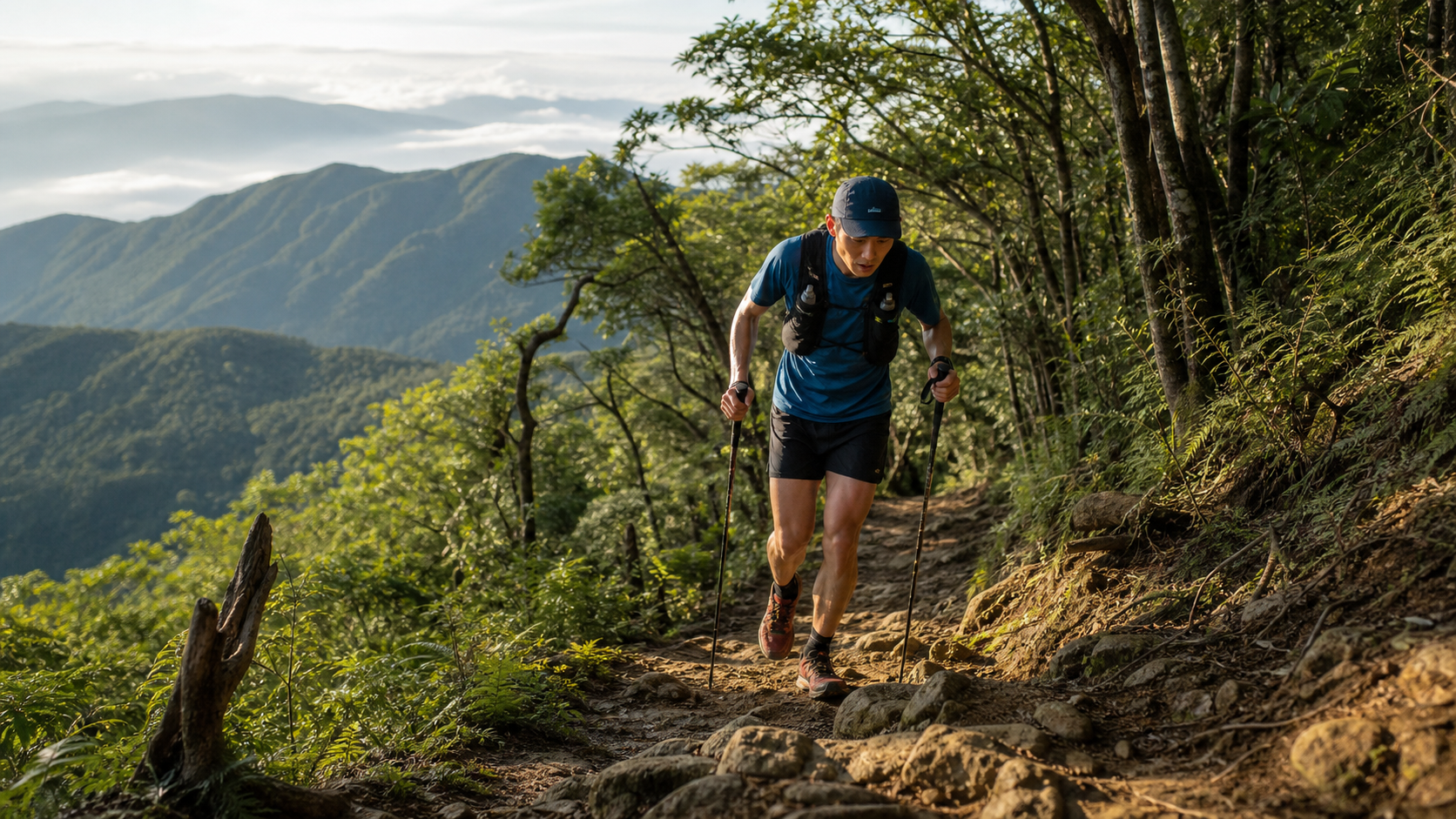
- Use trekking poles (if race rules allow) to significantly reduce the load on your lower body
- The rhythm of run/walk transitions needs practice: on trails, practice “running the flats, walking the steep sections” until this pattern becomes instinctive
Level 3: Climbing-Specific Strength Training
Running alone isn’t enough to strengthen the required muscle groups; supplementary strength training improves climbing efficiency:
- Bulgarian Split Squat: Mimics single-leg drive on uphill sections, 3 sets × 10–12 reps per leg
- Hip Thrust: Strengthens the glutes, significantly improving uphill propulsion
- Calf Raise: Protects the Achilles tendon and soleus, reducing calf cramps after prolonged climbing
- Core Training: Your body leans forward when climbing, and core stability directly affects efficiency and the risk of lower back pain
Technical Details for Climbing Efficiency
Body posture on climbs has a huge impact on efficiency:
- Slight forward lean: Keep your center of gravity ahead of the balls of your feet, using body weight to assist forward motion
- Shorten stride, increase cadence: Long strides on climbs are very energy-draining; short, quick steps are more efficient
- Look 5–10 meters ahead: Spot your “footing points” on the ground ahead rather than staring down at your feet
- Coordinated arm swing: Increase the range of your arm swing back and forth on climbs to assist propulsion
- Trekking pole technique: Plant the pole tip near your rear foot and push backward against the ground, rather than planting it forward
Recommended Climbing Training Locations in Taiwan
- Taipei: Elephant Mountain (60m gain loop, can be repeated for multiple laps), Erge Mountain, Fengguizui
- Taichung: Dakeng Trail System, Zhongdu Hiking Trail
- Tainan/Kaohsiung: Zhushan Trail, Chaishan
- Yilan/Hualien: Taiping Mountain area, Qilai Mountain range (suitable for those with mountaineering experience)
Each week, choose a route with 500 meters or more of elevation gain, repeat it regularly, and track your pace improvement.
Practical Tips
- Log your elevation gain each session: Garmin or Strava can calculate it automatically; set a weekly elevation gain target
- Schedule a “simulation race” late in your preparation: Choose a trail with elevation gain similar to your target race, complete it fully, and test your fueling strategy
- Training downhill is equally important: During climbing training, take the downhill sections seriously too (see the downhill technique article)
- Avoid high-elevation-gain training in the final two weeks before the race: Taper during the last two weeks to allow full muscle recovery
- Recon the course beforehand: If conditions allow, walk the high-climbing sections of the course in advance and memorize the terrain features
Conclusion
In ultramarathons with high cumulative elevation gain, it’s not “running strength” that determines everything, but the combination of “climbing strategy and specific strength.” By systematically training climbs, mastering run/walk transitions, and strengthening climbing muscles, you’ll find that the daunting climbs become your advantage zone over other runners. The mountain won’t wait for you, but you can prepare for the mountain in advance.
Related Reading
- Ultramarathon High-Climbing Training: Progressive Workouts for 1,000m Vertical Gain
- Ultramarathon Training Load: Recommendations for Weekly Mileage, Elevation Gain, and Long Run Distance
- Long-Term Ultramarathon Planning: Mileage Accumulation Strategies Over 6+ Months
- Mountain Marathon Training: How to Prepare for Climbing Power and Technique in Taiwan
一日北高前的高裝檢 | 北高 360 | 挑戰11小時的裝備 | 一日雙塔 | 補給
6 年前
日本公路最高登山賽,台灣首位YT挑戰實錄,乘鞍登山賽40週年,賽前篇完整版,請到我的YT收看 #公路車 #cycling
11 個月前
單車 梅山36灣 坡度介紹 路段介紹 空拍 (相關遊記影片,請參考說明或我的頻道喔,歡迎訂閱)
6 年前
西進武嶺 免費訓練分析服務 Intervals | 練不夠還是練過頭?你哪一種類型選手?AI模型告訴你! | 備戰神器 | 公路車 訓練 | CT Yeh
4 年前
單車 一日北高 ( 雙城 ) 肥宅雙人瘋狂行 紀錄片 REACTO
10 年前
Live) 備戰2019彰化經典百K 賽前攻略 (已完賽請看新影片
7 年前
FTL 與 SYB 車隊專訪 西進武嶺 實用攻略分享! 2小時 如何練?!你不知道的眉角!新手準備武嶺必看 EP1 | 實力派女車友 | 精華版 | 公路車 | CTYeh
4 年前
西進武嶺 自製新版AI配速表產生器 x 賽前攻略 抱佛腳! 沒有功率計也可以產生配速表嗎?有什麼其他眉角賽前要注意的呢? | 西進武嶺 / 東進武嶺 KOM 攻略 | 公路車 | CT Yeh
4 年前