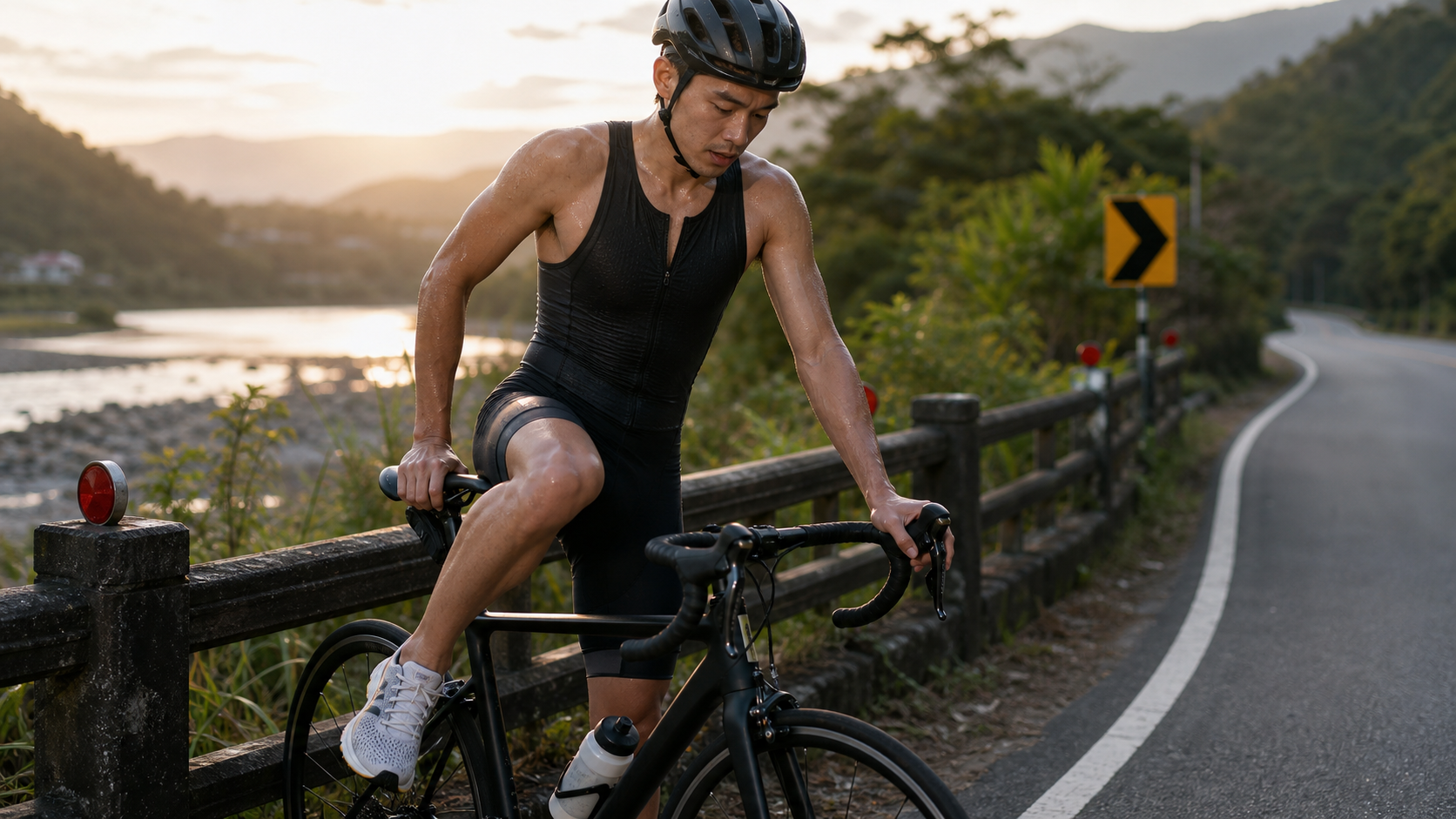
Why Train Reverse Brick?
Most people train Brick as Bike → Run, simulating the T2 transition in a race. But Reverse Brick (Run → Bike) is a severely underrated training method that solves three major problems:
- Running opens up the legs first → the subsequent bike leg allows precise activation of the glutes and posterior chain
- Trains cadence maintenance in a low-glycogen state → simulates late-race fatigue
- Strengthens quadriceps endurance under extension → reduces knee stress while riding
The Physiological Mechanism of Reverse Brick
Cycling Adaptation After Running Depletion
After 30-45 minutes of running, glycogen depletion reaches approximately 40-50%, making the training effect on the bike similar to the late stages of a race. Research shows Reverse Brick can:
- Improve maximal power output under fatigue by 5-8%
- Improve cadence stability in long-distance cycling (coefficient of variation drops 12%)
- Train fat oxidation capacity (FatMax improvement)
Four Reverse Brick Workouts
Workout 1: Easy Reverse Brick (Base Phase)
| Component | Intensity | Duration |
|---|---|---|
| Run Z2 | MAF Heart Rate | 30-45 min |
| Transition | — | 5 min |
| Bike Z2 | FTP 60-70% | 60-90 min |
Purpose: Adapt to consecutive two-discipline training
Workout 2: Tempo Reverse Brick (Build Phase)
| Component | Intensity | Duration |
|---|---|---|
| Run Tempo | Threshold Pace | 20-30 min |
| Transition | — | 5 min |
| Bike Sweet Spot | FTP 85-90% | 30-45 min |
Purpose: Train lactate tolerance across the two-discipline transition
Workout 3: FatMax Reverse Brick (Fat Burning)
| Component | Intensity | Duration |
|---|---|---|
| Run Z2 | MAF | 60 min |
| Transition | — | 5 min |
| Bike Z2 | FTP 65% | 120-180 min |
Purpose: Train long-distance fat oxidation (essential for IM 226)
Workout 4: Race Specific Reverse (Peak Phase)
| Component | Intensity | Duration |
|---|---|---|
| Run 70.3 Pace | Race Pace | 30 min |
| Transition | — | 5 min |
| Bike 70.3 Power | IF 0.78 | 90-120 min |
Purpose: Simulate late-race fatigue
Advanced Variation: Triple Brick
Advanced athletes can challenge themselves with Run → Bike → Run:
- Run 20 min @ Z2
- Bike 60 min @ FTP 75%
- Run 30 min @ Race Pace
This workout is a scaled-down version of a full 70.3 simulation, completed within 2 hours, but trains 3 transitions.
When to Add Reverse Brick?
| Training Phase | Frequency | Recommended Workout |
|---|---|---|
| Base Phase | Once every 2 weeks | Workout 1 |
| Build Phase | Once per week | Workout 2 |
| Peak Phase | Once every 2 weeks | Workout 4 |
| Taper Phase | Do not do | — |
Venue and Equipment Recommendations
Outdoor Reverse Brick
- Find a park with bike racks (e.g., riverside parks)
- Run a loop course and return to the bike
- Drawback: equipment security
Indoor Reverse Brick (Recommended)
- Treadmill + Smart Trainer
- Perfectly controllable and unaffected by weather
- Drawback: mentally monotonous (pair with Zwift or videos)
Common Mistakes
- Running intensity too high: legs are already spent after the run, making the bike segment meaningless
- Transition time too short: not changing clothes at all causes excessive fluid loss
- Frequency too high: more than twice per week leads to overtraining
- Ignoring nutrition: consume at least 30g of carbs + 300ml of water between the two disciplines
Conclusion
Reverse Brick is cycling ability training under fatigue, especially suited for IM 70.3 and 226 athletes. It is recommended to incorporate it into the weekly training plan; after 6-8 weeks, you will notice significantly more stable pacing in the late stages of a race.
Related Reading
- The Science of Brick Training — Muscle Adaptation Mechanisms and Workout Design for Bike-to-Run Transitions
- Sprint Triathlon Brick Workout Design: Building Muscle Memory for Running After Riding
- Brick Workout: The Core Workout for Triathlon Transition Training
- Triathlon Brick Training: Leg Adaptation Training Design for Running Immediately After Cycling
#公路車 #Fitting 靠人工智慧APP 幫你調整單車
6 年前
Fitting訓練兩用功率車 ! Thinkrider ST900 完整實測!/ 坡度升降 / 鄰居測試/ smart bike/公路車/ CT Yeh
2 年前
西進武嶺 免費訓練分析服務 Intervals | 練不夠還是練過頭?你哪一種類型選手?AI模型告訴你! | 備戰神器 | 公路車 訓練 | CT Yeh
4 年前
一日北高常見問題大集合 | 攻略 | 路線 | 訓練 | 補給 | 自行車 單車 | 一日雙城 | 雙塔 | TWB北高360 | 屁股痛
6 年前
ThinkRider 智騎 XXPRO 訓練台,高階機種功能 只要 1/3價格!? 實測功率對比、噪音實測 / 公路車 / CT Yeh
1 年前
靠單車減肥35公斤 心得分享與整理
7 年前
單車AI教練!全新 ChatGPT4o 幫你分析訓練成果!排武嶺課表,分析騎車姿勢! 太神了! / 公路車 / CT Yeh / feat. 緯緯
2 年前
本週北高前練習,連同天比的226們也來⋯鐵車真的太猛了 #cycling #北高
2 年前