文章導覽
Introduction
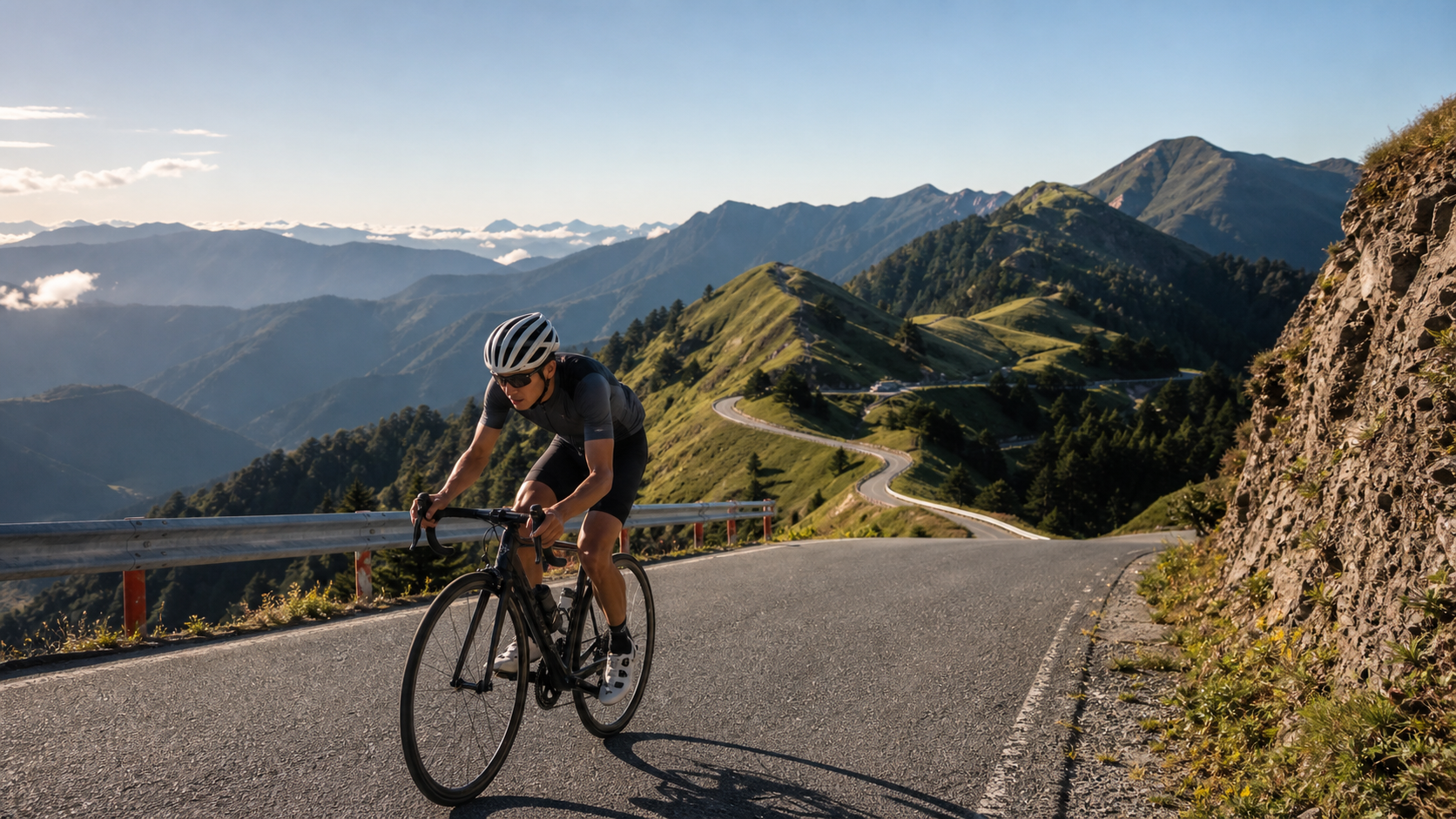
Wuling, at 3,275 meters above sea level, is the highest point on Taiwan’s roads. Starting from Puli, the full route is approximately 97 kilometers with over 3,000 meters of climbing, making it the ultimate challenge for amateur cyclists. A “sub-3 hour” (finishing within 3 hours) is a milestone for many advanced riders, but exactly how many W/kg does this goal require? This article provides a clear answer through physics-based calculations.
Wuling Route Basic Data
From Puli (elevation approximately 400 meters) to Wuling (3,275 meters), analyzed with “Cingjing Farm as the midpoint”:
| Section | Distance | Climbing | Average Gradient |
|---|---|---|---|
| Puli→Wushe | 30 km | 700 m | 2.3% |
| Wushe→Cingjing | 15 km | 750 m | 5.0% |
| Cingjing→Dayuling | 26 km | 900 m | 3.5% |
| Dayuling→Wuling | 26 km | 650 m | 2.5% |
| Total | 97 km | ~3000 m | 3.1% |
Physics Calculation: Climbing Power Requirements
In the power equation for cycling uphill, the main resisting forces come from three components:
Gravity component: P_gravity = m × g × v × sin(θ)
Air resistance: P_aero = 0.5 × ρ × CdA × v³
Rolling resistance: P_rolling = Crr × m × g × v × cos(θ)
For an average gradient of 3.1%, an average speed of approximately 32 km/h (the Wuling sub-3h pace), and a rider weighing 65 kg:
| Resistance Source | Power Requirement (Estimate) | Proportion |
|---|---|---|
| Gravity | ~230W | 78% |
| Air resistance | ~40W | 14% |
| Rolling resistance | ~25W | 8% |
| Total | ~295W | 100% |
295W ÷ 65 kg = 4.54 W/kg
Sub-3h Power Requirements for Different Body Weights
Calculated under the same road conditions (average gradient 3.1%, average speed 32 km/h):
| Body Weight | Required Power | Required W/kg |
|---|---|---|
| 55 kg | ~255W | 4.64 W/kg |
| 60 kg | ~275W | 4.58 W/kg |
| 65 kg | ~295W | 4.54 W/kg |
| 70 kg | ~315W | 4.50 W/kg |
| 75 kg | ~335W | 4.47 W/kg |
| 80 kg | ~355W | 4.44 W/kg |
Key Finding: The heavier the rider, the slightly lower the required W/kg (due to the proportionally smaller effect of air resistance), but the higher the required absolute power. Weight-loss strategies actually yield greater benefits for heavier riders.
The target W/kg for a Wuling sub-3h is approximately 4.5, which is the threshold for advanced amateur riders.
Real-World Conditions for Sub-3h
Calculations are just the starting point; real riding includes the following variables:
Weather: A tailwind can reduce requirements by 5–10%, while a headwind significantly increases them. The northeast monsoon, common at Wuling, is most pronounced in autumn and winter.
Road conditions: Poor asphalt or rainy conditions can increase rolling resistance by 10–20%.
Altitude effects: Above 3,000 meters, the air’s oxygen content is only 70% of that at sea level, and VO2max drops by approximately 15–20%. High-altitude adaptation ability affects final performance.
Nutrition strategy: Over a 97 km distance, insufficient fueling can lead to glycogen depletion (“hitting the wall”) in the latter stages, with power potentially dropping by 20–30%.
Practical recommended target: To ensure a sub-3h, your power reserve should be 10% above the calculated value, meaning your actual FTP should reach 4.8–5.0 W/kg, providing a safety margin for a full 3-hour effort.
Training Path: From 3.5 W/kg to 4.5 W/kg
Assuming your current W/kg is 3.5 and you want to reach 4.5 within 2 years:
Year 1 Goal (3.5 → 4.0 W/kg):
- Core work: 2 SST sessions per week (2×20 minutes), 1 long aerobic ride
- Supporting work: weight management (if BMI > 24, lose 3–5 kg)
- Key milestone: complete Wuling in sub-4h
Year 2 Goal (4.0 → 4.5 W/kg):
- Core work: add Over-Unders workouts, 1 VO2max interval session per week
- Key milestone: complete Wuling in sub-3.5h, approaching sub-3h
Special Power Strategies for High-Altitude Riding
Above 2,500 meters in elevation, even if your W/kg has reached the target, failing to adjust your strategy can still lead to failure:
- First 50 km (Puli→Dayuling): Ride conservatively at 90–95% FTP; don’t chase faster riders
- Dayuling→Wuling (final 26 km): This is where the altitude effect is most pronounced; allow power to drop to 85–90% FTP
- Feeding frequency: Consume 40–60 grams of carbohydrates every 45–60 minutes to avoid hitting the wall in the latter stages
Practical Advice
- Wuling test-ride strategy: Before the official attempt, do a “casual Wuling” ride first (untimed, focused on pacing feel) to understand your personal power drop at high altitude
- Use Strava analysis: Wuling has many public Strava Segments where you can compare power data from top amateur riders
- Best season is autumn: October–November offers moderate temperatures and stable wind conditions, making it the best time to chase a Wuling PR
Conclusion
A Wuling sub-3h requires an FTP of approximately 4.5 W/kg, a goal that takes 2–3 years of systematic training to achieve. But this goal is not out of reach—a clear W/kg pathway, structured workout planning, and proper race-day strategy turn this dream into a calculable, executable target.
Related Reading
- Climbing-Specific Training Plan: Complete 8-Week Wuling Preparation Schedule
- A Scientific Look at Breaking 4 Hours on the “West Approach” to Wuling
- Training Strategy for the King of the Mountain Challenge: A Complete Plan from W/kg to Climbing Pace
- Taiwan Cycling’s Hundred Peaks Challenge: Complete Preparation Guide for Conquering Wuling