Introduction
When many people talk about running training, their thinking often stops at “how many kilometers to run.” But for ultramarathon runners, “how many meters of elevation gain” is equally important, and in some races, even more critical. The UTMB main race has a total elevation gain of over 10,000 meters, and Taiwan’s mountain ultramarathons typically feature 4,000–6,000 meters of gain per 100K. If your legs aren’t prepared for this climbing, even the best flat-ground speed will be useless in the mountains.
This article focuses on a systematic approach to high-elevation training, including climbing mechanics, strength training, and a progressive plan targeting 1,000 meters of weekly elevation gain.
The Physiological Basis of Climbing
Primary Muscle Groups Used in Climbing
The muscle activation patterns in uphill running differ significantly from flat-ground running:
| Muscle Group | Flat Running | Uphill Running | Downhill Running |
|---|---|---|---|
| Glutes | Moderate | High | Low |
| Quadriceps | Moderate | High | Very High (Eccentric) |
| Calves (Gastrocnemius/Soleus) | High | Moderate | High |
| Core Muscles | Low | Moderate-High | Moderate |
| Gluteus Medius | Moderate | High | High |
Climbing training places particularly high demands on the glutes and core, which is exactly why flat-ground runners transitioning to trails often feel unusually sore in their hips and core.
Efficiency Comparison: Uphill Running vs. Uphill Hiking
As mentioned earlier, on gradients exceeding 10–15%, power hiking is often more energy-efficient than running. However, this doesn’t mean you don’t need to practice uphill running—maintaining a run on gentler slopes (5–10%) is key to improving your overall finish time. The goals of climbing training are:
- To make you run more comfortably on moderate gradients (5–10%)
- To make you hike faster and more efficiently on steep gradients (above 10%)
- To allow you to sustain longer efforts on any gradient
Core Movements in Climbing Training
Technical Points for Climbing Training
Proper Uphill Running Form:
- Shorten your stride and increase cadence (compared to flat running)
- Lean slightly forward from the ankles, but keep your back straight—don’t hunch over
- Look 2–3 meters ahead (don’t look down at your feet)
- Pump your arms actively to help drive your body forward
- Land on your forefoot to midfoot, not your heel (heel striking is extremely inefficient uphill)
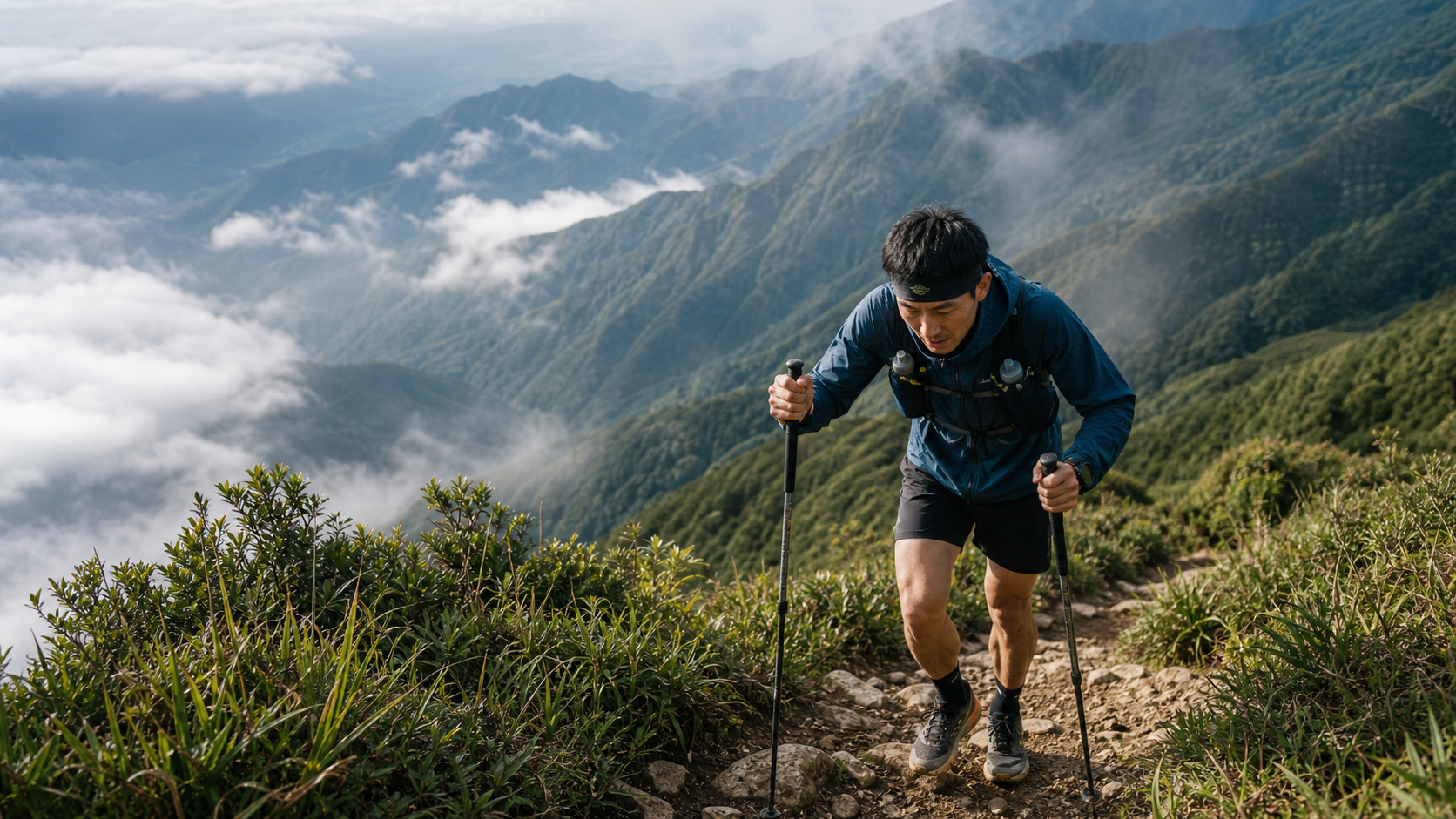
Uphill Technique with Trekking Poles:
- Plant both poles simultaneously, creating a rhythm with your feet (a 4-point contact rhythm: pole-foot-pole-foot)
- Keep elbows bent at about 90 degrees, pushing backward rather than pressing down
- Plant the pole tips slightly ahead of your feet, converting the pushing force into forward momentum
Supplementary Strength Training for Climbing
The following strength exercises can be done on non-running days to strengthen the muscles needed for climbing:
Glute Strengthening:
- Back Squat: 3 sets × 12 reps
- Assisted Pistol Squat: 3 sets × 8 reps (per leg)
- Bulgarian Split Squat: 3 sets × 10 reps (per leg)
Core Stability:
- Plank: 3 sets × 45–60 seconds
- Single-leg RDL: 3 sets × 10 reps (per leg)
- Side Plank: 3 sets × 30–45 seconds (per side)
Progressive Climbing Plan: From 500m to 1,000m Weekly Gain
The following plan suits runners with a current weekly mileage of 40–60K and basic climbing experience. The goal is to steadily build the ability to handle 1,000 meters of weekly elevation gain within 12 weeks.
Weeks 1–4: Foundation Building (500–700m weekly gain)
- Tuesday: Easy flat run 8K
- Wednesday: Hill repeats — find a road with an 8–10% gradient, run 300–400m × 6–8 reps (run hard up, jog easily back down); total gain approx. 200–300m
- Thursday: Easy flat run 6K + core training
- Saturday: Trail long run 18–22K, choose a route with 200–400m of gain
- Sunday: Easy flat run 6–8K (recovery)
Weeks 5–8: Volume Building (700–900m weekly gain)
- Tuesday: Easy flat run 10K
- Wednesday: Hill repeats — increase gradient to 10–15%, 500m × 6–8 reps; total gain approx. 350–450m
- Thursday: Easy run 8K + strength training (glutes, core)
- Saturday: Trail long run 24–28K, choose a route with 400–600m of gain
- Sunday: Trail recovery run 10–12K, choose a gentle-gradient route
Weeks 9–12: Intensification Phase (900m–1,200m weekly gain)
- Tuesday: 10K with hills (choose a route with 200m of gain)
- Wednesday: Intensified hill repeats — 1,000m long climbs × 4–5 reps, or short climbs × 12–15 reps; total gain 400–500m
- Thursday: Easy run 8K + strength training
- Saturday: Trail long run 28–35K, with 600–800m of gain (designed to simulate an ultramarathon course)
- Sunday: Trail recovery run 12–15K, with 200–300m of gain
Schedule a deload week every 4 weeks: Reduce training intensity by 30–40% to allow full recovery before entering the next phase.
Training Location Recommendations for Taiwanese Runners
Routes suitable for climbing training in the Taipei area (arranged by elevation gain):
- Elephant Mountain to 九五峰 (Jiouwufeng): Accessible from the city, single-climb gain of approx. 250–400m
- Datun Main Peak–Xiaoguanyin Route: Gain can reach 600–800m, with varied terrain
- Erge Mountain–Maokong Traverse: Good tree cover, suitable for summer
Runners in central and southern Taiwan can consider:
- Taichung Dakeng Trails (multiple sections can be linked, with over 1,000m of gain)
- Nantou Hehuan Mountain Area (high-altitude training with ample elevation gain)
- Kaohsiung Shoushan to Banpingshan Traverse
Practical Advice
Track cumulative elevation gain with a GPS watch: It’s recommended to use a GPS sports watch with an altimeter (such as Garmin, COROS, or Suunto) to accurately record the elevation gain of each session. Cumulative climbing data is one of the most important metrics for evaluating training progress and adjusting your plan.
Avoid common mistakes in climbing training: Many runners push too hard on the uphill during hill repeats, causing excessive fatigue that affects subsequent training. The intensity of hill repeats should be at a level where you’re “working hard but can maintain a breathing rhythm,” not “sprinting all-out until you’re gasping for air.”
Conclusion
Climbing ability is one of the most important capacities an ultramarathon runner needs to systematically develop—and it’s also one that requires the most patience. Taiwan’s abundant trail resources provide a naturally excellent environment for climbing training. Follow the progressive plan, let your weekly climbing numbers grow steadily, and your trail capabilities will exceed your imagination.
Related Reading
- Ultramarathon Climbing Training: How to Prepare for High-Cumulative-Gain Trail Races
- Ultramarathon Training Load: Recommendations for Weekly Mileage, Elevation Gain, and Long Run Distance
- Planning Weekly Vertical Gain (D+) for Trail Running Training
- Climbing-Specific Strength Training: Single-Leg Squats and Hip Flexor Strengthening Plan
單車 梅山36灣 坡度介紹 路段介紹 空拍 (相關遊記影片,請參考說明或我的頻道喔,歡迎訂閱)
6 年前
一日北高/長距離團騎 常見問題補充篇 / 組團或跟團的眉角 / 壯車友容易被瘦車友慢性拉爆 / 原來屁股痛可能是這個原因...? / 風場配速法 / 公路車 / CT Yeh
2 年前
一日北高常見問題大集合 | 攻略 | 路線 | 訓練 | 補給 | 自行車 單車 | 一日雙城 | 雙塔 | TWB北高360 | 屁股痛
6 年前
西進武嶺 8000名單車友數據分析 PART1 | 從新手到高手數量/瓦數/推力比/FTP推力比/功率計使用率 大解析 | 公路車 | CTYeh
5 年前
西進武嶺 免費訓練分析服務 Intervals | 練不夠還是練過頭?你哪一種類型選手?AI模型告訴你! | 備戰神器 | 公路車 訓練 | CT Yeh
4 年前
一日北高前的高裝檢 | 北高 360 | 挑戰11小時的裝備 | 一日雙塔 | 補給
6 年前
大禹嶺 到 武嶺牌樓 全程前後實況錄影 | 北進武嶺 | 東進武嶺 | KOM | 訓練台 | 坡度分析 | Taiwan KOM Last 10 km HARD | 公路車
6 年前
昇陽SYB車隊 & Fuji 菁英選手們的趣味經驗分享,長知識了!市民車友必看~ 一路被拉爆後才給問 | 戀戀197 武嶺 凸台經驗分享 | 公路車 | CT Yeh
4 年前